
nursing
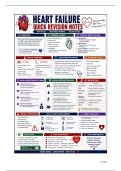
, HEART FAILURE QUICK REVISION NOTES
For Medical Students, Residents & Clinicians
Compiled: July 2026
1. CLASSIFICATION
By Ejection Fraction (EF)
Type EF Key Treatment
HFrEF <40% 4-pillar GDMT
HFmrEF 41-49% ACEi/ARB + BB + SGLT2i;
consider MRA
HFpEF >=50% SGLT2i; manage
comorbidities; diuretics
HFimpEF >=50% (was <=40%) Continue HFrEF therapy
By NYHA Functional Class
Class Symptoms
I No limitation; ordinary activity does not cause
symptoms
II Slight limitation; comfortable at rest; ordinary activity
causes symptoms
III Marked limitation; comfortable at rest; less than
ordinary activity causes symptoms
IV Unable to carry out any physical activity without
symptoms; symptoms at rest
ACC/AHA Stages
Stage Description
A At high risk; no structural heart disease or
symptoms
B Structural heart disease; no signs/symptoms
of
HF
C Structural heart disease; prior or current
symptoms of HF
D Refractory HF requiring specialised
interventions
nursing
, 2. AETIOLOGY — “HEART FAILURE”
Mnemonic Cause
Hypertension Most common cause globally
Endocarditis / Embolic (PE) Infective, marantic
Arrhythmia AF, VT, bradyarrhythmias
Rheumatic heart disease Valvular damage
Thyroid disease Hyper- or hypothyroidism
Failure (ischaemic) Coronary artery disease, post-MI
Amyloidosis / Anaemia Infiltrative, high-output
Infective (myocarditis) Viral, bacterial, HIV
Lupus / Lymphoma Autoimmune, infiltrative
Uraemia Renal failure
Radiation / Renal artery stenosis Iatrogenic, secondary HTN
Endocrine (pheochromocytoma, acromegaly) Hormonal
Common Causes
• CAD / post-MI (most common in developed countries)
• Hypertension
• Valvular heart disease
• Cardiomyopathy (dilated, hypertrophic, restrictive)
• Arrhythmias (especially AF)
• Alcohol / toxins (cocaine, methamphetamine, chemotherapy — doxorubicin,
trastuzumab)
• Viral myocarditis
• Congenital heart disease
3. PATHOPHYSIOLOGY
Neurohormonal Activation
Decreased CO --> Baroreceptor activation
|
+-- SNS activation --> increased HR, contractility,
vasoconstriction
+-- RAAS activation --> Ang II --> vasoconstriction +
aldosterone --> Na+/H2O retention
+-- ADH release --> water retention
+-- Natriuretic peptides (BNP, NT-proBNP) released as
counter-regulatory
nursing
, HEART FAILURE QUICK REVISION NOTES
For Medical Students, Residents & Clinicians
Compiled: July 2026
1. CLASSIFICATION
By Ejection Fraction (EF)
Type EF Key Treatment
HFrEF <40% 4-pillar GDMT
HFmrEF 41-49% ACEi/ARB + BB + SGLT2i;
consider MRA
HFpEF >=50% SGLT2i; manage
comorbidities; diuretics
HFimpEF >=50% (was <=40%) Continue HFrEF therapy
By NYHA Functional Class
Class Symptoms
I No limitation; ordinary activity does not cause
symptoms
II Slight limitation; comfortable at rest; ordinary activity
causes symptoms
III Marked limitation; comfortable at rest; less than
ordinary activity causes symptoms
IV Unable to carry out any physical activity without
symptoms; symptoms at rest
ACC/AHA Stages
Stage Description
A At high risk; no structural heart disease or
symptoms
B Structural heart disease; no signs/symptoms
of
HF
C Structural heart disease; prior or current
symptoms of HF
D Refractory HF requiring specialised
interventions
nursing
, 2. AETIOLOGY — “HEART FAILURE”
Mnemonic Cause
Hypertension Most common cause globally
Endocarditis / Embolic (PE) Infective, marantic
Arrhythmia AF, VT, bradyarrhythmias
Rheumatic heart disease Valvular damage
Thyroid disease Hyper- or hypothyroidism
Failure (ischaemic) Coronary artery disease, post-MI
Amyloidosis / Anaemia Infiltrative, high-output
Infective (myocarditis) Viral, bacterial, HIV
Lupus / Lymphoma Autoimmune, infiltrative
Uraemia Renal failure
Radiation / Renal artery stenosis Iatrogenic, secondary HTN
Endocrine (pheochromocytoma, acromegaly) Hormonal
Common Causes
• CAD / post-MI (most common in developed countries)
• Hypertension
• Valvular heart disease
• Cardiomyopathy (dilated, hypertrophic, restrictive)
• Arrhythmias (especially AF)
• Alcohol / toxins (cocaine, methamphetamine, chemotherapy — doxorubicin,
trastuzumab)
• Viral myocarditis
• Congenital heart disease
3. PATHOPHYSIOLOGY
Neurohormonal Activation
Decreased CO --> Baroreceptor activation
|
+-- SNS activation --> increased HR, contractility,
vasoconstriction
+-- RAAS activation --> Ang II --> vasoconstriction +
aldosterone --> Na+/H2O retention
+-- ADH release --> water retention
+-- Natriuretic peptides (BNP, NT-proBNP) released as
counter-regulatory
nursing


