
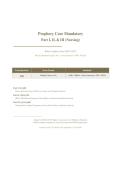
Prophecy Core Mandatory
Part I, II, & III (Nursing)
Relias Complete (Latest )
Most Comprehensive Qs & Ans - to Pass the Exam, 100% Verified
Total Questions Exam Format Standards
Multiple Choice (A-D) OSHA / HIPAA / Joint Commission / CDC / NPSG
200
Part I: Q1-Q80
Safety, Infection Control, OSHA, Fire Safety, and Workplace Hazards
Part II: Q81-Q130
HIPAA, Bloodborne Pathogens, Patient Rights, and Protected Health Information
Part III: Q131-Q200
Nursing Ethics, Cultural Competency, Professional Conduct, and Patient Advocacy
Aligned with 2026-2027 Prophecy Assessments Core Mandatory Standards,
Relias Learning Competencies, and Joint Commission/NPSG Requirements
Cognitive Levels: 35% Recall | 50% Application | 15% Analysis
, Part I - Safety, Infection Control, OSHA, Fire Safety, and Workplace Hazards (Q1-Q80)
Q1: A nurse is preparing to provide care to a patient with an unknown infectious status. Which action
demonstrates adherence to Standard Precautions?
A. A. Wearing gloves only when visible blood is present
B. B. Treating all blood and body fluids as potentially infectious [CORRECT]
C. C. Donning a gown only when the patient has a confirmed infection
D. D. Wearing a surgical mask for all patient encounters regardless of symptoms
Correct Answer: B.
Rationale: Standard Precautions require treating ALL blood and body fluids as potentially infectious, regardless of the patient's
confirmed or suspected infection status. This foundational OSHA and CDC guideline applies to every patient encounter. Option A
is incorrect because gloves are required for any contact with blood, body fluids, secretions, and excretions, not just when blood is
visible. Option C is incorrect because Standard Precautions apply universally. Option D is incorrect because surgical masks are not
required for every encounter under Standard Precautions alone; they are used based on transmission-based precautions or
procedure risk.
Q2: Which statement accurately describes the single most important practice for preventing the spread of
healthcare-associated infections (HAIs)?
A. A. Administering prophylactic antibiotics before invasive procedures
B. B. Performing hand hygiene before and after every patient contact [CORRECT]
C. C. Placing all patients in private rooms with negative-pressure ventilation
D. D. Wearing double gloves during all patient care activities
Correct Answer: B.
Rationale: Hand hygiene is universally recognized as the single most important practice in preventing the transmission of
healthcare-associated infections. The CDC and WHO emphasize that proper hand hygiene before and after every patient contact,
after glove removal, and after contact with body fluids or contaminated surfaces is the cornerstone of infection prevention.
Option A is incorrect because prophylactic antibiotics are procedure-specific and contribute to antimicrobial resistance. Option C is
incorrect because private negative-pressure rooms are reserved for airborne precautions, not all patients. Option D is incorrect
because double gloving is not a Standard Precaution requirement for all care.
Q3: A nurse enters the room of a patient diagnosed with Clostridioides difficile (C. difficile) infection.
Which hand hygiene method is MOST appropriate after removing gloves?
A. A. Apply an alcohol-based hand sanitizer thoroughly
B. B. Wash hands with soap and water [CORRECT]
C. C. Rinse hands with water only to conserve soap supplies
D. D. Use antibacterial wipes and allow hands to air dry
Correct Answer: B.
Rationale: C. difficile forms spores that are NOT effectively killed by alcohol-based hand sanitizers. The CDC and APIC
specifically recommend washing hands with soap and water after caring for patients with C. difficile infections because the
mechanical action of friction and rinsing helps physically remove the spores. Option A is incorrect and represents a common
Prophecy exam error because alcohol-based sanitizers do not kill C. difficile spores. Option C is incorrect because water alone
does not remove spores effectively. Option D is incorrect because antibacterial wipes are not a substitute for proper handwashing
in this scenario.
Prophecy Core Mandatory Part I, II & III - Page 2
,Q4: A nurse is caring for a patient with active pulmonary tuberculosis (TB). Which type of
transmission-based precautions is required?
A. A. Contact Precautions
B. B. Droplet Precautions
C. C. Airborne Precautions [CORRECT]
D. D. Standard Precautions only
Correct Answer: C.
Rationale: Pulmonary tuberculosis is spread via airborne transmission of droplet nuclei (particles smaller than 5 microns) that
remain suspended in the air for extended periods. Airborne Precautions require placement in a negative-pressure room and the use
of an N95 respirator or higher-level respiratory protection. Option A is incorrect because Contact Precautions are for infections
spread by direct or indirect contact (e.g., MRSA, VRE). Option B is incorrect because Droplet Precautions are for pathogens
spread by larger respiratory droplets (e.g., influenza, pertussis). Option D is incorrect because Standard Precautions alone are
insufficient for airborne pathogens.
Q5: A patient has been placed on Contact Precautions due to a confirmed MRSA wound infection. Which
personal protective equipment (PPE) must the nurse don BEFORE entering the patient's room?
A. A. N95 respirator and face shield
B. B. Surgical mask and eye protection
C. C. Gown and gloves [CORRECT]
D. D. Shoe covers and hairnet
Correct Answer: C.
Rationale: Contact Precautions require gown and gloves for all interactions that may involve contact with the patient or the
patient's environment. MRSA is transmitted primarily through direct contact with contaminated surfaces or skin-to-skin contact.
Option A is incorrect because N95 respirators are for Airborne Precautions, not Contact Precautions. Option B is incorrect because
surgical masks are for Droplet Precautions. Option D is incorrect because shoe covers and hairnets are not routinely required for
Contact Precautions and represent a common confusion point on Prophecy exams.
Q6: A nurse is caring for a patient with measles (rubeola). In addition to Standard Precautions, which
precautions must be implemented?
A. A. Airborne Precautions with N95 respirator and negative-pressure room [CORRECT]
B. B. Droplet Precautions with surgical mask within 3 feet
C. C. Contact Precautions with gown and gloves only
D. D. Enhanced Contact Precautions with dedicated equipment
Correct Answer: A.
Rationale: Measles is a highly contagious airborne disease caused by a virus that spreads through droplet nuclei that can remain
airborne for hours. Airborne Precautions including a negative-pressure room and N95 respirator are required per CDC
guidelines. Option B is incorrect because Droplet Precautions are insufficient for measles; the virus is smaller than droplet size and
travels further. Option C is incorrect because Contact Precautions address direct and indirect contact transmission, not airborne
spread. Option D is incorrect because 'enhanced contact' is not a recognized CDC precaution category for measles.
Q7: A nurse must provide care to a patient diagnosed with influenza. Which transmission-based
precaution is appropriate?
A. A. Airborne Precautions
B. B. Droplet Precautions with a surgical mask [CORRECT]
C. C. Contact Precautions with gown and gloves
D. D. Reverse (Protective) Precautions
Prophecy Core Mandatory Part I, II & III - Page 3
, Correct Answer: B.
Rationale: Influenza is transmitted through large respiratory droplets produced by coughing, sneezing, or talking. Droplet
Precautions require wearing a surgical mask when within approximately 6 feet (3 feet per older guidelines) of the patient. Option
A is incorrect because influenza is not spread via airborne route (it does not remain suspended in air for long periods). Option C is
incorrect because Contact Precautions are not the primary precaution for influenza unless the patient also has a contact-spread
condition. Option D is incorrect because Reverse Precautions protect immunocompromised patients from staff, which is unrelated.
Q8: A patient is admitted with varicella (chickenpox). Which precautions must the nurse implement?
A. A. Contact Precautions with gown and gloves
B. B. Droplet Precautions with surgical mask
C. C. Airborne Precautions with N95 respirator and negative-pressure room [CORRECT]
D. D. Standard Precautions with hand hygiene emphasis
Correct Answer: C.
Rationale: Varicella (chickenpox) is spread through the airborne route via droplet nuclei from respiratory secretions and also
through direct contact with vesicle fluid. Airborne Precautions with N95 respirator and negative-pressure room placement are
required per CDC guidelines. Option A is incorrect because although contact with vesicle fluid can spread the virus, Contact
Precautions alone are insufficient. Option B is incorrect because Droplet Precautions do not address the airborne component.
Option D is incorrect because Standard Precautions alone do not adequately protect against this highly contagious airborne
pathogen.
Q9: A nurse is preparing to enter the room of a patient on Contact Precautions for VRE
(Vancomycin-Resistant Enterococci). Which PPE items are required?
A. A. N95 respirator and face shield only
B. B. Gown and gloves [CORRECT]
C. C. Surgical mask and shoe covers
D. D. Face shield and gown without gloves
Correct Answer: B.
Rationale: VRE is spread through direct and indirect contact, primarily via contaminated hands and surfaces. Contact
Precautions mandate the use of gown and gloves upon room entry. Option A is incorrect because N95 respirators and face shields
are for Airborne Precautions. Option C is incorrect because surgical masks are for Droplet Precautions, and shoe covers are not
routinely required. Option D is incorrect because gloves are always required for Contact Precautions, and face shields are not the
primary PPE for VRE.
Q10: Which of the following represents the correct sequence for donning PPE prior to entering an
isolation room?
A. A. Gloves, then gown, then mask, then eye protection
B. B. Gown, then mask or respirator, then eye protection, then gloves [CORRECT]
C. C. Mask, then eye protection, then gown, then gloves
D. D. Eye protection, then mask, then gloves, then gown
Correct Answer: B.
Rationale: The correct PPE donning sequence is: Gown first, then mask or respirator, then eye protection (goggles or face shield),
and finally gloves. This sequence ensures that gloves are put on last, which prevents contamination of other PPE items during the
donning process. Option A is incorrect because gloves should be donned last, not first. Option C is incorrect because the gown
should be donned before the mask. Option D is incorrect because the gown should be donned before eye protection and gloves
should be last.
Prophecy Core Mandatory Part I, II & III - Page 4
Part I, II, & III (Nursing)
Relias Complete (Latest )
Most Comprehensive Qs & Ans - to Pass the Exam, 100% Verified
Total Questions Exam Format Standards
Multiple Choice (A-D) OSHA / HIPAA / Joint Commission / CDC / NPSG
200
Part I: Q1-Q80
Safety, Infection Control, OSHA, Fire Safety, and Workplace Hazards
Part II: Q81-Q130
HIPAA, Bloodborne Pathogens, Patient Rights, and Protected Health Information
Part III: Q131-Q200
Nursing Ethics, Cultural Competency, Professional Conduct, and Patient Advocacy
Aligned with 2026-2027 Prophecy Assessments Core Mandatory Standards,
Relias Learning Competencies, and Joint Commission/NPSG Requirements
Cognitive Levels: 35% Recall | 50% Application | 15% Analysis
, Part I - Safety, Infection Control, OSHA, Fire Safety, and Workplace Hazards (Q1-Q80)
Q1: A nurse is preparing to provide care to a patient with an unknown infectious status. Which action
demonstrates adherence to Standard Precautions?
A. A. Wearing gloves only when visible blood is present
B. B. Treating all blood and body fluids as potentially infectious [CORRECT]
C. C. Donning a gown only when the patient has a confirmed infection
D. D. Wearing a surgical mask for all patient encounters regardless of symptoms
Correct Answer: B.
Rationale: Standard Precautions require treating ALL blood and body fluids as potentially infectious, regardless of the patient's
confirmed or suspected infection status. This foundational OSHA and CDC guideline applies to every patient encounter. Option A
is incorrect because gloves are required for any contact with blood, body fluids, secretions, and excretions, not just when blood is
visible. Option C is incorrect because Standard Precautions apply universally. Option D is incorrect because surgical masks are not
required for every encounter under Standard Precautions alone; they are used based on transmission-based precautions or
procedure risk.
Q2: Which statement accurately describes the single most important practice for preventing the spread of
healthcare-associated infections (HAIs)?
A. A. Administering prophylactic antibiotics before invasive procedures
B. B. Performing hand hygiene before and after every patient contact [CORRECT]
C. C. Placing all patients in private rooms with negative-pressure ventilation
D. D. Wearing double gloves during all patient care activities
Correct Answer: B.
Rationale: Hand hygiene is universally recognized as the single most important practice in preventing the transmission of
healthcare-associated infections. The CDC and WHO emphasize that proper hand hygiene before and after every patient contact,
after glove removal, and after contact with body fluids or contaminated surfaces is the cornerstone of infection prevention.
Option A is incorrect because prophylactic antibiotics are procedure-specific and contribute to antimicrobial resistance. Option C is
incorrect because private negative-pressure rooms are reserved for airborne precautions, not all patients. Option D is incorrect
because double gloving is not a Standard Precaution requirement for all care.
Q3: A nurse enters the room of a patient diagnosed with Clostridioides difficile (C. difficile) infection.
Which hand hygiene method is MOST appropriate after removing gloves?
A. A. Apply an alcohol-based hand sanitizer thoroughly
B. B. Wash hands with soap and water [CORRECT]
C. C. Rinse hands with water only to conserve soap supplies
D. D. Use antibacterial wipes and allow hands to air dry
Correct Answer: B.
Rationale: C. difficile forms spores that are NOT effectively killed by alcohol-based hand sanitizers. The CDC and APIC
specifically recommend washing hands with soap and water after caring for patients with C. difficile infections because the
mechanical action of friction and rinsing helps physically remove the spores. Option A is incorrect and represents a common
Prophecy exam error because alcohol-based sanitizers do not kill C. difficile spores. Option C is incorrect because water alone
does not remove spores effectively. Option D is incorrect because antibacterial wipes are not a substitute for proper handwashing
in this scenario.
Prophecy Core Mandatory Part I, II & III - Page 2
,Q4: A nurse is caring for a patient with active pulmonary tuberculosis (TB). Which type of
transmission-based precautions is required?
A. A. Contact Precautions
B. B. Droplet Precautions
C. C. Airborne Precautions [CORRECT]
D. D. Standard Precautions only
Correct Answer: C.
Rationale: Pulmonary tuberculosis is spread via airborne transmission of droplet nuclei (particles smaller than 5 microns) that
remain suspended in the air for extended periods. Airborne Precautions require placement in a negative-pressure room and the use
of an N95 respirator or higher-level respiratory protection. Option A is incorrect because Contact Precautions are for infections
spread by direct or indirect contact (e.g., MRSA, VRE). Option B is incorrect because Droplet Precautions are for pathogens
spread by larger respiratory droplets (e.g., influenza, pertussis). Option D is incorrect because Standard Precautions alone are
insufficient for airborne pathogens.
Q5: A patient has been placed on Contact Precautions due to a confirmed MRSA wound infection. Which
personal protective equipment (PPE) must the nurse don BEFORE entering the patient's room?
A. A. N95 respirator and face shield
B. B. Surgical mask and eye protection
C. C. Gown and gloves [CORRECT]
D. D. Shoe covers and hairnet
Correct Answer: C.
Rationale: Contact Precautions require gown and gloves for all interactions that may involve contact with the patient or the
patient's environment. MRSA is transmitted primarily through direct contact with contaminated surfaces or skin-to-skin contact.
Option A is incorrect because N95 respirators are for Airborne Precautions, not Contact Precautions. Option B is incorrect because
surgical masks are for Droplet Precautions. Option D is incorrect because shoe covers and hairnets are not routinely required for
Contact Precautions and represent a common confusion point on Prophecy exams.
Q6: A nurse is caring for a patient with measles (rubeola). In addition to Standard Precautions, which
precautions must be implemented?
A. A. Airborne Precautions with N95 respirator and negative-pressure room [CORRECT]
B. B. Droplet Precautions with surgical mask within 3 feet
C. C. Contact Precautions with gown and gloves only
D. D. Enhanced Contact Precautions with dedicated equipment
Correct Answer: A.
Rationale: Measles is a highly contagious airborne disease caused by a virus that spreads through droplet nuclei that can remain
airborne for hours. Airborne Precautions including a negative-pressure room and N95 respirator are required per CDC
guidelines. Option B is incorrect because Droplet Precautions are insufficient for measles; the virus is smaller than droplet size and
travels further. Option C is incorrect because Contact Precautions address direct and indirect contact transmission, not airborne
spread. Option D is incorrect because 'enhanced contact' is not a recognized CDC precaution category for measles.
Q7: A nurse must provide care to a patient diagnosed with influenza. Which transmission-based
precaution is appropriate?
A. A. Airborne Precautions
B. B. Droplet Precautions with a surgical mask [CORRECT]
C. C. Contact Precautions with gown and gloves
D. D. Reverse (Protective) Precautions
Prophecy Core Mandatory Part I, II & III - Page 3
, Correct Answer: B.
Rationale: Influenza is transmitted through large respiratory droplets produced by coughing, sneezing, or talking. Droplet
Precautions require wearing a surgical mask when within approximately 6 feet (3 feet per older guidelines) of the patient. Option
A is incorrect because influenza is not spread via airborne route (it does not remain suspended in air for long periods). Option C is
incorrect because Contact Precautions are not the primary precaution for influenza unless the patient also has a contact-spread
condition. Option D is incorrect because Reverse Precautions protect immunocompromised patients from staff, which is unrelated.
Q8: A patient is admitted with varicella (chickenpox). Which precautions must the nurse implement?
A. A. Contact Precautions with gown and gloves
B. B. Droplet Precautions with surgical mask
C. C. Airborne Precautions with N95 respirator and negative-pressure room [CORRECT]
D. D. Standard Precautions with hand hygiene emphasis
Correct Answer: C.
Rationale: Varicella (chickenpox) is spread through the airborne route via droplet nuclei from respiratory secretions and also
through direct contact with vesicle fluid. Airborne Precautions with N95 respirator and negative-pressure room placement are
required per CDC guidelines. Option A is incorrect because although contact with vesicle fluid can spread the virus, Contact
Precautions alone are insufficient. Option B is incorrect because Droplet Precautions do not address the airborne component.
Option D is incorrect because Standard Precautions alone do not adequately protect against this highly contagious airborne
pathogen.
Q9: A nurse is preparing to enter the room of a patient on Contact Precautions for VRE
(Vancomycin-Resistant Enterococci). Which PPE items are required?
A. A. N95 respirator and face shield only
B. B. Gown and gloves [CORRECT]
C. C. Surgical mask and shoe covers
D. D. Face shield and gown without gloves
Correct Answer: B.
Rationale: VRE is spread through direct and indirect contact, primarily via contaminated hands and surfaces. Contact
Precautions mandate the use of gown and gloves upon room entry. Option A is incorrect because N95 respirators and face shields
are for Airborne Precautions. Option C is incorrect because surgical masks are for Droplet Precautions, and shoe covers are not
routinely required. Option D is incorrect because gloves are always required for Contact Precautions, and face shields are not the
primary PPE for VRE.
Q10: Which of the following represents the correct sequence for donning PPE prior to entering an
isolation room?
A. A. Gloves, then gown, then mask, then eye protection
B. B. Gown, then mask or respirator, then eye protection, then gloves [CORRECT]
C. C. Mask, then eye protection, then gown, then gloves
D. D. Eye protection, then mask, then gloves, then gown
Correct Answer: B.
Rationale: The correct PPE donning sequence is: Gown first, then mask or respirator, then eye protection (goggles or face shield),
and finally gloves. This sequence ensures that gloves are put on last, which prevents contamination of other PPE items during the
donning process. Option A is incorrect because gloves should be donned last, not first. Option C is incorrect because the gown
should be donned before the mask. Option D is incorrect because the gown should be donned before eye protection and gloves
should be last.
Prophecy Core Mandatory Part I, II & III - Page 4


