
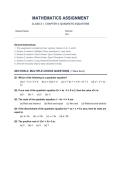
MATHEMATICS ASSIGNMENT
CLASS X | CHAPTER 4: QUADRATIC EQUATIONS
Student Name: Roll No /
Sec:
General Instructions:
1. This assignment is divided into four sections: Section A, B, C, and D.
2. Section A contains 5 Multiple Choice Questions (1 mark each).
3. Section B contains 5 Short Answer Type-I Questions (2 marks each).
4. Section C contains 4 Short Answer Type-II Questions (3 marks each).
5. Section D contains 3 Long Answer/Case-Based Questions (5 marks each).
6. Show all necessary step-by-step calculations neatly.
SECTION A: MULTIPLE CHOICE QUESTIONS (1 Mark Each)
Q1. Which of the following is a quadratic equation?
(a) x² - 3√x + 2 = 0 (b) x + (1/x) = x² (c) x² + 2x + 1 = (4 - x)² + 3 (d) x³ - x² = (x -
1)³
Q2. If one root of the quadratic equation 2x² + kx - 6 = 0 is 2, then the value of k is:
(a) 1 (b) -1 (c) 2 (d) -2
Q3. The roots of the quadratic equation x² - 4x + 4 = 0 are:
(a) Real and distinct (b) Real and equal (c) Not real (d) Rational and distinct
Q4. If the discriminant of the quadratic equation bx² + ax + c = 0 is zero, then its roots are
equal to:
(a) -b / 2a (b) -a / 2b (c) -c / 2a (d) a / 2b
Q5. The positive root of √(3x² + 6) = 9 is:
(a) 3 (b) 4 (c) 5 (d) 7
CLASS X | CHAPTER 4: QUADRATIC EQUATIONS
Student Name: Roll No /
Sec:
General Instructions:
1. This assignment is divided into four sections: Section A, B, C, and D.
2. Section A contains 5 Multiple Choice Questions (1 mark each).
3. Section B contains 5 Short Answer Type-I Questions (2 marks each).
4. Section C contains 4 Short Answer Type-II Questions (3 marks each).
5. Section D contains 3 Long Answer/Case-Based Questions (5 marks each).
6. Show all necessary step-by-step calculations neatly.
SECTION A: MULTIPLE CHOICE QUESTIONS (1 Mark Each)
Q1. Which of the following is a quadratic equation?
(a) x² - 3√x + 2 = 0 (b) x + (1/x) = x² (c) x² + 2x + 1 = (4 - x)² + 3 (d) x³ - x² = (x -
1)³
Q2. If one root of the quadratic equation 2x² + kx - 6 = 0 is 2, then the value of k is:
(a) 1 (b) -1 (c) 2 (d) -2
Q3. The roots of the quadratic equation x² - 4x + 4 = 0 are:
(a) Real and distinct (b) Real and equal (c) Not real (d) Rational and distinct
Q4. If the discriminant of the quadratic equation bx² + ax + c = 0 is zero, then its roots are
equal to:
(a) -b / 2a (b) -a / 2b (c) -c / 2a (d) a / 2b
Q5. The positive root of √(3x² + 6) = 9 is:
(a) 3 (b) 4 (c) 5 (d) 7


