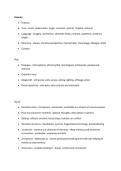
Unseen
• Themes
• Tone - ironic, melancholic, anger, romantic, cynical , hopeful, satirical
• Language - imagery, symbolism, semantic fields, contrast, repetition, sentence
length
• Structure - stanza, narrative perspective, rhyme/meter, chronology, dialogue, shifts
• Context
Play
• Dialogue - interruptions, stichomythia, monologues, soliloquies, pauses and
silences
• Dramatic irony
• Stagecraft - entrances, exits, props, setting, lighting, offstage action
• Power dynamics - who asks, who controls and interrupts
Novel
• Narrative voice - first person, omniscient, unreliable or a stream of consciousness
• How are characters revealed - speech, thoughts, description or actions
• Setting - reflects emotion, social class, isolation or conflict
• Narrative structure - flashbacks, cyclical, fragmented chronology, foreshadowing
• 1st person - narrator is a character in the story - deep intimacy and emotional
connection - unreliable - suspense and bias
• 2nd person - addresses us - active participant breaking the fourth wall helping to
involve us into the story
• 3rd person - outsider looking in - broad - limited and omniscient
,Poetry
• Form - sonnet (14 lines, ABAB), dramatic monologue, ballad, free verse or elegy
• Structure - volta, caesura, enjambment, regular vs irregular rhythm, rhyme scheme
• Poetic methods
• Meter - iambic pentameter (10) - associated with high status speech and
Shakespeare - sounds close to natural rhythm of English conversation - creates a
sense of balance, control and authority used for nobilitys separating high class
characters from comic speech
• iambic tetrameter (8) - faster and lighter than pentameter - flowing rhythm,
musicality and momentum - lyrical, charming and dreamlike - ballads, songs,
romantic poetry
• iambic trimeter (6) - shorter lines - quicker pace simplicity and intimacy - reflective
and delicate - can produce emotional vulnerability or quietness
• iambic dimeter (4) - tension, fragmentation, urgency, sharp emphasis, mimic panic,
heartbeat, childlike simplicity and sudden emotion - abrupt and tense
Time
Every Journey Requires New Routes Via Every Mile Passed
Elizabethan era 1558 to 1603
Jacobean era 1603 to 1625
Restoration era 1660 to 1688
Neoclassical era 1700 to 1780
Romantic era 1780 to 1837
,Victorian era 1837 to 1901
Edwardian era 1901 to 1914
Modern era 1910 to 1945
Post modern era 1945 to present
Elizabethan era (1558 - 1603)
• English renaissance, rebirth of art, literature and humanism
• Strong beliefs in the great chain of being
• Patriachy
• Exploration and expansion of Englands power
• Popularity of theatre
• Power and monarchy
• Religion vs morality
• Order vs chaos
• Gender roles
• Appearance vs reality
• Ruled by Elizabeth I in which people believed in the divine right of kings and queens
in which the monarchs were chosen by God and shouldn’t be challenged
• The monarch had enormous authority over politics, religion and law
• Parliament existed but had limited power
, • Loyalty to the crown was patriotic and a religious duty
• Rebellion against the monarch was viewed as rebellion against God
• Disorder in the state reflected moral disorder
• Kings and rulers are symbols of stability
• Elizabethan rulers feared rebellion, assassination, religious uprisings and foreign
invasion so the state enforced surveillance, punishment and propaganda
• Plays were controlled by master of the revels to avoid politically sensitive or
religious rebellion content
• Spies monitored catholics and political enemies
• One of the famous wars was the Spanish armada which increased nationalism,
pride and belief England was favored by God
• As a result of war tax and poverty rose along with patriotic literature
• Rebellion was seen in catholic plots against the queen, noble uprisings, succession
anxieties
• Voting belonged to wealthy land owning men
• Women, laborers, servants and poor lacked voting
• Voices of low class were mocked, ignored and were comedy
• Oppression was seen in religion - catholics were persecuted as England became
protestant - gender oppression
• Growth of trade and merchant class, capitalism, urbanization, poverty rose,
wealthy nobles lived in luxury and the poor struggled viewed as dangerous
• The setting was crowded, unsanitary and full of theatre
• Sumptuary laws restricted what people wore, appearance and luxury
• People performed different identities in courts, marriage, social life and politics
• Royal court rewarded charm, manipulation and performance creating tension
between appearance vs reality
•
• Themes
• Tone - ironic, melancholic, anger, romantic, cynical , hopeful, satirical
• Language - imagery, symbolism, semantic fields, contrast, repetition, sentence
length
• Structure - stanza, narrative perspective, rhyme/meter, chronology, dialogue, shifts
• Context
Play
• Dialogue - interruptions, stichomythia, monologues, soliloquies, pauses and
silences
• Dramatic irony
• Stagecraft - entrances, exits, props, setting, lighting, offstage action
• Power dynamics - who asks, who controls and interrupts
Novel
• Narrative voice - first person, omniscient, unreliable or a stream of consciousness
• How are characters revealed - speech, thoughts, description or actions
• Setting - reflects emotion, social class, isolation or conflict
• Narrative structure - flashbacks, cyclical, fragmented chronology, foreshadowing
• 1st person - narrator is a character in the story - deep intimacy and emotional
connection - unreliable - suspense and bias
• 2nd person - addresses us - active participant breaking the fourth wall helping to
involve us into the story
• 3rd person - outsider looking in - broad - limited and omniscient
,Poetry
• Form - sonnet (14 lines, ABAB), dramatic monologue, ballad, free verse or elegy
• Structure - volta, caesura, enjambment, regular vs irregular rhythm, rhyme scheme
• Poetic methods
• Meter - iambic pentameter (10) - associated with high status speech and
Shakespeare - sounds close to natural rhythm of English conversation - creates a
sense of balance, control and authority used for nobilitys separating high class
characters from comic speech
• iambic tetrameter (8) - faster and lighter than pentameter - flowing rhythm,
musicality and momentum - lyrical, charming and dreamlike - ballads, songs,
romantic poetry
• iambic trimeter (6) - shorter lines - quicker pace simplicity and intimacy - reflective
and delicate - can produce emotional vulnerability or quietness
• iambic dimeter (4) - tension, fragmentation, urgency, sharp emphasis, mimic panic,
heartbeat, childlike simplicity and sudden emotion - abrupt and tense
Time
Every Journey Requires New Routes Via Every Mile Passed
Elizabethan era 1558 to 1603
Jacobean era 1603 to 1625
Restoration era 1660 to 1688
Neoclassical era 1700 to 1780
Romantic era 1780 to 1837
,Victorian era 1837 to 1901
Edwardian era 1901 to 1914
Modern era 1910 to 1945
Post modern era 1945 to present
Elizabethan era (1558 - 1603)
• English renaissance, rebirth of art, literature and humanism
• Strong beliefs in the great chain of being
• Patriachy
• Exploration and expansion of Englands power
• Popularity of theatre
• Power and monarchy
• Religion vs morality
• Order vs chaos
• Gender roles
• Appearance vs reality
• Ruled by Elizabeth I in which people believed in the divine right of kings and queens
in which the monarchs were chosen by God and shouldn’t be challenged
• The monarch had enormous authority over politics, religion and law
• Parliament existed but had limited power
, • Loyalty to the crown was patriotic and a religious duty
• Rebellion against the monarch was viewed as rebellion against God
• Disorder in the state reflected moral disorder
• Kings and rulers are symbols of stability
• Elizabethan rulers feared rebellion, assassination, religious uprisings and foreign
invasion so the state enforced surveillance, punishment and propaganda
• Plays were controlled by master of the revels to avoid politically sensitive or
religious rebellion content
• Spies monitored catholics and political enemies
• One of the famous wars was the Spanish armada which increased nationalism,
pride and belief England was favored by God
• As a result of war tax and poverty rose along with patriotic literature
• Rebellion was seen in catholic plots against the queen, noble uprisings, succession
anxieties
• Voting belonged to wealthy land owning men
• Women, laborers, servants and poor lacked voting
• Voices of low class were mocked, ignored and were comedy
• Oppression was seen in religion - catholics were persecuted as England became
protestant - gender oppression
• Growth of trade and merchant class, capitalism, urbanization, poverty rose,
wealthy nobles lived in luxury and the poor struggled viewed as dangerous
• The setting was crowded, unsanitary and full of theatre
• Sumptuary laws restricted what people wore, appearance and luxury
• People performed different identities in courts, marriage, social life and politics
• Royal court rewarded charm, manipulation and performance creating tension
between appearance vs reality
•