

Part 2-Written Report
Introduction
Project management is the use of processes, methods, skills, knowledge, and experience to
meet specified project objectives within agreed-upon limitations. Project management
produces final deliverables within a specific timeframe and budget. In general, the project
management process consists of five stages: planning, initiation, execution, monitoring, and
closure. The Burj Khalifa is one of the most recognisable towers that illuminate Dubai's skyline.
The Burj Khalifa project management's principal goal was to transform Dubai into a global hub
for banking, trade, and tourism, as well as to strengthen the emirate's status on the world
stage.
Initiation
The project initiation phase is the initial step of the project management life cycle, and it
involves the start-up of a new project. The beginning step involves identifying a business
problem or opportunity, defining a solution, and forming a project.
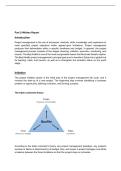
The triple constraint theory
According to the triple constraint’s theory, any project management paradigm, any project's
success or failure is determined by its budget, time, and scope. A project manager must strike
a balance between the three limitations so that the project stays on schedule.
, Project Definition
The goal of the Burj Khalifa was not simply to construct the highest structure. Previously, the
United Arab Emirates relied on petroleum as its primary source of wealth. The decision to
build the Burj Khalifa was predicated on the UAE government's desire to diversify its economy
from oil to service and tourism. Projects such as the Burj Khalifa were deemed vital to increase
worldwide recognition and investment in the UAE. Projects are created in response to market
demand for a specific product or service. In this scenario, there was a need for expensive and
opulent rooms, office space and other facilities. A project may also be approved due to a
business requirement, such as the UAE's desire to attract more investors and tourists.
Stakeholders Analysis
According to IGI Global (2018), stakeholders are individuals with a vested interest in a firm.
The most concerned stakeholders of the Burj Khalifa are as follows:
• Government of Dubai
• Architecture group - SOM, Chicago
• Consultant Group - Hyder Consulting
• Construction and foundation designer - Baier and Middle East foundation
Main Contractor
• Samsung
• Engineering, Besix, and Arabtec
• (Brookfield Multiplex - responsible for the construction of the foundation
• Others - Otis as lift contractor, Al Ghurair Group as cladding contractor,
• Dorma as a door contractor
General Overview of Stakeholders:
• 78 Companies:
• 16 Consultants
• 14 Contractors
• 3 Financial Institutions
• 2 Owners
• 2 Real Estate Companies
• 3 Sub-contractors
• 38 Suppliers
Project feasibility
The Burj Khalifa project, while eventually finished and regarded as a success in terms of
achieving its objectives, encountered significant project management issues, including cost
overruns and delays. These difficulties, while not insurmountable, illustrate the complexities
and risks that come with such large-scale initiatives.
Project Planning
Introduction
Project management is the use of processes, methods, skills, knowledge, and experience to
meet specified project objectives within agreed-upon limitations. Project management
produces final deliverables within a specific timeframe and budget. In general, the project
management process consists of five stages: planning, initiation, execution, monitoring, and
closure. The Burj Khalifa is one of the most recognisable towers that illuminate Dubai's skyline.
The Burj Khalifa project management's principal goal was to transform Dubai into a global hub
for banking, trade, and tourism, as well as to strengthen the emirate's status on the world
stage.
Initiation
The project initiation phase is the initial step of the project management life cycle, and it
involves the start-up of a new project. The beginning step involves identifying a business
problem or opportunity, defining a solution, and forming a project.
The triple constraint theory
According to the triple constraint’s theory, any project management paradigm, any project's
success or failure is determined by its budget, time, and scope. A project manager must strike
a balance between the three limitations so that the project stays on schedule.
, Project Definition
The goal of the Burj Khalifa was not simply to construct the highest structure. Previously, the
United Arab Emirates relied on petroleum as its primary source of wealth. The decision to
build the Burj Khalifa was predicated on the UAE government's desire to diversify its economy
from oil to service and tourism. Projects such as the Burj Khalifa were deemed vital to increase
worldwide recognition and investment in the UAE. Projects are created in response to market
demand for a specific product or service. In this scenario, there was a need for expensive and
opulent rooms, office space and other facilities. A project may also be approved due to a
business requirement, such as the UAE's desire to attract more investors and tourists.
Stakeholders Analysis
According to IGI Global (2018), stakeholders are individuals with a vested interest in a firm.
The most concerned stakeholders of the Burj Khalifa are as follows:
• Government of Dubai
• Architecture group - SOM, Chicago
• Consultant Group - Hyder Consulting
• Construction and foundation designer - Baier and Middle East foundation
Main Contractor
• Samsung
• Engineering, Besix, and Arabtec
• (Brookfield Multiplex - responsible for the construction of the foundation
• Others - Otis as lift contractor, Al Ghurair Group as cladding contractor,
• Dorma as a door contractor
General Overview of Stakeholders:
• 78 Companies:
• 16 Consultants
• 14 Contractors
• 3 Financial Institutions
• 2 Owners
• 2 Real Estate Companies
• 3 Sub-contractors
• 38 Suppliers
Project feasibility
The Burj Khalifa project, while eventually finished and regarded as a success in terms of
achieving its objectives, encountered significant project management issues, including cost
overruns and delays. These difficulties, while not insurmountable, illustrate the complexities
and risks that come with such large-scale initiatives.
Project Planning


