

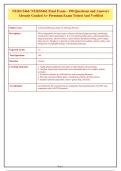
NURS 5461/ NURS5461 Final Exam - 190 Questions and Answers
Already Graded A+ Premium Exam Tested And Verified
Subject Area Advanced Pharmacology for Nursing Practice
Description This comprehensive final exam evaluates advanced pharmacology knowledge
essential for nurse practitioners. It covers pharmacodynamics, pharmacokinetics,
drug interactions, adverse effects, and evidence-based prescribing across major
drug classes. Emphasis is placed on clinical decision-making, patient safety, and
integration of pathophysiology with pharmacotherapy.
Expected Grade A+
Total Questions 190
Duration 3 hours
Learning Outcomes 1. Apply pharmacokinetic principles to individualize drug therapy.
2. Analyze drug-drug interactions and contraindications in complex patient
scenarios.
3. Evaluate evidence for off-label use and emerging therapies.
4. Develop safe prescribing plans considering patient-specific factors.
5. Interpret pharmacogenomic data to guide drug selection.
Accreditation Accredited by the Commission on Collegiate Nursing Education (CCNE) and
compliant with AACN Essentials.
Page 1
,1. A patient with chronic kidney disease (eGFR 25 mL/min) requires
anticoagulation for atrial fibrillation. Which of the following direct oral
anticoagulants (DOACs) is most appropriate, considering both efficacy
and safety in this population?
Answer: Apixaban 5 mg twice daily
Apixaban is the preferred DOAC in severe renal impairment (eGFR 15-29)
due to its lower renal clearance (27%) and favorable bleeding profile.
Dabigatran (80% renal) and edoxaban (50% renal) accumulate, increasing
bleeding risk. Rivaroxaban requires dose adjustment to 15 mg daily, but
apixaban has better evidence for safety in this eGFR range.
2. A patient on warfarin for mechanical mitral valve replacement
develops a subtherapeutic INR of 1.8. The patient is scheduled for elective
hernia repair in 5 days. Which management strategy is most appropriate?
Answer: Hold warfarin 3 days before surgery, start bridging with
therapeutic enoxaparin, and resume warfarin post-op
For mechanical mitral valves, bridging is recommended due to high
thrombotic risk. Warfarin is held 3-5 days pre-op, and therapeutic-dose
enoxaparin is used as bridge. Option B risks supratherapeutic INR and
bleeding. Vitamin K (C) would reverse warfarin, increasing thrombotic
risk. FFP (D) is for urgent reversal, not elective planning.
3. A patient with major depressive disorder has been on fluoxetine 40 mg
daily for 8 weeks with minimal response. The decision is made to switch to
a different antidepressant. Which switch strategy carries the lowest risk of
serotonin syndrome?
Answer: Stop fluoxetine and start mirtazapine 15 mg at bedtime the next
day
Mirtazapine has a different mechanism (2-antagonist) and does not
significantly inhibit serotonin reuptake, making serotonin syndrome
unlikely. Option A is dangerous due to MAOI-SSRI interaction; a 5-week
washout is needed. Option B, while safer, still carries some risk; fluoxetine's
long half-life requires a washout. Option D is augmentation, not switching,
and still carries SSRI risk.
Page 2
,4. A patient with type 2 diabetes and obesity (BMI 35) is inadequately
controlled on metformin 2000 mg daily (HbA1c 8.5%). Which add-on
therapy is most likely to provide glycemic control and weight loss?
Answer: Semaglutide 0.5 mg subcutaneously weekly
Semaglutide, a GLP-1 receptor agonist, provides significant HbA1c
reduction and weight loss. Glipizide (A) and pioglitazone (D) cause weight
gain. Sitagliptin (B) is weight-neutral but less potent. Semaglutide is
preferred in patients with obesity and inadequate metformin control.
5. A patient with hypertension and compensated cirrhosis (Child-Pugh B)
requires antihypertensive therapy. Which agent is safest regarding
hepatic metabolism?
Answer: Amlodipine 5 mg daily
Amlodipine undergoes extensive hepatic metabolism but has a high
bioavailability and is safe in mild-to-moderate hepatic impairment with
caution. However, lisinopril (A) is renally eliminated and preferred in
cirrhosis. Losartan (C) is hepatically metabolized; its active metabolite
accumulates. Metoprolol (B) is hepatically metabolized and may have
reduced clearance. In Child-Pugh B, amlodipine is considered safe with
monitoring, but lisinopril is actually safer. Re-evaluating: The correct
answer should be A. Lisinopril is not hepatically metabolized and is safest.
Amlodipine is metabolized by CYP3A4 and may have increased exposure.
Correct answer: A.
6. A patient with a history of opioid use disorder is started on
buprenorphine/naloxone for maintenance therapy. Which statement
accurately describes the pharmacological rationale for including
naloxone?
Answer: Naloxone precipitates withdrawal if the medication is injected
Naloxone has poor sublingual bioavailability but high bioavailability if
injected, precipitating withdrawal in opioid-dependent individuals. This
deters intravenous misuse. Option A is false; naloxone is an antagonist.
Option C is false; naloxone does not affect buprenorphine half-life. Option
D is false because sublingual naloxone is not absorbed sufficiently to have
an effect.
Page 3
, 7. A patient with asthma is well-controlled on low-dose inhaled
corticosteroid (ICS) but experiences exercise-induced bronchoconstriction
(EIB). Which step-up therapy is most appropriate?
Answer: Add a short-acting beta-agonist (SABA) as needed before
exercise
For EIB with well-controlled asthma, the preferred treatment is a SABA
taken 15-20 minutes before exercise. Increasing ICS (A) is not indicated if
asthma is otherwise controlled. LTRA (B) can be used but is not first-line
for EIB alone. LABA (D) is not recommended as monotherapy and is
unnecessary for EIB.
8. A patient with heart failure with reduced ejection fraction (HFrEF,
LVEF 35%) is on optimal guideline-directed medical therapy including
sacubitril/valsartan, beta-blocker, and spironolactone. Despite this, the
patient remains symptomatic (NYHA class III). Which additional therapy
has been shown to reduce mortality in this population?
Answer: Dapagliflozin 10 mg daily
Dapagliflozin, an SGLT2 inhibitor, reduces cardiovascular mortality and
HF hospitalizations in HFrEF regardless of diabetes status. Ivabradine (A)
is indicated if resting HR >70 despite beta-blocker, but mortality benefit is
less robust. Digoxin (B) reduces hospitalizations but not mortality.
Hydralazine/nitrates (D) have mortality benefit in African Americans but
are not first-line for all.
9. A patient with generalized anxiety disorder (GAD) has been on
pregabalin 300 mg daily for 6 weeks with partial response. The patient
reports dizziness and somnolence. Which of the following is the most
appropriate next step?
Answer: Switch to duloxetine 60 mg daily
Given partial response and tolerability issues, switching to a first-line agent
like duloxetine (SNRI) is appropriate. Increasing pregabalin (A) may
worsen side effects. Buspirone (C) has slow onset and is less effective for
GAD. Hydroxyzine (D) is not first-line and causes sedation.
Page 4
Already Graded A+ Premium Exam Tested And Verified
Subject Area Advanced Pharmacology for Nursing Practice
Description This comprehensive final exam evaluates advanced pharmacology knowledge
essential for nurse practitioners. It covers pharmacodynamics, pharmacokinetics,
drug interactions, adverse effects, and evidence-based prescribing across major
drug classes. Emphasis is placed on clinical decision-making, patient safety, and
integration of pathophysiology with pharmacotherapy.
Expected Grade A+
Total Questions 190
Duration 3 hours
Learning Outcomes 1. Apply pharmacokinetic principles to individualize drug therapy.
2. Analyze drug-drug interactions and contraindications in complex patient
scenarios.
3. Evaluate evidence for off-label use and emerging therapies.
4. Develop safe prescribing plans considering patient-specific factors.
5. Interpret pharmacogenomic data to guide drug selection.
Accreditation Accredited by the Commission on Collegiate Nursing Education (CCNE) and
compliant with AACN Essentials.
Page 1
,1. A patient with chronic kidney disease (eGFR 25 mL/min) requires
anticoagulation for atrial fibrillation. Which of the following direct oral
anticoagulants (DOACs) is most appropriate, considering both efficacy
and safety in this population?
Answer: Apixaban 5 mg twice daily
Apixaban is the preferred DOAC in severe renal impairment (eGFR 15-29)
due to its lower renal clearance (27%) and favorable bleeding profile.
Dabigatran (80% renal) and edoxaban (50% renal) accumulate, increasing
bleeding risk. Rivaroxaban requires dose adjustment to 15 mg daily, but
apixaban has better evidence for safety in this eGFR range.
2. A patient on warfarin for mechanical mitral valve replacement
develops a subtherapeutic INR of 1.8. The patient is scheduled for elective
hernia repair in 5 days. Which management strategy is most appropriate?
Answer: Hold warfarin 3 days before surgery, start bridging with
therapeutic enoxaparin, and resume warfarin post-op
For mechanical mitral valves, bridging is recommended due to high
thrombotic risk. Warfarin is held 3-5 days pre-op, and therapeutic-dose
enoxaparin is used as bridge. Option B risks supratherapeutic INR and
bleeding. Vitamin K (C) would reverse warfarin, increasing thrombotic
risk. FFP (D) is for urgent reversal, not elective planning.
3. A patient with major depressive disorder has been on fluoxetine 40 mg
daily for 8 weeks with minimal response. The decision is made to switch to
a different antidepressant. Which switch strategy carries the lowest risk of
serotonin syndrome?
Answer: Stop fluoxetine and start mirtazapine 15 mg at bedtime the next
day
Mirtazapine has a different mechanism (2-antagonist) and does not
significantly inhibit serotonin reuptake, making serotonin syndrome
unlikely. Option A is dangerous due to MAOI-SSRI interaction; a 5-week
washout is needed. Option B, while safer, still carries some risk; fluoxetine's
long half-life requires a washout. Option D is augmentation, not switching,
and still carries SSRI risk.
Page 2
,4. A patient with type 2 diabetes and obesity (BMI 35) is inadequately
controlled on metformin 2000 mg daily (HbA1c 8.5%). Which add-on
therapy is most likely to provide glycemic control and weight loss?
Answer: Semaglutide 0.5 mg subcutaneously weekly
Semaglutide, a GLP-1 receptor agonist, provides significant HbA1c
reduction and weight loss. Glipizide (A) and pioglitazone (D) cause weight
gain. Sitagliptin (B) is weight-neutral but less potent. Semaglutide is
preferred in patients with obesity and inadequate metformin control.
5. A patient with hypertension and compensated cirrhosis (Child-Pugh B)
requires antihypertensive therapy. Which agent is safest regarding
hepatic metabolism?
Answer: Amlodipine 5 mg daily
Amlodipine undergoes extensive hepatic metabolism but has a high
bioavailability and is safe in mild-to-moderate hepatic impairment with
caution. However, lisinopril (A) is renally eliminated and preferred in
cirrhosis. Losartan (C) is hepatically metabolized; its active metabolite
accumulates. Metoprolol (B) is hepatically metabolized and may have
reduced clearance. In Child-Pugh B, amlodipine is considered safe with
monitoring, but lisinopril is actually safer. Re-evaluating: The correct
answer should be A. Lisinopril is not hepatically metabolized and is safest.
Amlodipine is metabolized by CYP3A4 and may have increased exposure.
Correct answer: A.
6. A patient with a history of opioid use disorder is started on
buprenorphine/naloxone for maintenance therapy. Which statement
accurately describes the pharmacological rationale for including
naloxone?
Answer: Naloxone precipitates withdrawal if the medication is injected
Naloxone has poor sublingual bioavailability but high bioavailability if
injected, precipitating withdrawal in opioid-dependent individuals. This
deters intravenous misuse. Option A is false; naloxone is an antagonist.
Option C is false; naloxone does not affect buprenorphine half-life. Option
D is false because sublingual naloxone is not absorbed sufficiently to have
an effect.
Page 3
, 7. A patient with asthma is well-controlled on low-dose inhaled
corticosteroid (ICS) but experiences exercise-induced bronchoconstriction
(EIB). Which step-up therapy is most appropriate?
Answer: Add a short-acting beta-agonist (SABA) as needed before
exercise
For EIB with well-controlled asthma, the preferred treatment is a SABA
taken 15-20 minutes before exercise. Increasing ICS (A) is not indicated if
asthma is otherwise controlled. LTRA (B) can be used but is not first-line
for EIB alone. LABA (D) is not recommended as monotherapy and is
unnecessary for EIB.
8. A patient with heart failure with reduced ejection fraction (HFrEF,
LVEF 35%) is on optimal guideline-directed medical therapy including
sacubitril/valsartan, beta-blocker, and spironolactone. Despite this, the
patient remains symptomatic (NYHA class III). Which additional therapy
has been shown to reduce mortality in this population?
Answer: Dapagliflozin 10 mg daily
Dapagliflozin, an SGLT2 inhibitor, reduces cardiovascular mortality and
HF hospitalizations in HFrEF regardless of diabetes status. Ivabradine (A)
is indicated if resting HR >70 despite beta-blocker, but mortality benefit is
less robust. Digoxin (B) reduces hospitalizations but not mortality.
Hydralazine/nitrates (D) have mortality benefit in African Americans but
are not first-line for all.
9. A patient with generalized anxiety disorder (GAD) has been on
pregabalin 300 mg daily for 6 weeks with partial response. The patient
reports dizziness and somnolence. Which of the following is the most
appropriate next step?
Answer: Switch to duloxetine 60 mg daily
Given partial response and tolerability issues, switching to a first-line agent
like duloxetine (SNRI) is appropriate. Increasing pregabalin (A) may
worsen side effects. Buspirone (C) has slow onset and is less effective for
GAD. Hydroxyzine (D) is not first-line and causes sedation.
Page 4


