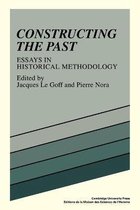
Mentalities: a History of Ambiguities by Jacques Le Goff - 166-180 (VLE)
References
Footnotes - Jacques Le Goff, ‘Mentalities: a History of Ambiguities’ in Constructing the Past: Essays in
Historical Methodology, edited by G.R. Elton, Jacques Le Goff and Pierre Nora (Cambridge: Cambridge
University Pressl, 1985) 166-180.
Bibliography - Le Goff, Jacques. “Mentalities: a History of Ambiguities.” In Constructing the Past: Essays
in historical Methodology, edited by G.R. Elton, Jacques Le Goff and Pierre Nora, 166-180. Cambridge:
Cambridge University Press, 1985.
Notes and Quotes
- ‘The notion of 'mentality', then, refers to a kind of historical beyond. Its function, as a concept, is to
satisfy the historian's desire to `go further', and it leads to a point of contact with the other human
sciences’ - 167
- The idea that mentalities as a concept picks up the aspects of history which other methods cannot
reach is an interesting point. Although this may be generally true, this attitude to the method
suggests using a search for mentalities as a last step of analysing a source when it may be more useful
to understand the attitudes of the author and the society prior to attempting to construct a more
detailed and accurate image of a society
- ‘The primary attraction of the history of mentalities lies in its vagueness: it can be used to refer to the
left-overs, the indefinable residue of historical analysis.’ - 166
- ‘The history of mentalities operates at the level of the everyday automatisms of behaviour. Its object is
that which escapes historical individuals because it reveals the impersonal content of their thought:’ -
169
- This illustrates that historians use the method of searching for mentalities to find historical evidence in
what is unintentionally in the source, for example the language used or the tone of the writing. It is
also interesting to consider that as a result of these aspects being the least intentional aspects of the
source they may perhaps be the most accurate sources of evidence for a historian to learn about a
society.
- ‘Two stages may be noted: first, the identification of different strata and fragments of what, following
Andre Varagnac's term 'archaeocivilisation', we may call 'archaeopsychology'; and, secondly, since these
remnants are nevertheless ordered according to certain criteria of mental, if not logical, coherence, the
historian must determine these psychic systems of organisation’ - 169
- This demonstrates that this method historiography is perhaps more scientific than other methods,
having a specific process and being based on scientific principles around psychology. Again this may
lead us to believe that these unintentional aspects of the sources are the most useful as well as being
clearly defined unlike the majority of historical methodology
- ‘The French mentalite is borrowed from the English 'mentality', which dates back to the seventeenth
century and is a product of seventeenth-century English philosophy, referring to the collective
References
Footnotes - Jacques Le Goff, ‘Mentalities: a History of Ambiguities’ in Constructing the Past: Essays in
Historical Methodology, edited by G.R. Elton, Jacques Le Goff and Pierre Nora (Cambridge: Cambridge
University Pressl, 1985) 166-180.
Bibliography - Le Goff, Jacques. “Mentalities: a History of Ambiguities.” In Constructing the Past: Essays
in historical Methodology, edited by G.R. Elton, Jacques Le Goff and Pierre Nora, 166-180. Cambridge:
Cambridge University Press, 1985.
Notes and Quotes
- ‘The notion of 'mentality', then, refers to a kind of historical beyond. Its function, as a concept, is to
satisfy the historian's desire to `go further', and it leads to a point of contact with the other human
sciences’ - 167
- The idea that mentalities as a concept picks up the aspects of history which other methods cannot
reach is an interesting point. Although this may be generally true, this attitude to the method
suggests using a search for mentalities as a last step of analysing a source when it may be more useful
to understand the attitudes of the author and the society prior to attempting to construct a more
detailed and accurate image of a society
- ‘The primary attraction of the history of mentalities lies in its vagueness: it can be used to refer to the
left-overs, the indefinable residue of historical analysis.’ - 166
- ‘The history of mentalities operates at the level of the everyday automatisms of behaviour. Its object is
that which escapes historical individuals because it reveals the impersonal content of their thought:’ -
169
- This illustrates that historians use the method of searching for mentalities to find historical evidence in
what is unintentionally in the source, for example the language used or the tone of the writing. It is
also interesting to consider that as a result of these aspects being the least intentional aspects of the
source they may perhaps be the most accurate sources of evidence for a historian to learn about a
society.
- ‘Two stages may be noted: first, the identification of different strata and fragments of what, following
Andre Varagnac's term 'archaeocivilisation', we may call 'archaeopsychology'; and, secondly, since these
remnants are nevertheless ordered according to certain criteria of mental, if not logical, coherence, the
historian must determine these psychic systems of organisation’ - 169
- This demonstrates that this method historiography is perhaps more scientific than other methods,
having a specific process and being based on scientific principles around psychology. Again this may
lead us to believe that these unintentional aspects of the sources are the most useful as well as being
clearly defined unlike the majority of historical methodology
- ‘The French mentalite is borrowed from the English 'mentality', which dates back to the seventeenth
century and is a product of seventeenth-century English philosophy, referring to the collective