
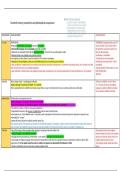
Twentieth-century perspectives and philosophical comparisons
PHILOSOPHER MAIN ARGUMENT CONS/CRITICISMS
A.J. Ayer VERIFICATION -SWINBURNE: people generally accept “all
-Relig lang UNVERIFIABLE; not cognitive, therefore meaningless. ravens are black” but no way to confirm
-Only scientific language can be meaningful (empirically verifiable) this statement- cannot be proved true or
-Statements are meaningful if they fall into analytical/synthetic- if they don’t it says nothing about reality. false yet still meaningful.
-Statements have to be verifiable using empirical methods -Verification is unverifiable:
-Any relig lang or claims about G cannot be verified as T/F by senses= meaningless. “Statements are only meaningful if
-Relig exp are also meaningless as they are not verifiable because one is recounting a set of emotions. verifiable by sense observation” is itself
-strong verification= something that can be verified conclusively by observation and experience- no statement made about history can be verified as fact (did unverifiable.
later recog this and say it has no possible application) -Evidence problem: What evidence counts?
-weak verification= anything shows to be probable by observation and experience- Ayer also did recognise later that weak verification was “far too liberal”. (LINK TO RELIG EXP)
-SEE HICK
John Hick Hick’s critique of Ayer – eschatological verification -If there is no afterlife, we won’t know.
Religious language is empirically verifiable – in an afterlife. -So – Hick has only shown that religious
Hick is arguing that God is verifiable in principle, because there is a way to verify God even if we are currently unable to do so while alive. language is possibly verifiable in principle,
but not actually verifiable in principle.
Anthony Flew FP better theory of empiricism than VP
Religious language as not cognitive and therefore meaningless
-If one piece of evidence can be presented against a statement then it can be falsified and is meaningful (how alibis work)
“The belief in God dies a ‘death by a thousand qualifications’”.
-Original belief is lost due to the amount of qualifications that are used to justify the idea
-when believers say “God is different from us”, they end up with a description of God that has no content because their statement is empty; they are
meaningful but “vacuous”.
-people will always cling to their original assertions about God.
Flew uses the parable of the gardener to illustrate why unfalsifiable language is meaningless. Imagine someone claimed a gardener existed, but every time
that was tested, they diluted the original concept to avoid the possibility of it being proven false (by saying it’s not visible, not tangible, etc).
R.M Hare -Ayer & Flew wrong in their assumption that relig lang is an attempt to describe reality at all -Flew pointed out that many religious
-religious language is non-cognitively meaningful believers intend their claims to be cognitive
-relig lang affects human behaviour and mentality – so this makes it meaningful to those who have it. eg Jesus rose from the dead so Hare's non
-when people use religious language, they should not be interpreted as truth claims in a cognitive sense but as expressions of what he called a 'blik'; cognitive approach does not work
expressions of how the speaker views the world; no evidence or argument can demonstrate the falseness of a blik -Most religious people would reject Hare’s
-Therefore, falsification works but only when asserting cognitive claims theory.
PHILOSOPHER MAIN ARGUMENT CONS/CRITICISMS
A.J. Ayer VERIFICATION -SWINBURNE: people generally accept “all
-Relig lang UNVERIFIABLE; not cognitive, therefore meaningless. ravens are black” but no way to confirm
-Only scientific language can be meaningful (empirically verifiable) this statement- cannot be proved true or
-Statements are meaningful if they fall into analytical/synthetic- if they don’t it says nothing about reality. false yet still meaningful.
-Statements have to be verifiable using empirical methods -Verification is unverifiable:
-Any relig lang or claims about G cannot be verified as T/F by senses= meaningless. “Statements are only meaningful if
-Relig exp are also meaningless as they are not verifiable because one is recounting a set of emotions. verifiable by sense observation” is itself
-strong verification= something that can be verified conclusively by observation and experience- no statement made about history can be verified as fact (did unverifiable.
later recog this and say it has no possible application) -Evidence problem: What evidence counts?
-weak verification= anything shows to be probable by observation and experience- Ayer also did recognise later that weak verification was “far too liberal”. (LINK TO RELIG EXP)
-SEE HICK
John Hick Hick’s critique of Ayer – eschatological verification -If there is no afterlife, we won’t know.
Religious language is empirically verifiable – in an afterlife. -So – Hick has only shown that religious
Hick is arguing that God is verifiable in principle, because there is a way to verify God even if we are currently unable to do so while alive. language is possibly verifiable in principle,
but not actually verifiable in principle.
Anthony Flew FP better theory of empiricism than VP
Religious language as not cognitive and therefore meaningless
-If one piece of evidence can be presented against a statement then it can be falsified and is meaningful (how alibis work)
“The belief in God dies a ‘death by a thousand qualifications’”.
-Original belief is lost due to the amount of qualifications that are used to justify the idea
-when believers say “God is different from us”, they end up with a description of God that has no content because their statement is empty; they are
meaningful but “vacuous”.
-people will always cling to their original assertions about God.
Flew uses the parable of the gardener to illustrate why unfalsifiable language is meaningless. Imagine someone claimed a gardener existed, but every time
that was tested, they diluted the original concept to avoid the possibility of it being proven false (by saying it’s not visible, not tangible, etc).
R.M Hare -Ayer & Flew wrong in their assumption that relig lang is an attempt to describe reality at all -Flew pointed out that many religious
-religious language is non-cognitively meaningful believers intend their claims to be cognitive
-relig lang affects human behaviour and mentality – so this makes it meaningful to those who have it. eg Jesus rose from the dead so Hare's non
-when people use religious language, they should not be interpreted as truth claims in a cognitive sense but as expressions of what he called a 'blik'; cognitive approach does not work
expressions of how the speaker views the world; no evidence or argument can demonstrate the falseness of a blik -Most religious people would reject Hare’s
-Therefore, falsification works but only when asserting cognitive claims theory.


