She Walks in Beauty by Lord Byron - Poetry Revision Notes and
Annotation
1. She walks in beauty, like the night A
2. Of cloudless climes and starry skies;B
3. And all that’s best of dark and brightA
4. Meet in her aspect and her eyes;B
5. Thus mellowed to that tender light A
6. Which heaven to gaudy day denies.B
7. One shade the more, one ray the less,C
8. Had half impaired the nameless graceD
9. Which waves in every raven tress,C
10. Or softly lightens o’er her face;D
11. Where thoughts serenely sweet express,C
12. How pure, how dear their dwelling-place.D
13. And on that cheek, and o’er that brow,E
14. So soft, so calm, yet eloquent,F
15. The smiles that win, the tints that glow,E
16. But tell of days in goodness spent,F
17. A mind at peace with all below,E
18. A heart whose love is innocent!F
Analysis
● Three sestets (stanzas of six lines)
● Published in 1814
● Form: Lyric
, ○ Analyse musical qualities (particularly rhythm and rhyme)
● Immediate context / explanation
○ Written after Byron saw his cousin-in-law (his cousin's wife) in
black mourning dress at a party in London.
○ This woman, Mrs Anne Wilmot, served as Byron’s muse
● Byron was one of the core Romantic poets
○ The Romantic Period in literary studies
■ Romanticism was more focused on emotional motivation
rather than the pure rationality of the Enlightenment.
● Core themes
○ Beauty
○ Idealisation
○ Happiness/beauty and sadness/mourning
■ Opposites / contrasts
Structure and Form
● Regular rhythm (smooth and flowing)
○ Iambic tetrameter
○ Regularity and constancy of feeling
○ Mirrors graceful movement
○ Link to form as a lyric
● Consistent rhyme
○ Alternate rhyme (ABAB)
○ Adds to the musical quality of the lyric
■ Adds to the theme of harmony and balance
● Three stanzas of six lines (sestet)
○ Start is more about contrast and outward beauty
○ End is more about morality and inner beauty
○ Analyse, compare, and contrast the broader themes of each
individual stanza
Annotation
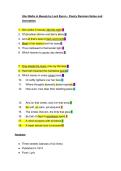
1. She walks in beauty, like the night A
2. Of cloudless climes and starry skies;B
3. And all that’s best of dark and brightA
4. Meet in her aspect and her eyes;B
5. Thus mellowed to that tender light A
6. Which heaven to gaudy day denies.B
7. One shade the more, one ray the less,C
8. Had half impaired the nameless graceD
9. Which waves in every raven tress,C
10. Or softly lightens o’er her face;D
11. Where thoughts serenely sweet express,C
12. How pure, how dear their dwelling-place.D
13. And on that cheek, and o’er that brow,E
14. So soft, so calm, yet eloquent,F
15. The smiles that win, the tints that glow,E
16. But tell of days in goodness spent,F
17. A mind at peace with all below,E
18. A heart whose love is innocent!F
Analysis
● Three sestets (stanzas of six lines)
● Published in 1814
● Form: Lyric
, ○ Analyse musical qualities (particularly rhythm and rhyme)
● Immediate context / explanation
○ Written after Byron saw his cousin-in-law (his cousin's wife) in
black mourning dress at a party in London.
○ This woman, Mrs Anne Wilmot, served as Byron’s muse
● Byron was one of the core Romantic poets
○ The Romantic Period in literary studies
■ Romanticism was more focused on emotional motivation
rather than the pure rationality of the Enlightenment.
● Core themes
○ Beauty
○ Idealisation
○ Happiness/beauty and sadness/mourning
■ Opposites / contrasts
Structure and Form
● Regular rhythm (smooth and flowing)
○ Iambic tetrameter
○ Regularity and constancy of feeling
○ Mirrors graceful movement
○ Link to form as a lyric
● Consistent rhyme
○ Alternate rhyme (ABAB)
○ Adds to the musical quality of the lyric
■ Adds to the theme of harmony and balance
● Three stanzas of six lines (sestet)
○ Start is more about contrast and outward beauty
○ End is more about morality and inner beauty
○ Analyse, compare, and contrast the broader themes of each
individual stanza