

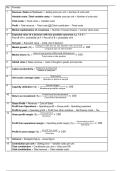
No. Formula
1 Revenue (Sales or Turnover) = Selling price per unit × Number of units sold
Variable costs (Total variable costs) = Variable cost per unit × Number of units sold
Total costs = Fixed costs + Variable costs
Profit = Total revenue − Total costs OR Total contribution − Fixed costs
2 Market capitalisation of a business = Number of issued shares × Current share price
3 Expected value of a decision with two possible outcomes e.g. A & B =
Pay-off of A × probability of A + Pay-off of B × probability of B
Net gain = Expected value − Initial cost of decision
4 𝐶ℎ𝑎𝑛𝑔𝑒 𝑖𝑛 𝑡ℎ𝑒 𝑠𝑖𝑧𝑒 𝑜𝑓 𝑡ℎ𝑒 𝑚𝑎𝑟𝑘𝑒𝑡 𝑜𝑣𝑒𝑟 𝑎 𝑝𝑒𝑟𝑖𝑜𝑑
Market growth (%) = × 100
𝑜𝑟𝑖𝑔𝑖𝑛𝑎𝑙 𝑠𝑖𝑧𝑒 𝑜𝑓 𝑡ℎ𝑒 𝑚𝑎𝑟𝑘𝑒𝑡
5 sales of one product OR brand OR business
Market share (%) = × 100
Total sales in the market
6 Added value = Sales revenue − costs of bought-in goods and services
7 Labour productivity =
𝑶𝒖𝒕𝒑𝒖𝒕 𝒐𝒗𝒆𝒓 𝒂 𝒕𝒊𝒎𝒆 𝒑𝒆𝒓𝒊𝒐𝒅
𝑵𝒖𝒎𝒃𝒆𝒓 𝒐𝒇 𝒆𝒎𝒑𝒍𝒐𝒚𝒆𝒆𝒔
8 Total costs
Unit costs (average costs) =
Number of units of output
9 Actual output
Capacity utilisation (%) = × 100
Maximum possible output
10 Profit from the investment
Return on investment (%) = × 100
Cost of the investment
11 Gross Profit = Revenue − Cost of Sales
Profit from Operations = Operating profit = Gross profit – Operating expenses
Profit for year = Operating profit + Profit from other activities − Net finance costs − Tax
12 𝐺𝑟𝑜𝑠𝑠 𝑝𝑟𝑜𝑓𝑖𝑡
Gross profit margin (%) = × 100
𝑅𝑒𝑣𝑒𝑛𝑢𝑒
𝑂𝑝𝑒𝑟𝑎𝑡𝑖𝑛𝑔 𝑝𝑟𝑜𝑓𝑖𝑡
Profit from operations margin = Operating profit margin (%) = × 100
𝑅𝑒𝑣𝑒𝑛𝑢𝑒
𝑃𝑟𝑜𝑓𝑖𝑡 𝑓𝑜𝑟 𝑦𝑒𝑎𝑟
Profit for year margin (%) = × 100
𝑅𝑒𝑣𝑒𝑛𝑢𝑒
13 Variance = Budgeted figure – actual figure
14 Contribution per unit = Selling price − Variable costs per unit
Total contribution = Contribution per unit × Units sold OR
Total contribution = Total revenue − Total variable costs
1 Revenue (Sales or Turnover) = Selling price per unit × Number of units sold
Variable costs (Total variable costs) = Variable cost per unit × Number of units sold
Total costs = Fixed costs + Variable costs
Profit = Total revenue − Total costs OR Total contribution − Fixed costs
2 Market capitalisation of a business = Number of issued shares × Current share price
3 Expected value of a decision with two possible outcomes e.g. A & B =
Pay-off of A × probability of A + Pay-off of B × probability of B
Net gain = Expected value − Initial cost of decision
4 𝐶ℎ𝑎𝑛𝑔𝑒 𝑖𝑛 𝑡ℎ𝑒 𝑠𝑖𝑧𝑒 𝑜𝑓 𝑡ℎ𝑒 𝑚𝑎𝑟𝑘𝑒𝑡 𝑜𝑣𝑒𝑟 𝑎 𝑝𝑒𝑟𝑖𝑜𝑑
Market growth (%) = × 100
𝑜𝑟𝑖𝑔𝑖𝑛𝑎𝑙 𝑠𝑖𝑧𝑒 𝑜𝑓 𝑡ℎ𝑒 𝑚𝑎𝑟𝑘𝑒𝑡
5 sales of one product OR brand OR business
Market share (%) = × 100
Total sales in the market
6 Added value = Sales revenue − costs of bought-in goods and services
7 Labour productivity =
𝑶𝒖𝒕𝒑𝒖𝒕 𝒐𝒗𝒆𝒓 𝒂 𝒕𝒊𝒎𝒆 𝒑𝒆𝒓𝒊𝒐𝒅
𝑵𝒖𝒎𝒃𝒆𝒓 𝒐𝒇 𝒆𝒎𝒑𝒍𝒐𝒚𝒆𝒆𝒔
8 Total costs
Unit costs (average costs) =
Number of units of output
9 Actual output
Capacity utilisation (%) = × 100
Maximum possible output
10 Profit from the investment
Return on investment (%) = × 100
Cost of the investment
11 Gross Profit = Revenue − Cost of Sales
Profit from Operations = Operating profit = Gross profit – Operating expenses
Profit for year = Operating profit + Profit from other activities − Net finance costs − Tax
12 𝐺𝑟𝑜𝑠𝑠 𝑝𝑟𝑜𝑓𝑖𝑡
Gross profit margin (%) = × 100
𝑅𝑒𝑣𝑒𝑛𝑢𝑒
𝑂𝑝𝑒𝑟𝑎𝑡𝑖𝑛𝑔 𝑝𝑟𝑜𝑓𝑖𝑡
Profit from operations margin = Operating profit margin (%) = × 100
𝑅𝑒𝑣𝑒𝑛𝑢𝑒
𝑃𝑟𝑜𝑓𝑖𝑡 𝑓𝑜𝑟 𝑦𝑒𝑎𝑟
Profit for year margin (%) = × 100
𝑅𝑒𝑣𝑒𝑛𝑢𝑒
13 Variance = Budgeted figure – actual figure
14 Contribution per unit = Selling price − Variable costs per unit
Total contribution = Contribution per unit × Units sold OR
Total contribution = Total revenue − Total variable costs


