
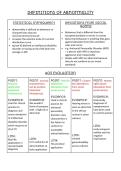
Definitions of Abnormality
Statistical infrequency Deviations From Social
Norms
• abnormality is defined as behaviour or
characteristics that are • Behaviour that is different from the
rare/uncommon/unusual accepted standard or norms in society
• occupies the extreme ends of a normal • Abnormal behaviour is anything that goes
distribution curve against (deviates from) the unwritten
• eg low IQ defined as intellectual disability rules and norms
disorder or having an IQ of 60 when the • e.g. Antisocial Personality Disorder (APD)
average is 100 – a person with APD is impulsive,
aggressive and irresponsible
• People with APD are abnormal because
they do not conform to our moral
standards
AO3 Evaluation
POint: Point: unusual Point: Real life POint: Culture Point: Human
Practical characteristics application bias (deviations rights abuse
application can be positive (deviations from from social (deviations from
(statistical (statistical social norms) norms) social norms)
infrequency) infrequency)
Evidence: Evidence:
Evidence: Evidence: Used in clinical Evidence: Historically
Used for clinical We wouldn’t practice for Hearing voices is diagnoses of
practice to think of someone antisocial seen as abnormal nymphomania
diagnose and with a high IQ as in the UK but have been used
personality
abnormal to control women
assess symptoms disorder a key normal in other
of intellectual characteristic is cultures
disability disorder the failure to
which requires an conform to Link:
IQ of 70 acceptable Lacks temporal
ethical behaviour validity and has
Link: Link: negative
Real life Link: Limited implications
Link:
application in Isn’t useful for all generalisability
Has practical
mental health abnormalities so across cultures
application
diagnosis lacks application
, Definitions of Abnormality
Failure to Function Deviation from ideal mental
Adequately health
• Failure to function adequately is when behaviour • Occurs when someone doesn’t meet the set of
is considered abnormal when an individual criteria for good mental health proposed by
cannot keep up with the demands of everyday life Jahoda
e.g. work, school, hygiene, permanent address • Absence of signs of mental health used to judge
abnormality
• Rosenhan and Seligman suggested related • Positive attitude towards self
characteristics include: • Self-actualisation and personal growth
→ When a person can’t conform to standard • Being resistant to stress – being able to cope
interpersonal rules e.g. maintaining eye with the demands of life
contact and respecting personal space • Being independent
→ When a person experiences severe personal • Accurate perception of reality – viewing the
distress and causes distress to others world in an objective manner
→ When a person's behaviour becomes • Environmental mastery - cope to changes in your
irrational or dangerous to themselves or surroundings
others • The more characteristics an individual fails to
meet the criteria the more abnormal they are
AO3 Evaluation
POint: may lead Point: failure to Point: Highly POint: POint: high
to discrimination function is normal comprehensive culturally biased standards
(failure to function (failure to function (deviations from (deviations from (deviations from
adequately) adequately) ideal mental ideal mental ideal mental
health) health) health)
Evidence: Evidence:
Non-standard life Under some Evidence: Evidence:
choices may be circumstances it is Jahoda’s criteria Jahoda’s ideas Evidence:
labelled as hard to cope like covers a wide stem from Jahoda’s criteria
losing a loved one range of factors western are quite
abnormal e.g.
so it is unfair to demanding and
those who travel and can act as a individualistic
label someone
won’t have checklist cultures are hard to all
because of
permanent address distressing keep up for a long
circumstances time
Link:
Link: Link: Real life Link: Link:
subjective Reductionist as it application and Isn’t applicable Negative
overlooks factors has a positive over different implications
affect on people cultures
Statistical infrequency Deviations From Social
Norms
• abnormality is defined as behaviour or
characteristics that are • Behaviour that is different from the
rare/uncommon/unusual accepted standard or norms in society
• occupies the extreme ends of a normal • Abnormal behaviour is anything that goes
distribution curve against (deviates from) the unwritten
• eg low IQ defined as intellectual disability rules and norms
disorder or having an IQ of 60 when the • e.g. Antisocial Personality Disorder (APD)
average is 100 – a person with APD is impulsive,
aggressive and irresponsible
• People with APD are abnormal because
they do not conform to our moral
standards
AO3 Evaluation
POint: Point: unusual Point: Real life POint: Culture Point: Human
Practical characteristics application bias (deviations rights abuse
application can be positive (deviations from from social (deviations from
(statistical (statistical social norms) norms) social norms)
infrequency) infrequency)
Evidence: Evidence:
Evidence: Evidence: Used in clinical Evidence: Historically
Used for clinical We wouldn’t practice for Hearing voices is diagnoses of
practice to think of someone antisocial seen as abnormal nymphomania
diagnose and with a high IQ as in the UK but have been used
personality
abnormal to control women
assess symptoms disorder a key normal in other
of intellectual characteristic is cultures
disability disorder the failure to
which requires an conform to Link:
IQ of 70 acceptable Lacks temporal
ethical behaviour validity and has
Link: Link: negative
Real life Link: Limited implications
Link:
application in Isn’t useful for all generalisability
Has practical
mental health abnormalities so across cultures
application
diagnosis lacks application
, Definitions of Abnormality
Failure to Function Deviation from ideal mental
Adequately health
• Failure to function adequately is when behaviour • Occurs when someone doesn’t meet the set of
is considered abnormal when an individual criteria for good mental health proposed by
cannot keep up with the demands of everyday life Jahoda
e.g. work, school, hygiene, permanent address • Absence of signs of mental health used to judge
abnormality
• Rosenhan and Seligman suggested related • Positive attitude towards self
characteristics include: • Self-actualisation and personal growth
→ When a person can’t conform to standard • Being resistant to stress – being able to cope
interpersonal rules e.g. maintaining eye with the demands of life
contact and respecting personal space • Being independent
→ When a person experiences severe personal • Accurate perception of reality – viewing the
distress and causes distress to others world in an objective manner
→ When a person's behaviour becomes • Environmental mastery - cope to changes in your
irrational or dangerous to themselves or surroundings
others • The more characteristics an individual fails to
meet the criteria the more abnormal they are
AO3 Evaluation
POint: may lead Point: failure to Point: Highly POint: POint: high
to discrimination function is normal comprehensive culturally biased standards
(failure to function (failure to function (deviations from (deviations from (deviations from
adequately) adequately) ideal mental ideal mental ideal mental
health) health) health)
Evidence: Evidence:
Non-standard life Under some Evidence: Evidence:
choices may be circumstances it is Jahoda’s criteria Jahoda’s ideas Evidence:
labelled as hard to cope like covers a wide stem from Jahoda’s criteria
losing a loved one range of factors western are quite
abnormal e.g.
so it is unfair to demanding and
those who travel and can act as a individualistic
label someone
won’t have checklist cultures are hard to all
because of
permanent address distressing keep up for a long
circumstances time
Link:
Link: Link: Real life Link: Link:
subjective Reductionist as it application and Isn’t applicable Negative
overlooks factors has a positive over different implications
affect on people cultures


