

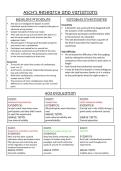
Asch’s Research and Variations
Baseline Procedure Variables Investigated
• Aim was to investigate the degree to which
Unanimity
individuals would conform to a majority who gave an
• A dissenter was used and they disagreed with
obviously wrong answer
• Sample included 123 American males the answers of the confederates
• Their task was to say out loud which line (A,B or C) • The genuine participant conformed less often
was the same length as the stimulus line (line in the presence of a dissenter
judgement task) • The rate decreased to less than a quarter of
• All participants in the group (6-8 people) except for the level it was when the majority was
one person was a confederate unanimous
• Participant was seated last or second last
• Participants conformed around 36.8% of the time, Task Difficulty
25% never conformed, 75% participants conformed • He increased the difficulty of the line-judging
to the incorrect majority at least once
task by making the stimulus line and the
comparison lines more similar to each other in
Group Size
• To test this he varied the number of confederates length
from 1 to 15 • Asch found that conformity increased
• Asch found a curvilinear relationship between group • It may be that the situation is more ambiguous
size and conformity rate when the task becomes harder so it is unclear
• With three confederates, conformity to the wrong to the participants what the right answer is
answer rose to 31.8%
• The presence of more confederates made little
difference so conformity increases up until a certain
point
AO3 Evaluation
POint: Point: Point:
Demand characteristics Sample bias Lacks temporal validity
Evidence: Evidence: Evidence:
In post event interviews some All participants were American Carried out in the 1950s during a
participants said they didn’t want men particularly conformist society
to spoil the experiment GRAVE term:
GRAVE term: Lacks external validity and GRAVE term:
Low internal validity generalisability Cannot generalise
POint: POint: POint:
Research to contradict unanimity Research to support group size Scientific
Evidence: Evidence:
Mori and Aria done a partial Bond and Smith conducted a meta Evidence:
replication where participants wore analysis of studies using Asch’s Asch had a standardised procedure
filter glasses and conformity was paradigm and found conformity which he used throughout all
similar regardless is the majority peaks at around 4-5 confederates experiments
answered unanimously or not
GRAVE term: GRAVE term: GRAVE term:
Discredits reliability accurate Credible basis + internal validity
, Types and Explanations of Conformity
Types of Conformity Explanations for
Conformity
Compliance
• Publicly agreeing with something but privately • Dual process model created by Deutsch and
still holding the same belief from before Gerard
• ‘Going along with other’ to fit in Normative social influence (NSI)
• Behaviour/ opinions stops when group pressure • The desire to be liked by other people and
stops (temporary change) avoid being left out and social rejection
• Leads to a temporary change in behaviour
Identification
• Publicly change behaviour/ opinions to be • suggests that conformity is public agreement
accepted by a group even if we don't privately with the group and not private agreement
agree with everything the group stands for (compliance)
• Identify with a valued person • change in attitude/behaviour is temporary
Informational social influence (ISI)
Internalisation • The desire to be right
• When a person genuinely accepts the opinion • Accept the majorities viewpoint
• Private and public opinion change • Likely to occur in ambiguous situations
• Behaviour/ opinions persists even in the absence
• Likely to happen when you believe others
of group members (permanent change)
have superior knowledge to you
• can result in public and private opinion
matching (internalisation)
• change in attitude/behaviour is more likely to
be permanent
AO3 Evaluation
POint: Point: POint: Point: often
Research support for Subject to individual Research support for unclear whether it is
NSI differences ISI ISI or NSI at work in
Evidence: real situations
Evidence: Evidence: Lucas et al found there
Asch found that when Some people care was greater Evidence:
participants were given more about being liked conformity when Asch found conformity
the opportunity to and we call these maths questions were reduced when a
privately write down people Affiliators and difficult and dissenter was present
answers conformity have greater need for participants relied on
dropped to 12.5% social relationships answers that were GRAVE term:
given Hard to separate as
GRAVE term: GRAVE term: GRAVE term: they both work
Clearly shows that Cannot generalise Increases strength as together
some conformity is due an explanation for
to the desire to be liked conformity
Baseline Procedure Variables Investigated
• Aim was to investigate the degree to which
Unanimity
individuals would conform to a majority who gave an
• A dissenter was used and they disagreed with
obviously wrong answer
• Sample included 123 American males the answers of the confederates
• Their task was to say out loud which line (A,B or C) • The genuine participant conformed less often
was the same length as the stimulus line (line in the presence of a dissenter
judgement task) • The rate decreased to less than a quarter of
• All participants in the group (6-8 people) except for the level it was when the majority was
one person was a confederate unanimous
• Participant was seated last or second last
• Participants conformed around 36.8% of the time, Task Difficulty
25% never conformed, 75% participants conformed • He increased the difficulty of the line-judging
to the incorrect majority at least once
task by making the stimulus line and the
comparison lines more similar to each other in
Group Size
• To test this he varied the number of confederates length
from 1 to 15 • Asch found that conformity increased
• Asch found a curvilinear relationship between group • It may be that the situation is more ambiguous
size and conformity rate when the task becomes harder so it is unclear
• With three confederates, conformity to the wrong to the participants what the right answer is
answer rose to 31.8%
• The presence of more confederates made little
difference so conformity increases up until a certain
point
AO3 Evaluation
POint: Point: Point:
Demand characteristics Sample bias Lacks temporal validity
Evidence: Evidence: Evidence:
In post event interviews some All participants were American Carried out in the 1950s during a
participants said they didn’t want men particularly conformist society
to spoil the experiment GRAVE term:
GRAVE term: Lacks external validity and GRAVE term:
Low internal validity generalisability Cannot generalise
POint: POint: POint:
Research to contradict unanimity Research to support group size Scientific
Evidence: Evidence:
Mori and Aria done a partial Bond and Smith conducted a meta Evidence:
replication where participants wore analysis of studies using Asch’s Asch had a standardised procedure
filter glasses and conformity was paradigm and found conformity which he used throughout all
similar regardless is the majority peaks at around 4-5 confederates experiments
answered unanimously or not
GRAVE term: GRAVE term: GRAVE term:
Discredits reliability accurate Credible basis + internal validity
, Types and Explanations of Conformity
Types of Conformity Explanations for
Conformity
Compliance
• Publicly agreeing with something but privately • Dual process model created by Deutsch and
still holding the same belief from before Gerard
• ‘Going along with other’ to fit in Normative social influence (NSI)
• Behaviour/ opinions stops when group pressure • The desire to be liked by other people and
stops (temporary change) avoid being left out and social rejection
• Leads to a temporary change in behaviour
Identification
• Publicly change behaviour/ opinions to be • suggests that conformity is public agreement
accepted by a group even if we don't privately with the group and not private agreement
agree with everything the group stands for (compliance)
• Identify with a valued person • change in attitude/behaviour is temporary
Informational social influence (ISI)
Internalisation • The desire to be right
• When a person genuinely accepts the opinion • Accept the majorities viewpoint
• Private and public opinion change • Likely to occur in ambiguous situations
• Behaviour/ opinions persists even in the absence
• Likely to happen when you believe others
of group members (permanent change)
have superior knowledge to you
• can result in public and private opinion
matching (internalisation)
• change in attitude/behaviour is more likely to
be permanent
AO3 Evaluation
POint: Point: POint: Point: often
Research support for Subject to individual Research support for unclear whether it is
NSI differences ISI ISI or NSI at work in
Evidence: real situations
Evidence: Evidence: Lucas et al found there
Asch found that when Some people care was greater Evidence:
participants were given more about being liked conformity when Asch found conformity
the opportunity to and we call these maths questions were reduced when a
privately write down people Affiliators and difficult and dissenter was present
answers conformity have greater need for participants relied on
dropped to 12.5% social relationships answers that were GRAVE term:
given Hard to separate as
GRAVE term: GRAVE term: GRAVE term: they both work
Clearly shows that Cannot generalise Increases strength as together
some conformity is due an explanation for
to the desire to be liked conformity


