

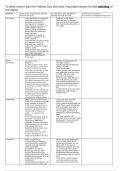
To what extent was the Federal Gov the most important reason for the settling of
the West?
RANKING It was super important for settling Its importance was LIMITED for Justification of position …
the west because … settling the west because … It is more/ less important than other
Fur Trade - They sold pelts to companies - Declined in the 1840s
like Astor's American Fur - Declined due to change in
Company or the Rocky fashion trends so temporary
Mountains Fur Company. BUT had transferable skills so
- Many became pioneers and LT benefit
guided wagon trains of
settlers due to knowledge
gained from fur trade and
mapping trails.
- Involvement of range of
European countries in fur
trade network
- Promoted the concept of west
as a valuable resource
- Fortunes were made by
Astor’s fur company in years
1808 to 1830
- Created close links between
white settlers and the NA with
inter racial marriages
- Stories inspired others to
move west
Land - $15 million in total - Without developments the
purchases - 828,000m^2 land was useless.
- The 1803 Louisiana Purchase more - Hostility developed between
than doubled the size of the USA for settlers and NA
less than 3 cents per acre, which - Land inhabitable
meant that it provided the USA with - States gained from purchases
vast fertile lands essential for only admitted into the Union
agriculture and settlement, opening in 1889 – 90 years later
up opportunities for people to move - Reduction of Gadsden
west. This purchase, orchestrated by Purchase from 250,00square
the Federal Government earlier than mile to 9,000 square miles
other purchases, resulted in the due to Norths opposition to a
foundations for westward expansion, means of expanding slavery
as proven by the 15 states included in - Shows lack of control from
gov
the purchase.
- Created issue of slavery which
- Additionally, the 1853 Gadsden Land
needed the 1820 Missouri
Purchase resulted in the acquisition
Compromise
of 30,000 square miles of land from
Mexico, which facilitated the
development of southern railways.
Exploration - 1803 Lewis and Clark chart - Lewis and Clark did little
lands from Louisiana Purchase exploring of the west
which resulted in maps of - Long’s reports argued that the
4,000 miles detailing Missouri Great Plains were inhabitable,
and Columbia Rivers, the Rocky and he brought back info in
Mountains, and the Atlantic Coast. the infertility of land which
- Created safety net for gov and discouraged movement of
settlers – can navigate terrain plantations seeking profitable
effectively. land.
- Commissioned same year as - The land explored not
purchase – proactive role admitted into Union until 1889
- 1819 Long – Nebraska, - Route wasn’t found through
Colorado, Rockies represents the Rockies until 1826
the willingness to move west
and explore new land
- Explorers first to travel west
so broke hesitation
- detailed maps, reports on natural
resources, and details on the
indigenous populations of the west
Transport - 1869 completion of - Mainly occurred mostly after
Transcontinental Railroad the Civil War 1865 which
which physically united the limited the influence on the
country, making migration latter half of the period.
more accessible - Heightened tensions with NA
- 139,000km of track of as cut through their lands,
Mississippi river by 1900 destroyed way of life which
- Ensured people and econ heightened tensions leading
activity could move with ease to discouragement of living in
- Allowed development of large- west.
scale cattle ranching - These conflicts created dangerous
operations and hostile conditions, deterring
- providing efficient transport for cattle some settlers from venturing west.
and crops to eastern markets, the
, railroad directly contributed to the
economic success of western settlers
and expanded the agricultural
industry
- railway companies launched
aggressive marketing campaigns,
using promotional literature that
depicted the West as a land of "milk
and honey," overflowing with
opportunities for prosperity. These
advertisements appealed to the
aspirations of settlers eager to escape
poverty or acquire land.
- Companies offered long term
loans and temporary
accommodation and
advertised west as land of
milk and honey.
- 1862 Pacific Railroad Act -
chartered the two companies to build
the railroads, resulting in the
completion of the railroad uniting the
country. Union pacific railroad
company and Central Pacific company
- Physically united country
- Developed agriculture
-
Communicatio - Development of steamboats - Steamboats impact limited Railroads come under
ns from 1807 onwards – reduced due to Railroads which were communications
costs and travel times faster
- the number operating on the - The establishment of mail late
Mississippi River increasing from 17 not until 1857 with Butterfield
in 1817 to 361 by 1836 Overland mail company
- establishment of mail: allowing them awarded contract.
to maintain contact with relatives and
conduct business over long distances.
This sense of connectivity encouraged
settlers to move west, assured that
they could remain in touch with the
rest of the country.
- Eerie canal completed in 1825
which meant that freight
charges dropped from 19
cents per tonne/mile to 2cents
- Cumberland Pike 1808 linked
the Atlantic shore with the
Ohio river which made
movement easier which also
expanded to Illinois in 1830
-
Farming John Deer’s steel plough 1837 - Cattle drives less profitable as
could cope with prairie soil. cattle lost weight, spread
McCormick mechanical reaper disease and created conflict
around 1831 allowed large area of with other farmers when
grain to be harvested efficiently. crossing other farms.
Deep drilled wells and windmills - Severe winters of 1885 and
1887 killed 90% cattle leading
to pump water from deep
to collapse of open range
underground allowed crops to be
system
watered and provided water for - Conflicts rose between sheep
cattle. farmers and cattle ranchers as
Development of dry farming argued that sheep polluted
solved the lack of water. water holes.
these developments along with
combine harvesters and threshing
machines allowed wheat and maize
farming to develop on a large
scale.
Development of barbed wire by
Joseph Glidden in 1874 and
electric fencing allowed large areas
to be fenced so that cattle farming
became an option.
Production rose from 1.2 billion
litres of wheat in 1865 to 7 billion
by 1900
resulted in the
population of Kansas,
Nebraska, Dakota, Iowa
and Minnesota rose from
less than 1 million in
1860 to over 7 million by
the West?
RANKING It was super important for settling Its importance was LIMITED for Justification of position …
the west because … settling the west because … It is more/ less important than other
Fur Trade - They sold pelts to companies - Declined in the 1840s
like Astor's American Fur - Declined due to change in
Company or the Rocky fashion trends so temporary
Mountains Fur Company. BUT had transferable skills so
- Many became pioneers and LT benefit
guided wagon trains of
settlers due to knowledge
gained from fur trade and
mapping trails.
- Involvement of range of
European countries in fur
trade network
- Promoted the concept of west
as a valuable resource
- Fortunes were made by
Astor’s fur company in years
1808 to 1830
- Created close links between
white settlers and the NA with
inter racial marriages
- Stories inspired others to
move west
Land - $15 million in total - Without developments the
purchases - 828,000m^2 land was useless.
- The 1803 Louisiana Purchase more - Hostility developed between
than doubled the size of the USA for settlers and NA
less than 3 cents per acre, which - Land inhabitable
meant that it provided the USA with - States gained from purchases
vast fertile lands essential for only admitted into the Union
agriculture and settlement, opening in 1889 – 90 years later
up opportunities for people to move - Reduction of Gadsden
west. This purchase, orchestrated by Purchase from 250,00square
the Federal Government earlier than mile to 9,000 square miles
other purchases, resulted in the due to Norths opposition to a
foundations for westward expansion, means of expanding slavery
as proven by the 15 states included in - Shows lack of control from
gov
the purchase.
- Created issue of slavery which
- Additionally, the 1853 Gadsden Land
needed the 1820 Missouri
Purchase resulted in the acquisition
Compromise
of 30,000 square miles of land from
Mexico, which facilitated the
development of southern railways.
Exploration - 1803 Lewis and Clark chart - Lewis and Clark did little
lands from Louisiana Purchase exploring of the west
which resulted in maps of - Long’s reports argued that the
4,000 miles detailing Missouri Great Plains were inhabitable,
and Columbia Rivers, the Rocky and he brought back info in
Mountains, and the Atlantic Coast. the infertility of land which
- Created safety net for gov and discouraged movement of
settlers – can navigate terrain plantations seeking profitable
effectively. land.
- Commissioned same year as - The land explored not
purchase – proactive role admitted into Union until 1889
- 1819 Long – Nebraska, - Route wasn’t found through
Colorado, Rockies represents the Rockies until 1826
the willingness to move west
and explore new land
- Explorers first to travel west
so broke hesitation
- detailed maps, reports on natural
resources, and details on the
indigenous populations of the west
Transport - 1869 completion of - Mainly occurred mostly after
Transcontinental Railroad the Civil War 1865 which
which physically united the limited the influence on the
country, making migration latter half of the period.
more accessible - Heightened tensions with NA
- 139,000km of track of as cut through their lands,
Mississippi river by 1900 destroyed way of life which
- Ensured people and econ heightened tensions leading
activity could move with ease to discouragement of living in
- Allowed development of large- west.
scale cattle ranching - These conflicts created dangerous
operations and hostile conditions, deterring
- providing efficient transport for cattle some settlers from venturing west.
and crops to eastern markets, the
, railroad directly contributed to the
economic success of western settlers
and expanded the agricultural
industry
- railway companies launched
aggressive marketing campaigns,
using promotional literature that
depicted the West as a land of "milk
and honey," overflowing with
opportunities for prosperity. These
advertisements appealed to the
aspirations of settlers eager to escape
poverty or acquire land.
- Companies offered long term
loans and temporary
accommodation and
advertised west as land of
milk and honey.
- 1862 Pacific Railroad Act -
chartered the two companies to build
the railroads, resulting in the
completion of the railroad uniting the
country. Union pacific railroad
company and Central Pacific company
- Physically united country
- Developed agriculture
-
Communicatio - Development of steamboats - Steamboats impact limited Railroads come under
ns from 1807 onwards – reduced due to Railroads which were communications
costs and travel times faster
- the number operating on the - The establishment of mail late
Mississippi River increasing from 17 not until 1857 with Butterfield
in 1817 to 361 by 1836 Overland mail company
- establishment of mail: allowing them awarded contract.
to maintain contact with relatives and
conduct business over long distances.
This sense of connectivity encouraged
settlers to move west, assured that
they could remain in touch with the
rest of the country.
- Eerie canal completed in 1825
which meant that freight
charges dropped from 19
cents per tonne/mile to 2cents
- Cumberland Pike 1808 linked
the Atlantic shore with the
Ohio river which made
movement easier which also
expanded to Illinois in 1830
-
Farming John Deer’s steel plough 1837 - Cattle drives less profitable as
could cope with prairie soil. cattle lost weight, spread
McCormick mechanical reaper disease and created conflict
around 1831 allowed large area of with other farmers when
grain to be harvested efficiently. crossing other farms.
Deep drilled wells and windmills - Severe winters of 1885 and
1887 killed 90% cattle leading
to pump water from deep
to collapse of open range
underground allowed crops to be
system
watered and provided water for - Conflicts rose between sheep
cattle. farmers and cattle ranchers as
Development of dry farming argued that sheep polluted
solved the lack of water. water holes.
these developments along with
combine harvesters and threshing
machines allowed wheat and maize
farming to develop on a large
scale.
Development of barbed wire by
Joseph Glidden in 1874 and
electric fencing allowed large areas
to be fenced so that cattle farming
became an option.
Production rose from 1.2 billion
litres of wheat in 1865 to 7 billion
by 1900
resulted in the
population of Kansas,
Nebraska, Dakota, Iowa
and Minnesota rose from
less than 1 million in
1860 to over 7 million by


