

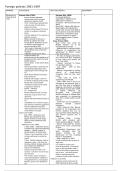
Foreign policies 1951-1997
RANKING SUCCESSFUL NOT SUCCESSFUL JUDGEMENT
Response to Korean War 1950: Korean War 1950:
international - Korea divided between - increased defence
crisis communist north and pro- expenditure added to the
American regime south. difficulties to Britain’s
- 1950 - North Korea launched full- economy - still recovered from
scale invasion of South Korea ← WW2
- Dec 1950 - Attlee (PM) flew to
almost succeeded
Washington and agreement
- USSR was boycotting UN over its
made with Truman that British
refusal to recognise communist gov would be consulted before
China Americans considered using
- UN had coalition of 16 countries to nuclear weapons in Korea. ←
fight the invasion what happens when Truman
- Britain joined US forces in leaves office?
Korea as Labour gov and Suez Crisis 1956:
Ernest Bevin believed crucial - Suez canal vital route for
to defeat communism to Middle Eastern oil to be
prevent another WW. transported to Europe
- first major challenge for UN of - - determined to remove British
which Britain was a founder influence so negotiated the
member withdrawal of British troops
- If Britain failed to join then from Suez Canal
might threaten US - - He was an Egypt nationalist,
commitment to the defence of not communist BUT prepared
Europe and the newly formed to buy arms and accept aid
NATO alliance. from the USSR
- end in draw - ends where they - - Nasser reluctant to follow
started pro-western policies
- shown that Britain would take part - - July 1956 - offer of loan
in defending independent states withdrawn
supporting UN and working with - - Nasser responded by taking
US control of Anglo-French
- North Korea defeated and South company that ran the Suez
Korea protected Canal
- Political and strategic control in - - USA tried to solve it
peacefully but FAILED
US hands so Britain junior partner
- - Eden (PM) saw it all as an
- British and commonwealth outrage as he believed that: it
contribution important but minor was the first step to establish
compared to American Egyptian domination of Middle
- Britain - 700 dead East, Nasser would allow USSR
- US - 34,000 dead to extend influence, US
- British influenced idea to invade accepted that continued
North but troops involved were British influence in Middle East
American. was essential to preventing
- Britain had demonstrated loyalty to area from falling under Soviet
US control.
- - more than 2/3 oil supplied to
- established UN as effective agency
western Europe passed
and checked communist aggression through it.
- NATO established permanent - - Eden believed that Nasser
military bureaucracy that tied USA needed to be challenged and
to the defence of Europe French disliked him cos he
Suez Crisis 1956: was assisting rebels fighting to
- Dec 1955 - American and end French colonial rule in
British gov agreed to lend Algeria
Egypt money to build large - - October 1956 - French,
dam to help modernise the British with collusion with
economy. Israel attacked Egypt - FAILED
Falkland’s crisis 1982: - - Nasser responded by sinking
ships in the canal - preventing
- 2 April 1982 - Argentine forces its use.
invaded and captured Falkland - - President Eisenhower (not
Islands ← British colony in been consulted bout the
South Atlantic to build navy. attack) insisted on the
- Thatcher’s gov dispatched a force withdrawal of the invading
of ships and troops to retake the forces = humiliation
islands. - - Eden resigned in 1957
- 2 May - British submarine sank an - USSR condemned the invasion as
Argentine cruiser - 360 lives lost imperialist
- 14 June, British troops entered - US wanted to see the crisis
the capital and Argentine resolved peacefully - Eisenhower
forces surrendered. angry as had repeatedly made it
- Thatcher reacted swiftly to the clear to Eden that he opposed the
invasion - task force set sail 3 days use of force. - felt deceived and
after invasion dislike colonialism that big
- UN security council at Britain’s countries invade smaller countries
request demanded the withdrawal
Falkland’s Crisis1982:
of Argentine forces, ensuring that
Britain’s actions were justified in - Argentine missile destroyed the
law. HMS Sheffield, British warship,
, - Thatcher’s personal political killed 20 crew members
fortunes transformed by the war - - Reinforced idea that Britain could
contributed to be landslide victory not go to war without active
in 1983 support of the USA
- Thatcher liked to boast that her - to defend islands from further
policies had restored Britain’s attack had to rebuild the airport
‘greatness’ which costed £1.5 million per
- many admired Britain’s resolution islander.
and skill - issue of sovereignty on islands
1991 Gulf War remains unresolved despite
- RAF planes played significant replacement of dictatorship to
role in bombing campaign and democratic gov in 1983
British troops were involved in - costly enterprise of little
the ground assault significance which left cost of
- showed that British armed maintaining the defence of the
forced would still play a islands.
significant role in supporting
US initiatives
1991 Gulf War
- believed that Thatcher stiffened the
resolve of President Bush by
telling him ‘this is no time to go
wobbly.’ but they differed - Bush
wanted to take time but Thatcher
wanted to act immediately
- Britain - 47 deaths
- Still problems: Saddam Hussein
still maintained control of Iraq, war
seen by many as British and
American imperialism despite
coalition with Arab states, PM
Major demonstrated that Britain
still had diplomatic influences, Iraq
continued to be issue for Britain
and USA and controversial action
taken to remove Saddam Hussein
Britain and - strong ties of language, - decline in Britain’s economic
USA relations culture, trade and relationship power meant that it offered limited
did seem close military assistance to the USA
- Churchill had claimed ‘a - USA had security concerns outside
special relationship between Europe in the Pacific and Latin
the British Commonwealth and
America and these were areas
Empire and the US.’
where Britain could offer only
- fought alongside each other in
WW2 limited assistance especially once it
- Co-operated to defeat USSR gave up its Far Eastern bases.
attempt to dominate Berlin 1950s
- relationship reinforced by - but Britain subordinate to US
membership of NATO after decision making
1949 and by co-operation over - Suez Crisis demonstrated that
nuclear weapons and secret Britain could no longer act
intelligence during Cold War
independently of US
1950s
- fought together in Korean War 1960s and 1970s
- Suez crisis did little damage to - decolonisation and Britain’s
the relationship because standing as a world power reduced
Macmillan exploited his - meant that importance of them to
wartime friendship with Americans reduced but peaceful
Eisenhower and made it clear relations
that the US alliance was - Harold Wilson tried to broker
central to Britain’s foreign peace in the Vietnam War in 1967
policy
but FAILED
- after crisis, American
- Wilson only irritated Johnson who
increased taking over Britain’s
role as guardian of Western was already disappointed that no
interests in Middle East British troops were fighting
1960s and 1970s alongside US in Vietnam
- President Kennedy regarded Reagan and Thatcher
Macmillan as a political father - Thatcher was dismayed by
figure and consulted him for Reagan’s willingness to bargain
advice on 1961 Berlin Crisis away the West’s nuclear deterrent
and 1962 Cuban missile crisis
- disliked Reagan’s strategic defence
but Britain no active role
initiative idea
- Heath believed that Britain’s future
- October 1983 - Americans invaded
lay with Europe and wanted Britain
Grenada (member of
to be part of a Europe wide
Commonwealth) to remove its
partnership with the USA.
communist gov. Thatcher outraged
- Warmer relations restored by
because she had advised Reagan
Callaghan and Jimmy Carter
against invasion.
Reagan and Thatcher:
1997:
- warm friendship and agreed about
- British politicians had little
most policy issues
influence over American decision
- 1982 Falklands war US logistical
making
RANKING SUCCESSFUL NOT SUCCESSFUL JUDGEMENT
Response to Korean War 1950: Korean War 1950:
international - Korea divided between - increased defence
crisis communist north and pro- expenditure added to the
American regime south. difficulties to Britain’s
- 1950 - North Korea launched full- economy - still recovered from
scale invasion of South Korea ← WW2
- Dec 1950 - Attlee (PM) flew to
almost succeeded
Washington and agreement
- USSR was boycotting UN over its
made with Truman that British
refusal to recognise communist gov would be consulted before
China Americans considered using
- UN had coalition of 16 countries to nuclear weapons in Korea. ←
fight the invasion what happens when Truman
- Britain joined US forces in leaves office?
Korea as Labour gov and Suez Crisis 1956:
Ernest Bevin believed crucial - Suez canal vital route for
to defeat communism to Middle Eastern oil to be
prevent another WW. transported to Europe
- first major challenge for UN of - - determined to remove British
which Britain was a founder influence so negotiated the
member withdrawal of British troops
- If Britain failed to join then from Suez Canal
might threaten US - - He was an Egypt nationalist,
commitment to the defence of not communist BUT prepared
Europe and the newly formed to buy arms and accept aid
NATO alliance. from the USSR
- end in draw - ends where they - - Nasser reluctant to follow
started pro-western policies
- shown that Britain would take part - - July 1956 - offer of loan
in defending independent states withdrawn
supporting UN and working with - - Nasser responded by taking
US control of Anglo-French
- North Korea defeated and South company that ran the Suez
Korea protected Canal
- Political and strategic control in - - USA tried to solve it
peacefully but FAILED
US hands so Britain junior partner
- - Eden (PM) saw it all as an
- British and commonwealth outrage as he believed that: it
contribution important but minor was the first step to establish
compared to American Egyptian domination of Middle
- Britain - 700 dead East, Nasser would allow USSR
- US - 34,000 dead to extend influence, US
- British influenced idea to invade accepted that continued
North but troops involved were British influence in Middle East
American. was essential to preventing
- Britain had demonstrated loyalty to area from falling under Soviet
US control.
- - more than 2/3 oil supplied to
- established UN as effective agency
western Europe passed
and checked communist aggression through it.
- NATO established permanent - - Eden believed that Nasser
military bureaucracy that tied USA needed to be challenged and
to the defence of Europe French disliked him cos he
Suez Crisis 1956: was assisting rebels fighting to
- Dec 1955 - American and end French colonial rule in
British gov agreed to lend Algeria
Egypt money to build large - - October 1956 - French,
dam to help modernise the British with collusion with
economy. Israel attacked Egypt - FAILED
Falkland’s crisis 1982: - - Nasser responded by sinking
ships in the canal - preventing
- 2 April 1982 - Argentine forces its use.
invaded and captured Falkland - - President Eisenhower (not
Islands ← British colony in been consulted bout the
South Atlantic to build navy. attack) insisted on the
- Thatcher’s gov dispatched a force withdrawal of the invading
of ships and troops to retake the forces = humiliation
islands. - - Eden resigned in 1957
- 2 May - British submarine sank an - USSR condemned the invasion as
Argentine cruiser - 360 lives lost imperialist
- 14 June, British troops entered - US wanted to see the crisis
the capital and Argentine resolved peacefully - Eisenhower
forces surrendered. angry as had repeatedly made it
- Thatcher reacted swiftly to the clear to Eden that he opposed the
invasion - task force set sail 3 days use of force. - felt deceived and
after invasion dislike colonialism that big
- UN security council at Britain’s countries invade smaller countries
request demanded the withdrawal
Falkland’s Crisis1982:
of Argentine forces, ensuring that
Britain’s actions were justified in - Argentine missile destroyed the
law. HMS Sheffield, British warship,
, - Thatcher’s personal political killed 20 crew members
fortunes transformed by the war - - Reinforced idea that Britain could
contributed to be landslide victory not go to war without active
in 1983 support of the USA
- Thatcher liked to boast that her - to defend islands from further
policies had restored Britain’s attack had to rebuild the airport
‘greatness’ which costed £1.5 million per
- many admired Britain’s resolution islander.
and skill - issue of sovereignty on islands
1991 Gulf War remains unresolved despite
- RAF planes played significant replacement of dictatorship to
role in bombing campaign and democratic gov in 1983
British troops were involved in - costly enterprise of little
the ground assault significance which left cost of
- showed that British armed maintaining the defence of the
forced would still play a islands.
significant role in supporting
US initiatives
1991 Gulf War
- believed that Thatcher stiffened the
resolve of President Bush by
telling him ‘this is no time to go
wobbly.’ but they differed - Bush
wanted to take time but Thatcher
wanted to act immediately
- Britain - 47 deaths
- Still problems: Saddam Hussein
still maintained control of Iraq, war
seen by many as British and
American imperialism despite
coalition with Arab states, PM
Major demonstrated that Britain
still had diplomatic influences, Iraq
continued to be issue for Britain
and USA and controversial action
taken to remove Saddam Hussein
Britain and - strong ties of language, - decline in Britain’s economic
USA relations culture, trade and relationship power meant that it offered limited
did seem close military assistance to the USA
- Churchill had claimed ‘a - USA had security concerns outside
special relationship between Europe in the Pacific and Latin
the British Commonwealth and
America and these were areas
Empire and the US.’
where Britain could offer only
- fought alongside each other in
WW2 limited assistance especially once it
- Co-operated to defeat USSR gave up its Far Eastern bases.
attempt to dominate Berlin 1950s
- relationship reinforced by - but Britain subordinate to US
membership of NATO after decision making
1949 and by co-operation over - Suez Crisis demonstrated that
nuclear weapons and secret Britain could no longer act
intelligence during Cold War
independently of US
1950s
- fought together in Korean War 1960s and 1970s
- Suez crisis did little damage to - decolonisation and Britain’s
the relationship because standing as a world power reduced
Macmillan exploited his - meant that importance of them to
wartime friendship with Americans reduced but peaceful
Eisenhower and made it clear relations
that the US alliance was - Harold Wilson tried to broker
central to Britain’s foreign peace in the Vietnam War in 1967
policy
but FAILED
- after crisis, American
- Wilson only irritated Johnson who
increased taking over Britain’s
role as guardian of Western was already disappointed that no
interests in Middle East British troops were fighting
1960s and 1970s alongside US in Vietnam
- President Kennedy regarded Reagan and Thatcher
Macmillan as a political father - Thatcher was dismayed by
figure and consulted him for Reagan’s willingness to bargain
advice on 1961 Berlin Crisis away the West’s nuclear deterrent
and 1962 Cuban missile crisis
- disliked Reagan’s strategic defence
but Britain no active role
initiative idea
- Heath believed that Britain’s future
- October 1983 - Americans invaded
lay with Europe and wanted Britain
Grenada (member of
to be part of a Europe wide
Commonwealth) to remove its
partnership with the USA.
communist gov. Thatcher outraged
- Warmer relations restored by
because she had advised Reagan
Callaghan and Jimmy Carter
against invasion.
Reagan and Thatcher:
1997:
- warm friendship and agreed about
- British politicians had little
most policy issues
influence over American decision
- 1982 Falklands war US logistical
making


