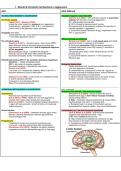
1 - Neural & hormonal mechanisms in aggression
AO1 AO3 CBD A2
NEURAL MECHANISMS IN AGGRESSION Research support - role of the OFC
- Coccaro et al (2007) - OFC activity is reduced in psychiatric
The limbic system patients with disorders involving aggression
- Papez (1937) + Maclean (1952) - EG - affectionless psychopathy
- Linked the limbic system to emotions (incl. aggression) - E: OFC is linked to impulse-control function
- Hypothalamus / amygdala / ORC (h & h - less relevant) - Disrupted activity & low serotonin explains the reduction in
- Limbic linked to the prefrontal cortex (planning) impulse regulation = aggression
- L: Causal link between serotonin & agg / impairment in the
Amygdala (the radar) OFC = agg disorders
- Threat detection (eg - more reactive to environmental threats
= more likely agg will be shown)
Effects of drugs on serotonin
The ultimatum game - Berman et al (2009) - ppts in a lab-based game and GAVE
- Gospic et al (2011) - ultimatum game / brain scans (fMRI) electrical shocks in response to provocation
taken with ppts during a lab-based game provoking agg - E: Ppts given paroxetine (SSRI increasing serotonin) =
- Agg reactions associated with a fast & heightened response increases self-control (more ORC activity) = reduction in
by the amygdala impulsive reactions
- Benzodiazepine (drug) = sedates the amygdala - Consistently gave fewer / lower intensity shocks VS the
- Reduces arousal of the ANS, taken before the game placebo group
- Decreased amygdala activity = decreased agg - L: Causal link between serotonin + OFC functioning +
REactive agg
Orbitofrontal contex (OFC) + the serotonin deficiency hypothesis
- Serotonin = inhibits amygdala activity
- OFC = self-control & impulse regulation Biological determinism
- Decreased serotonin = disturbs this mechanism - Implies individuals with neural abnormalities have no control
- Denson et al (2012) over their aggressive behaviour
- Low levels of s = reduces the inhibitory effect in the OFC = - E: Undermines the consequence of free will - agg as an
impulsive behaviour & loss of self-control inevitable outcome of biological factors, without influence of
personal responsibility or social factors
- Virkkunen et al (1994) - Lower levels of s metabolite 5-HIAA - L: Used to excuse violent-behaviour on the basis of brain
in violent impulsive offenders function - excuses, vexing legal issues in court.
- Compared to non-impulsive offenders
- Taken from cerebral spinal fluid
HORMONAL MECHANISMS IN AGGRESSION Ao3 - hormonal
Research with animals - inter-species support
Testosterone - Gimmanco et al (2005) - review confirms the role of
- Hormone that regulates social behaviour testosterone & agg in male rhesus macaque monkeys
- Daly & Wilson (1998) - Males 20+ are more aggressive - During mating season
towards other males when testosterone levels peak - E: Rats = castration reduces testosterone & mouse killing
- Dolan et al (2001) - Positive correlation between testosterone - Injecting female rats with T = increases both
+ agg in 60 male prisoners / all with a history of impulsively - L: Biological basis in a range of mammalian species,
violent behaviour generalisability & external validity - key role of testosterone
Animal studies Contradictory ev - the dual hormone hypothesis
- Giammanco et al (2005) - Castration reduces agg in many - Carré & Mehtá et al (2005) - dual-hormone hypothesis
species / injecting testosterone restores agg behaviour - Suggests high testosterone levels = agg
- Causal biological role - ONLY when cortisol levels are low
- E: High cortisol blocks testosterone’s influence on agg
Progesterone - Key hormone in the body’s chronic stress response
- Progesterone levels vary during the menstrual cycle - L: Testosterone ALONE lacks predictive validity = interactionist
- Low levels = agg (low during & just after menstruation) explanation is strong
- Ziomkiewicz et al (2012) - Negative correlation between
progesterone levels & self-reported agg (low p, high agg)
, 2 - Genetic factors in aggression
AO1 AO3 MMET
Twin studies Support for the role of the MAOA gene
- Coccaro et al (1997) - Mertins et al (2011) - money distribution game
- Studied adult male MZ + DZ twins - concordance rates - Male ppts with high-activity MAOA-H gene variant = more
- Direct physical agg = 50% MZ / 19% DZ co-operative & less aggressive
- Verbal agg = 28% MZ / 7% DZ - E: Supports Lea & C’s research that the MAOA-L = high agg
- Genetics = 50% of variance in agg behaviour - L: The converse mechanism may be valid - strengthens the
relationship between MAOA activity and aggression
Adoption studies - External validity
- Rhee + Walderman (2002) - meta-analysis of adoption
studies / genetic influences = 41% of variance in aggression Environmental factors may override genetic factors
- Mertins et al (2011) - same study = found ppts with the
MAOA-L gene MAOA-L variant ALSO behaved co-operatively when others
- Enzyme monoamine oxidase A regulates serotonin were ALSO being co-operative
- MAOA gene: controls production of the MAO-A enzyme - E: ⅓ of caucasian men have the variant, yet only a small % of
- MAOA-L: Low activity variant of the gene linked to agg (less s men are actually aggressive
broken down, so should mean more remains -> ao3 link) - L: Genes do NOT operate in a vacuum - strongly influenced
The warrior gene by environmental & social conditions
- Lea + Chambers (2007) - MAOA-L variant = 56% of New
Zealand Maori males / 34% of Caucasians The mechanism linking MAOA + serotonin is unclear
- Maori warriors = historically ferocious = nickname - If MAOA-L = agg = contradicts the neural mechanisms
- MAOA breaks down serotonin, so less enzyme production =
MAOA - Extreme violence in a Dutch family less serotonin is broken down = more serotonin remains = so
- Brunner et al (1993) - studied 28 male family members this contracts the neural mechanism
- Repeatedly involved in impulsively violent criminal behaviours - E: It is not deactivated = better viewed as disrupted activity,
- EG - rape / attempted murder / assault not as high or low (hyper / hypo)
- F: Abnormally low levels of enzyme MAO-A + the MAOA-L - Role of noradrenaline / dopamine / serotonin / developmental
variant = the ‘Brunner syndrome’ timing = complex interaction of neurotransmitter
- L: Relationship between s + MAOA is not fully understood
GxE - Gene-environment interactions
- Frazzetto et al (2007) - association between antisocial agg + Twin studies may lack validity
the MAOA-L gene in adult males - Twins raised together both share the same environment, but
- ONLY in those who had experienced significant trauma in the DZ may be treated more differently than MZ twins
first 15yrs of their life - E: The ‘equal environment hypothesis’ - suggests MZs are
- No trauma = not especially aggressive, even if they treated very similarly, DZ’s less so
possessed the MAOA-L gene variant - EG - MZs = both taken to boxing clubs / DZs = different clubs
- Diathesis - stress model (can use as ao3) (link to agg), one does boxing, another does swimming
- L: Concordance rates may be inflated, genetic influences on
agg may not be a significant as twin studies suggest -
questions internal validity
AO1 AO3 CBD A2
NEURAL MECHANISMS IN AGGRESSION Research support - role of the OFC
- Coccaro et al (2007) - OFC activity is reduced in psychiatric
The limbic system patients with disorders involving aggression
- Papez (1937) + Maclean (1952) - EG - affectionless psychopathy
- Linked the limbic system to emotions (incl. aggression) - E: OFC is linked to impulse-control function
- Hypothalamus / amygdala / ORC (h & h - less relevant) - Disrupted activity & low serotonin explains the reduction in
- Limbic linked to the prefrontal cortex (planning) impulse regulation = aggression
- L: Causal link between serotonin & agg / impairment in the
Amygdala (the radar) OFC = agg disorders
- Threat detection (eg - more reactive to environmental threats
= more likely agg will be shown)
Effects of drugs on serotonin
The ultimatum game - Berman et al (2009) - ppts in a lab-based game and GAVE
- Gospic et al (2011) - ultimatum game / brain scans (fMRI) electrical shocks in response to provocation
taken with ppts during a lab-based game provoking agg - E: Ppts given paroxetine (SSRI increasing serotonin) =
- Agg reactions associated with a fast & heightened response increases self-control (more ORC activity) = reduction in
by the amygdala impulsive reactions
- Benzodiazepine (drug) = sedates the amygdala - Consistently gave fewer / lower intensity shocks VS the
- Reduces arousal of the ANS, taken before the game placebo group
- Decreased amygdala activity = decreased agg - L: Causal link between serotonin + OFC functioning +
REactive agg
Orbitofrontal contex (OFC) + the serotonin deficiency hypothesis
- Serotonin = inhibits amygdala activity
- OFC = self-control & impulse regulation Biological determinism
- Decreased serotonin = disturbs this mechanism - Implies individuals with neural abnormalities have no control
- Denson et al (2012) over their aggressive behaviour
- Low levels of s = reduces the inhibitory effect in the OFC = - E: Undermines the consequence of free will - agg as an
impulsive behaviour & loss of self-control inevitable outcome of biological factors, without influence of
personal responsibility or social factors
- Virkkunen et al (1994) - Lower levels of s metabolite 5-HIAA - L: Used to excuse violent-behaviour on the basis of brain
in violent impulsive offenders function - excuses, vexing legal issues in court.
- Compared to non-impulsive offenders
- Taken from cerebral spinal fluid
HORMONAL MECHANISMS IN AGGRESSION Ao3 - hormonal
Research with animals - inter-species support
Testosterone - Gimmanco et al (2005) - review confirms the role of
- Hormone that regulates social behaviour testosterone & agg in male rhesus macaque monkeys
- Daly & Wilson (1998) - Males 20+ are more aggressive - During mating season
towards other males when testosterone levels peak - E: Rats = castration reduces testosterone & mouse killing
- Dolan et al (2001) - Positive correlation between testosterone - Injecting female rats with T = increases both
+ agg in 60 male prisoners / all with a history of impulsively - L: Biological basis in a range of mammalian species,
violent behaviour generalisability & external validity - key role of testosterone
Animal studies Contradictory ev - the dual hormone hypothesis
- Giammanco et al (2005) - Castration reduces agg in many - Carré & Mehtá et al (2005) - dual-hormone hypothesis
species / injecting testosterone restores agg behaviour - Suggests high testosterone levels = agg
- Causal biological role - ONLY when cortisol levels are low
- E: High cortisol blocks testosterone’s influence on agg
Progesterone - Key hormone in the body’s chronic stress response
- Progesterone levels vary during the menstrual cycle - L: Testosterone ALONE lacks predictive validity = interactionist
- Low levels = agg (low during & just after menstruation) explanation is strong
- Ziomkiewicz et al (2012) - Negative correlation between
progesterone levels & self-reported agg (low p, high agg)
, 2 - Genetic factors in aggression
AO1 AO3 MMET
Twin studies Support for the role of the MAOA gene
- Coccaro et al (1997) - Mertins et al (2011) - money distribution game
- Studied adult male MZ + DZ twins - concordance rates - Male ppts with high-activity MAOA-H gene variant = more
- Direct physical agg = 50% MZ / 19% DZ co-operative & less aggressive
- Verbal agg = 28% MZ / 7% DZ - E: Supports Lea & C’s research that the MAOA-L = high agg
- Genetics = 50% of variance in agg behaviour - L: The converse mechanism may be valid - strengthens the
relationship between MAOA activity and aggression
Adoption studies - External validity
- Rhee + Walderman (2002) - meta-analysis of adoption
studies / genetic influences = 41% of variance in aggression Environmental factors may override genetic factors
- Mertins et al (2011) - same study = found ppts with the
MAOA-L gene MAOA-L variant ALSO behaved co-operatively when others
- Enzyme monoamine oxidase A regulates serotonin were ALSO being co-operative
- MAOA gene: controls production of the MAO-A enzyme - E: ⅓ of caucasian men have the variant, yet only a small % of
- MAOA-L: Low activity variant of the gene linked to agg (less s men are actually aggressive
broken down, so should mean more remains -> ao3 link) - L: Genes do NOT operate in a vacuum - strongly influenced
The warrior gene by environmental & social conditions
- Lea + Chambers (2007) - MAOA-L variant = 56% of New
Zealand Maori males / 34% of Caucasians The mechanism linking MAOA + serotonin is unclear
- Maori warriors = historically ferocious = nickname - If MAOA-L = agg = contradicts the neural mechanisms
- MAOA breaks down serotonin, so less enzyme production =
MAOA - Extreme violence in a Dutch family less serotonin is broken down = more serotonin remains = so
- Brunner et al (1993) - studied 28 male family members this contracts the neural mechanism
- Repeatedly involved in impulsively violent criminal behaviours - E: It is not deactivated = better viewed as disrupted activity,
- EG - rape / attempted murder / assault not as high or low (hyper / hypo)
- F: Abnormally low levels of enzyme MAO-A + the MAOA-L - Role of noradrenaline / dopamine / serotonin / developmental
variant = the ‘Brunner syndrome’ timing = complex interaction of neurotransmitter
- L: Relationship between s + MAOA is not fully understood
GxE - Gene-environment interactions
- Frazzetto et al (2007) - association between antisocial agg + Twin studies may lack validity
the MAOA-L gene in adult males - Twins raised together both share the same environment, but
- ONLY in those who had experienced significant trauma in the DZ may be treated more differently than MZ twins
first 15yrs of their life - E: The ‘equal environment hypothesis’ - suggests MZs are
- No trauma = not especially aggressive, even if they treated very similarly, DZ’s less so
possessed the MAOA-L gene variant - EG - MZs = both taken to boxing clubs / DZs = different clubs
- Diathesis - stress model (can use as ao3) (link to agg), one does boxing, another does swimming
- L: Concordance rates may be inflated, genetic influences on
agg may not be a significant as twin studies suggest -
questions internal validity