Q1.
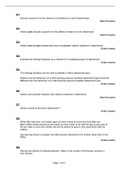
Discuss research into the influence of childhood on adult relationships.
(Total 16 marks)
Q2.
Outline and evaluate research into the effects of failure to form attachment.
(Total 16 marks)
Q3.
Outline one or more studies that have investigated cultural variations in attachment.
(Total 6 marks)
Q4.
Evaluate the Strange Situation as a method for investigating types of attachment.
(Total 4 marks)
Q5.
The Strange Situation can be used to identify a child’s attachment type.
Explain how the behaviour of a child showing insecure-avoidant attachment type would be
different from the behaviour of a child showing insecure-resistant attachment type.
(Total 4 marks)
Q6.
Outline and evaluate research into cultural variations in attachment.
(Total 16 marks)
Q7.
What is meant by the term 'attachment'?
(Total 2 marks)
Q8.
When Max was born, his mother gave up work to stay at home and look after him.
Max’s father works long hours and does not have much to do with the day-to-day care of
his son. Max is now nine months old and he seems to have a very close bond with his
mother.
Use learning theory to explain how Max became attached to his mother rather than to his
father.
(Total 6 marks)
Q9.
Discuss the effects of institutionalisation. Refer to the studies of Romanian orphans in
your answer.
Page 1 of 41
, (Total 16 marks)
Q10.
Briefly evaluate Bowlby’s monotropic theory. In your answer, refer to multiple attachments
and the role of the father.
(Total 6 marks)
Q11.
Two researchers wanted to investigate the influence of early
attachment on later relationships. They asked 20 teenagers aged
14-16 to write an essay on the importance of family and friends. Ten
of the teenagers had been raised by their mother and father. The
other ten had spent the first five years of their lives in care (and
were then adopted).
The researchers used content analysis to analyse the teenagers’
essays. The researchers devised a set of categories to do this, two
of which were ‘references to love’ and ‘references to fear of
rejection’.
(a) Explain one way in which the researchers may have checked whether their
categories were reliable.
(3)
The results of the investigation for references to love and references to fear of rejection
are shown in the table below:
The total number of references to love and references to fear of rejection
in essays written by the care group and the non-care group
Total number of
Total number of
references to fear of
references to love
rejection
Non-care group 40 5
Care group 16 15
(b) Draw a suitable graphical display to represent the data in the table.
Page 2 of 41
, (3)
(c) Express the total number of references to love in the essays written by the care
group as a fraction of the total number of references to love in the essays overall.
Show your calculations.
(3)
(d) The researchers decided to interview some of the teenagers about their early life
experiences.
Explain how the data collected from the interview might have improved upon the
data collected from the content analysis.
(3)
(e) Explain Bowlby’s monotropic theory. Refer to the data from the table in part (a) in
your answer.
(6)
(Total 18 marks)
Q12.
Briefly discuss how researchers might address difficulties encountered when trying to
investigate caregiver-infant interaction.
(Total 4 marks)
Page 3 of 41
, Q13.
Match each of the research findings 1, 2, 3 and 4 with one of the researchers A, B, C, D or
E. Write A, B, C, D or E in the box next to the appropriate research finding. Use each letter
once only.
A John Bowlby
B Mary Ainsworth
C Harry Harlow
D Karl Lorenz
E Rudolf Schaffer
1 Infants form multiple, rather than monotropic, attachments.
2 Infants form monotropic, rather than multiple, attachments.
3 Contact comfort is essential to an infant’s psychological health.
4 Through imprinting, newborns attach to the first moving object that they see
(Total 4 marks)
Q14.
Discuss research into the influence of early attachment on adult relationships.
(Total 8 marks)
Q15.
Briefly evaluate learning theory as an explanation of attachment.
(Total 4 marks)
Q16.
Describe and evaluate Ainsworth’s work on attachment. As part of your evaluation, you
should refer to the work of at least one other researcher.
(Total 16 marks)
Q17.
Outline and evaluate Bowlby’s explanation of attachment.
(Total 8 marks)
Q18.
Page 4 of 41
Discuss research into the influence of childhood on adult relationships.
(Total 16 marks)
Q2.
Outline and evaluate research into the effects of failure to form attachment.
(Total 16 marks)
Q3.
Outline one or more studies that have investigated cultural variations in attachment.
(Total 6 marks)
Q4.
Evaluate the Strange Situation as a method for investigating types of attachment.
(Total 4 marks)
Q5.
The Strange Situation can be used to identify a child’s attachment type.
Explain how the behaviour of a child showing insecure-avoidant attachment type would be
different from the behaviour of a child showing insecure-resistant attachment type.
(Total 4 marks)
Q6.
Outline and evaluate research into cultural variations in attachment.
(Total 16 marks)
Q7.
What is meant by the term 'attachment'?
(Total 2 marks)
Q8.
When Max was born, his mother gave up work to stay at home and look after him.
Max’s father works long hours and does not have much to do with the day-to-day care of
his son. Max is now nine months old and he seems to have a very close bond with his
mother.
Use learning theory to explain how Max became attached to his mother rather than to his
father.
(Total 6 marks)
Q9.
Discuss the effects of institutionalisation. Refer to the studies of Romanian orphans in
your answer.
Page 1 of 41
, (Total 16 marks)
Q10.
Briefly evaluate Bowlby’s monotropic theory. In your answer, refer to multiple attachments
and the role of the father.
(Total 6 marks)
Q11.
Two researchers wanted to investigate the influence of early
attachment on later relationships. They asked 20 teenagers aged
14-16 to write an essay on the importance of family and friends. Ten
of the teenagers had been raised by their mother and father. The
other ten had spent the first five years of their lives in care (and
were then adopted).
The researchers used content analysis to analyse the teenagers’
essays. The researchers devised a set of categories to do this, two
of which were ‘references to love’ and ‘references to fear of
rejection’.
(a) Explain one way in which the researchers may have checked whether their
categories were reliable.
(3)
The results of the investigation for references to love and references to fear of rejection
are shown in the table below:
The total number of references to love and references to fear of rejection
in essays written by the care group and the non-care group
Total number of
Total number of
references to fear of
references to love
rejection
Non-care group 40 5
Care group 16 15
(b) Draw a suitable graphical display to represent the data in the table.
Page 2 of 41
, (3)
(c) Express the total number of references to love in the essays written by the care
group as a fraction of the total number of references to love in the essays overall.
Show your calculations.
(3)
(d) The researchers decided to interview some of the teenagers about their early life
experiences.
Explain how the data collected from the interview might have improved upon the
data collected from the content analysis.
(3)
(e) Explain Bowlby’s monotropic theory. Refer to the data from the table in part (a) in
your answer.
(6)
(Total 18 marks)
Q12.
Briefly discuss how researchers might address difficulties encountered when trying to
investigate caregiver-infant interaction.
(Total 4 marks)
Page 3 of 41
, Q13.
Match each of the research findings 1, 2, 3 and 4 with one of the researchers A, B, C, D or
E. Write A, B, C, D or E in the box next to the appropriate research finding. Use each letter
once only.
A John Bowlby
B Mary Ainsworth
C Harry Harlow
D Karl Lorenz
E Rudolf Schaffer
1 Infants form multiple, rather than monotropic, attachments.
2 Infants form monotropic, rather than multiple, attachments.
3 Contact comfort is essential to an infant’s psychological health.
4 Through imprinting, newborns attach to the first moving object that they see
(Total 4 marks)
Q14.
Discuss research into the influence of early attachment on adult relationships.
(Total 8 marks)
Q15.
Briefly evaluate learning theory as an explanation of attachment.
(Total 4 marks)
Q16.
Describe and evaluate Ainsworth’s work on attachment. As part of your evaluation, you
should refer to the work of at least one other researcher.
(Total 16 marks)
Q17.
Outline and evaluate Bowlby’s explanation of attachment.
(Total 8 marks)
Q18.
Page 4 of 41