

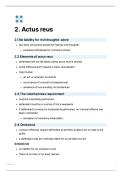
2. Actus reus
2.1 No liability for ‘evil thoughts’ alone
law does not punish people for having ‘evil thoughts’
punishes individuals for criminal conduct
2.2 Elements of actus reus
defendant will not be liable unless actus reus is proved
some offences don’t require a mens rea element
may involve
an act or omission (conduct)
occurrence of a result (consequences)
existence of surrounding circumstances
2.3 The voluntariness requirement
must be voluntarily performed
defendant must be in control of his movements
if defendant’s conduct is involuntarily performed, no criminal offence has
been committed
exception of voluntary intoxication
2.4 Omissions
conduct offences require defendant to perform positive act in order to be
guilty
a defendant may be criminally liable for an omission to act
General rule
no liability for an omission to act
‘there is no duty of an easy rescue’
2. Actus reus 1
, conventional view
A should not be compelled to serve B
A should not be encouraged to interfere with B’s life
law values individual autonomy and liberty
positive criminal act with bad consequences is morally more
blameworthy than omitting to act and causing the same consequences
would increase possibility of mass liability
social responsibility view
A should be under duty to help stranger B
society recognises a duty of mutual support
all of society would benefit from duty to rescue
liability should be limited to those who had a greater opportunity to save
B
liability should be limited to cases where the danger to B outweighs
inconvenience to A
Exceptions
five instances where the law imposes a duty to act
special relationship
parent and child, patient-doctor, etc.
the closer the relationship, the more likely that the law would
impose a duty to act
Downes (1875)
didn't get medical assistance - believed that prayer would heal
their child
statutory duty
Sheppard [1981]
voluntary assumption of responsibility
defendant undertakes care for another
Nicholls (1874)
2. Actus reus 2
2.1 No liability for ‘evil thoughts’ alone
law does not punish people for having ‘evil thoughts’
punishes individuals for criminal conduct
2.2 Elements of actus reus
defendant will not be liable unless actus reus is proved
some offences don’t require a mens rea element
may involve
an act or omission (conduct)
occurrence of a result (consequences)
existence of surrounding circumstances
2.3 The voluntariness requirement
must be voluntarily performed
defendant must be in control of his movements
if defendant’s conduct is involuntarily performed, no criminal offence has
been committed
exception of voluntary intoxication
2.4 Omissions
conduct offences require defendant to perform positive act in order to be
guilty
a defendant may be criminally liable for an omission to act
General rule
no liability for an omission to act
‘there is no duty of an easy rescue’
2. Actus reus 1
, conventional view
A should not be compelled to serve B
A should not be encouraged to interfere with B’s life
law values individual autonomy and liberty
positive criminal act with bad consequences is morally more
blameworthy than omitting to act and causing the same consequences
would increase possibility of mass liability
social responsibility view
A should be under duty to help stranger B
society recognises a duty of mutual support
all of society would benefit from duty to rescue
liability should be limited to those who had a greater opportunity to save
B
liability should be limited to cases where the danger to B outweighs
inconvenience to A
Exceptions
five instances where the law imposes a duty to act
special relationship
parent and child, patient-doctor, etc.
the closer the relationship, the more likely that the law would
impose a duty to act
Downes (1875)
didn't get medical assistance - believed that prayer would heal
their child
statutory duty
Sheppard [1981]
voluntary assumption of responsibility
defendant undertakes care for another
Nicholls (1874)
2. Actus reus 2


