Look through the slides (required readings) in the textbook
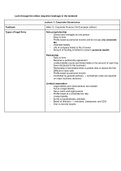
Lecture 1: Corporate Governance
Textbook Hiller, D, Corporate Finance (3rd European edition)
Types of legal firms Sole proprietorship
- Owned and managed by one person
- Easy to form
- Profits taxed as personal income and do not pay any corporate
tax
- Unlimited liability
- Life of company linked to life of owner
- Amount of funding is limited to owner’s personal wealth
Partnership
- Easy to form
- Requires a partnership agreement
- Limited liability (some are limited liable to the amount of cash they
have introduced to the business)
- Partnership is terminated when a partner dies or leaves the firm
- Difficult to raise cash
- Profits taxed as personal income
- Controlled by general partners → sometimes votes are required
on major business decisions
Limited corporation
- Legal articles and memorandum are needed
- Act as a legal identity
- Has a name and legal powers
- Profits taxed at a corporate tax rate
- Limited liability
- Its life is hypothetically unlimited
- Board of directors → members, chairperson and CEO
- One vs two-tier boards
, One-tier board structure
- Directors and non-executive directors appoint the chairman
- Non-executive directors appoint the actions managed by
executive directors
Two-tier board structure
- Supervisory board appoints executive directors who then appoints
the chief executive
Corporate governance - Defined as the system of internal controls and procedures by
which companies are managed
- It provides a framework that defines the rights, roles and
responsibilities of various groups within an organization
Agency Problems - We have corporate governance to mitigate interests between the
stakeholders (agency problems)
E.g. Managers and CEOs
- Characterized by competing interests between these two groups
- Indirect agency cost
- Lost opportunity
- Direct agency cost:
1. Capital expenditures benefiting the CEO but costing the
shareholders (managers) and their job
What can be done to minimize this type of agency problem?
- Leverage the executive pay (how managers are paid)
2. Monitoring management actions
Majority - minority shareholder relationship
- In concentrated ownership firms, majority shareholders can use
their voting powers to elect directors to the board who will take
actions benefiting the elector shareholders and not the
shareholders in minority
, Shareholder - debtholder relationship
- Arises when CEO favours one type of principles over the other
(favours shareholders over debt holders)
How to minimize this agency cost?
- The 2004 OECD Principles of Corporate Governance
- Ensuring the basis for an effective Corporate Governance
framework
- The rights of shareholders and key ownership functions
- The equitable treatment of shareholders
- The role of stakeholders in Corporate Governance
- Disclosure and Transparency
- The Responsibility of the Board
- Board’s accountability to the company and
shareholders
- Transparency International’s Corruption Perceptions Index (where
corruption in the public sector is most prominent)
Lecture 2: Risk Technique Analysis (Ch 8)
Risk Analysis NPV
- Superior capital budgeting technique
- Entails discounting, future cash flow and getting the present value
of the cash flow, while subtracting the initial investment
- Projects should be taken if NPV > 0
NPV has be adjusted according to:
- Possible changes in events
- Opportunity
- Unexpected events
Risk Analysis Technique: - Provides financial managers the best, worst and expected
, Sensitivity Analysis scenarios according to underlying assumptions
- It shows how each particular variable will be in pessimistic,
expected and optimistic scenarios
- Then it focuses on one variable for one specific scenario,
keeping all other variables constant with the expected
scenario → calculates the NPV based on this case
- Finally, it applies this logic to all other variables individually
and provides a matrix of NPVs under different cases
Net profit (£654) + depreciation (£300) = cash flow
Lecture 1: Corporate Governance
Textbook Hiller, D, Corporate Finance (3rd European edition)
Types of legal firms Sole proprietorship
- Owned and managed by one person
- Easy to form
- Profits taxed as personal income and do not pay any corporate
tax
- Unlimited liability
- Life of company linked to life of owner
- Amount of funding is limited to owner’s personal wealth
Partnership
- Easy to form
- Requires a partnership agreement
- Limited liability (some are limited liable to the amount of cash they
have introduced to the business)
- Partnership is terminated when a partner dies or leaves the firm
- Difficult to raise cash
- Profits taxed as personal income
- Controlled by general partners → sometimes votes are required
on major business decisions
Limited corporation
- Legal articles and memorandum are needed
- Act as a legal identity
- Has a name and legal powers
- Profits taxed at a corporate tax rate
- Limited liability
- Its life is hypothetically unlimited
- Board of directors → members, chairperson and CEO
- One vs two-tier boards
, One-tier board structure
- Directors and non-executive directors appoint the chairman
- Non-executive directors appoint the actions managed by
executive directors
Two-tier board structure
- Supervisory board appoints executive directors who then appoints
the chief executive
Corporate governance - Defined as the system of internal controls and procedures by
which companies are managed
- It provides a framework that defines the rights, roles and
responsibilities of various groups within an organization
Agency Problems - We have corporate governance to mitigate interests between the
stakeholders (agency problems)
E.g. Managers and CEOs
- Characterized by competing interests between these two groups
- Indirect agency cost
- Lost opportunity
- Direct agency cost:
1. Capital expenditures benefiting the CEO but costing the
shareholders (managers) and their job
What can be done to minimize this type of agency problem?
- Leverage the executive pay (how managers are paid)
2. Monitoring management actions
Majority - minority shareholder relationship
- In concentrated ownership firms, majority shareholders can use
their voting powers to elect directors to the board who will take
actions benefiting the elector shareholders and not the
shareholders in minority
, Shareholder - debtholder relationship
- Arises when CEO favours one type of principles over the other
(favours shareholders over debt holders)
How to minimize this agency cost?
- The 2004 OECD Principles of Corporate Governance
- Ensuring the basis for an effective Corporate Governance
framework
- The rights of shareholders and key ownership functions
- The equitable treatment of shareholders
- The role of stakeholders in Corporate Governance
- Disclosure and Transparency
- The Responsibility of the Board
- Board’s accountability to the company and
shareholders
- Transparency International’s Corruption Perceptions Index (where
corruption in the public sector is most prominent)
Lecture 2: Risk Technique Analysis (Ch 8)
Risk Analysis NPV
- Superior capital budgeting technique
- Entails discounting, future cash flow and getting the present value
of the cash flow, while subtracting the initial investment
- Projects should be taken if NPV > 0
NPV has be adjusted according to:
- Possible changes in events
- Opportunity
- Unexpected events
Risk Analysis Technique: - Provides financial managers the best, worst and expected
, Sensitivity Analysis scenarios according to underlying assumptions
- It shows how each particular variable will be in pessimistic,
expected and optimistic scenarios
- Then it focuses on one variable for one specific scenario,
keeping all other variables constant with the expected
scenario → calculates the NPV based on this case
- Finally, it applies this logic to all other variables individually
and provides a matrix of NPVs under different cases
Net profit (£654) + depreciation (£300) = cash flow