

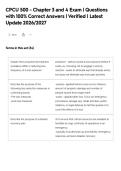
CPCU 500 - Chapter 3 and 4 Exam | Questions
with 100% Correct Answers | Verified | Latest
Update 2026/2027
Save
Terms in this set (34)
Explain How proactive and reactive proactive - seeks to avoid a loss exposure before it
avoidance differ in reducing loss exists, ex. choosing not to engage in activity
frequency of a loss exposure reactive - seeks to eliminate exp that already exists,
but does not eliminate exp from past activities
Describe the purpose of the -preloss- applied before a loss occurs. Reduce
following loss reduction measures in amount of property damage and number of
controlling losses: people injured from single event
-Pre-loss measures -posts - applied after loss. Focus on emergency
-post-loss measures procedures, salvage ops, rehab activities, public
relations, or legal defense to halt the spread or to
count the effects of a loss
Describe the purpose of a disaster its to ensure that critical resources are available to
recovery plan facilitate an orgs continuity of operations in an
emergency.
-typically includes back up procedures, emergency
response, and post-disaster recovery
, Identify circumstances in which each -sep- appropriate if the org can operate with only
of the following techniques would a portion of the separated assets or locations left
be an effective choice for loss intact
reduction: -dup - approp. if antire asset or activity is so
-separation important that the consequence of its loss justifies
-duplication the expense and time to duplicate it
-diversification -divers- more commonly applied to business risks
than to hazard risks. Org engage in divers by
providing a variety of products and services that
are used by a range of customers
Describe the advantage of using -helps achieve the org's value-maximization goal
cash flow analysis for the selection by providing a basis of comparison for all value-
of risk control measures max decisions
-increases efficiency by reducing unnecessary
expenditures on risk control
Describe the disadvantage of using -weakness of the assumptions that often must be
cash flow analysis for the selection made to conduct the analysis
of risk control measures -difficulty of accurately estimating future CF
-lack of consideration of nonfinancial goals or
selection criteria
List the types of state or federal -fire safety codes,
statutes an organization may need to -environmental regulations
consider when selecting risk control -workers comp laws
measures in order to comply with -disability laws
legal requirements
Identify possible consequences an fines, sanctions, or liability for failure to comply
organization can face for failure to with legal requirements
comply with legal requirements
with 100% Correct Answers | Verified | Latest
Update 2026/2027
Save
Terms in this set (34)
Explain How proactive and reactive proactive - seeks to avoid a loss exposure before it
avoidance differ in reducing loss exists, ex. choosing not to engage in activity
frequency of a loss exposure reactive - seeks to eliminate exp that already exists,
but does not eliminate exp from past activities
Describe the purpose of the -preloss- applied before a loss occurs. Reduce
following loss reduction measures in amount of property damage and number of
controlling losses: people injured from single event
-Pre-loss measures -posts - applied after loss. Focus on emergency
-post-loss measures procedures, salvage ops, rehab activities, public
relations, or legal defense to halt the spread or to
count the effects of a loss
Describe the purpose of a disaster its to ensure that critical resources are available to
recovery plan facilitate an orgs continuity of operations in an
emergency.
-typically includes back up procedures, emergency
response, and post-disaster recovery
, Identify circumstances in which each -sep- appropriate if the org can operate with only
of the following techniques would a portion of the separated assets or locations left
be an effective choice for loss intact
reduction: -dup - approp. if antire asset or activity is so
-separation important that the consequence of its loss justifies
-duplication the expense and time to duplicate it
-diversification -divers- more commonly applied to business risks
than to hazard risks. Org engage in divers by
providing a variety of products and services that
are used by a range of customers
Describe the advantage of using -helps achieve the org's value-maximization goal
cash flow analysis for the selection by providing a basis of comparison for all value-
of risk control measures max decisions
-increases efficiency by reducing unnecessary
expenditures on risk control
Describe the disadvantage of using -weakness of the assumptions that often must be
cash flow analysis for the selection made to conduct the analysis
of risk control measures -difficulty of accurately estimating future CF
-lack of consideration of nonfinancial goals or
selection criteria
List the types of state or federal -fire safety codes,
statutes an organization may need to -environmental regulations
consider when selecting risk control -workers comp laws
measures in order to comply with -disability laws
legal requirements
Identify possible consequences an fines, sanctions, or liability for failure to comply
organization can face for failure to with legal requirements
comply with legal requirements


