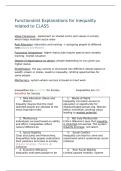
Functionalist Explanations for Inequality
related to CLASS
Value Consensus- agreement on shared norms and values in society
which helps maintain social order
Role Allocation- education and training -> assigning people to different
roles (Davis and Moore)
Functional Uniqueness- higher status jobs require special and complex
training- market situation
Degree of dependance on others- people depending on you gives you
higher status
Stratification- the way society is structured into different classes based on
wealth, power or status- leads to inequality, limiting opportunities for
some people
Meritocracy- system where success is based on hard work
Inequalities are Benefitial for Society Inequalities are not
Benefitial for Society
1. Role Allocation (Davis and 1. Waste of Talent
Moore) Inequality can block access to
Inquality insures that the most education or opportunity for
talented people are allocatd to the disadvantaged groups (eg. Women,
most important roles ethnic minorities, working class)
leading to wasted potential
2. Meritocracy 2. Not truly Meritocratic
Individuals succeed based on ability Critics (Marxism) says that inquality
and effort. Inequalities reflect is inherited,not earned. The system
natural differences rewards privilege, not talent.
3. Social Stability 3. Social Conflict
Clear structures and Hierarchies, Inequality can lead to crime and
Inequalities help people understand resentment which undermines social
their positions and roles in society. cohesion
Organic Analogy – Parsons ->
Cohesion
4. Economic Efficiency 4. Poor Social Mobility
Inequality motivates people to be Limited upward mobility- system
related to CLASS
Value Consensus- agreement on shared norms and values in society
which helps maintain social order
Role Allocation- education and training -> assigning people to different
roles (Davis and Moore)
Functional Uniqueness- higher status jobs require special and complex
training- market situation
Degree of dependance on others- people depending on you gives you
higher status
Stratification- the way society is structured into different classes based on
wealth, power or status- leads to inequality, limiting opportunities for
some people
Meritocracy- system where success is based on hard work
Inequalities are Benefitial for Society Inequalities are not
Benefitial for Society
1. Role Allocation (Davis and 1. Waste of Talent
Moore) Inequality can block access to
Inquality insures that the most education or opportunity for
talented people are allocatd to the disadvantaged groups (eg. Women,
most important roles ethnic minorities, working class)
leading to wasted potential
2. Meritocracy 2. Not truly Meritocratic
Individuals succeed based on ability Critics (Marxism) says that inquality
and effort. Inequalities reflect is inherited,not earned. The system
natural differences rewards privilege, not talent.
3. Social Stability 3. Social Conflict
Clear structures and Hierarchies, Inequality can lead to crime and
Inequalities help people understand resentment which undermines social
their positions and roles in society. cohesion
Organic Analogy – Parsons ->
Cohesion
4. Economic Efficiency 4. Poor Social Mobility
Inequality motivates people to be Limited upward mobility- system