
APK Final ACTUAL UPDATED QUESTIONS AND CORRECT ANSWERS
Hierarchy of structural organization in the body 1) Chemical Level. Atoms make up Molecules
2) Cellular Level. Organelles makeup Cells
3) Tissue Level. Similar types of Cells make up Tissues.
4) Organ Level. Different types of Tissue make up Organs.
5) Organ System Level. Different Organs with similar functions work together in an
Organ System.
6) Organismal Level. Many Organ Systems make up an individual, the Organism.
Anatomical positions and terminology Anatomical position: The body is standing, the head is forward, the feet are facing
forward in neutral position, the palms are facing outwards. Palms are intentionally
turned forwards so that we are able to describe body parts relative to one
another.
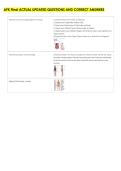
Regional terminology- anterior
,Regional terminology- posterior
Body planes and sections The transverse plane is also called the horizontal plane. It separates a body into
superior and inferior portions. Cross section!
The frontal plane is also called the coronal plane. It separates and creates an
anterior and posterior side of the body.
The median plane is also called the sagittal plane. It divides something into a right
and a left half. Midsagittal: divides the body into equal left and right halves.
Parasagittal: divides the body into unequal left and right halves.
The oblique plane cuts something at an angle and is looked at generally in a time
of trauma.
What are the smallest living units in our bodies? Cells are the smallest living units in the body.
3 main structural components of ANY cell Nucleus, Cytoplasm, Plasma Membrane
General structure of the plasma membrane - fluid mosaic Fluid: it's a very movable, pliable, dynamic type of structure.
model Mosaic: lots of little pieces that make up the big picture.
There is a two-layer sea of lipids (the fluid part) with a mosaic of proteins
embedded in those lipids.
The tail ends of the phospholipid molecules are the squiggly parts and the head
ends are the round balls. These phospholipids make up a "sea of lipids" which
contains proteins and other kinds of lipids embedded in the layers.
Cilia vs. flagella vs. microvilli Cilia wave rhythmically to move dirt and mucus out. Flagella are found on some
bacteria and allow them to swim. microvilli are found in the small intestine, and
increase the surface area for nutrient absorption.
General functions of the major organelles: Mitochondria The mitochondria are the powerhouse of the cell because they make the energy
of the cell, the adenosine triphosphate (ATP)
, General functions of the major organelles: Ribosomes Ribosomes make important proteins and some ribosomes, that are on the rough
endoplasmic reticulum, are either secreted from the cell as a chemical messenger
or they're incorporated into the plasma membrane.
General functions of the major organelles: Endoplasmic Rough ER ‐protein synthesis. It is an outward projection of the nucleus.
Reticulum (ER) Smooth ER - making or breaking down fats AND calcium storage
General functions of the major organelles: Golgi The Golgi Apparatus further enhances proteins that are coming from the rough
Apparatus endoplasmic reticulum.
General functions of the major organelles: Lysosomes Lysosomes are a specific type of membrane bound organelle that contains
hydrolase enzymes (digestive enzymes) which break things like bacteria,
macromolecules, etc. down.
General functions of the major organelles: Peroxisomes Removes toxic wastes by using special enzymes, oxidase and catalase
General functions of the major organelles: Cytoskeleton Functions like the bones, muscles, and ligaments do in an organism as well as
supporting the cell's shape and producing movement
General functions of the major organelles: Centriole These "sprout" the microtubules. They also play a large part in cellular division.
Hierarchy of structural organization in the body 1) Chemical Level. Atoms make up Molecules
2) Cellular Level. Organelles makeup Cells
3) Tissue Level. Similar types of Cells make up Tissues.
4) Organ Level. Different types of Tissue make up Organs.
5) Organ System Level. Different Organs with similar functions work together in an
Organ System.
6) Organismal Level. Many Organ Systems make up an individual, the Organism.
Anatomical positions and terminology Anatomical position: The body is standing, the head is forward, the feet are facing
forward in neutral position, the palms are facing outwards. Palms are intentionally
turned forwards so that we are able to describe body parts relative to one
another.
Regional terminology- anterior
,Regional terminology- posterior
Body planes and sections The transverse plane is also called the horizontal plane. It separates a body into
superior and inferior portions. Cross section!
The frontal plane is also called the coronal plane. It separates and creates an
anterior and posterior side of the body.
The median plane is also called the sagittal plane. It divides something into a right
and a left half. Midsagittal: divides the body into equal left and right halves.
Parasagittal: divides the body into unequal left and right halves.
The oblique plane cuts something at an angle and is looked at generally in a time
of trauma.
What are the smallest living units in our bodies? Cells are the smallest living units in the body.
3 main structural components of ANY cell Nucleus, Cytoplasm, Plasma Membrane
General structure of the plasma membrane - fluid mosaic Fluid: it's a very movable, pliable, dynamic type of structure.
model Mosaic: lots of little pieces that make up the big picture.
There is a two-layer sea of lipids (the fluid part) with a mosaic of proteins
embedded in those lipids.
The tail ends of the phospholipid molecules are the squiggly parts and the head
ends are the round balls. These phospholipids make up a "sea of lipids" which
contains proteins and other kinds of lipids embedded in the layers.
Cilia vs. flagella vs. microvilli Cilia wave rhythmically to move dirt and mucus out. Flagella are found on some
bacteria and allow them to swim. microvilli are found in the small intestine, and
increase the surface area for nutrient absorption.
General functions of the major organelles: Mitochondria The mitochondria are the powerhouse of the cell because they make the energy
of the cell, the adenosine triphosphate (ATP)
, General functions of the major organelles: Ribosomes Ribosomes make important proteins and some ribosomes, that are on the rough
endoplasmic reticulum, are either secreted from the cell as a chemical messenger
or they're incorporated into the plasma membrane.
General functions of the major organelles: Endoplasmic Rough ER ‐protein synthesis. It is an outward projection of the nucleus.
Reticulum (ER) Smooth ER - making or breaking down fats AND calcium storage
General functions of the major organelles: Golgi The Golgi Apparatus further enhances proteins that are coming from the rough
Apparatus endoplasmic reticulum.
General functions of the major organelles: Lysosomes Lysosomes are a specific type of membrane bound organelle that contains
hydrolase enzymes (digestive enzymes) which break things like bacteria,
macromolecules, etc. down.
General functions of the major organelles: Peroxisomes Removes toxic wastes by using special enzymes, oxidase and catalase
General functions of the major organelles: Cytoskeleton Functions like the bones, muscles, and ligaments do in an organism as well as
supporting the cell's shape and producing movement
General functions of the major organelles: Centriole These "sprout" the microtubules. They also play a large part in cellular division.


