

Page 1 of 44
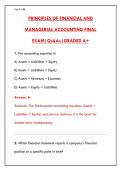
PRINCIPLES OF FINANCIAL AND
MANAGERIAL ACCOUNTING FINAL
EXAM|Qs&As|GRADED A+
1. The accounting equation is:
A) Assets = Liabilities + Equity
B) Assets + Liabilities = Equity
C) Assets = Revenues – Expenses
D) Assets + Equity = Liabilities
Answer: A
Rationale: The fundamental accounting equation (Assets =
Liabilities + Equity) must always balance. It is the basis for
double-entry bookkeeping.
2. Which financial statement reports a company's financial
position at a specific point in time?
,Page 2 of 44
A) Income statement
B) Statement of cash flows
C) Balance sheet
D) Statement of retained earnings
Answer: C
Rationale: The balance sheet is a snapshot of assets, liabilities,
and equity at a specific date. The income statement covers a
period.
3. A company purchases equipment for $10,000 cash. How does
this transaction affect the accounting equation?
A) Assets increase and decrease by equal amounts
B) Assets increase and liabilities increase
C) Assets decrease and equity decreases
D) No effect on total assets
,Page 3 of 44
Answer: A (Assets increase (equipment) and decrease (cash) by
$10,000; total assets unchanged)
Rationale: One asset (equipment) increases while another asset
(cash) decreases. Total assets remain the same.
4. Which of the following is an example of an operating activity
on the statement of cash flows (indirect method)?
A) Purchase of equipment
B) Issuance of common stock
C) Payment of salaries to employees
D) Payment of a long-term note
Answer: C
Rationale: Operating activities include transactions that affect net
income, such as cash received from customers and cash paid for
salaries, rent, etc.
, Page 4 of 44
5. A company has current assets
of 200,000andcurrentliabilitiesof200,000andcurrentliabilitiesof1
50,000. What is the current ratio?
A) 1.33
B) 0.75
C) 1.00
D) 2.00
Answer: A (200,000/200,000/150,000 = 1.33)
Rationale: Current ratio = current assets / current liabilities. It
measures short-term liquidity.
6. Under accrual accounting, revenue is recognized when:
A) Cash is received
B) The performance obligation is satisfied (earned)
C) The customer orders the product
D) The invoice is printed
PRINCIPLES OF FINANCIAL AND
MANAGERIAL ACCOUNTING FINAL
EXAM|Qs&As|GRADED A+
1. The accounting equation is:
A) Assets = Liabilities + Equity
B) Assets + Liabilities = Equity
C) Assets = Revenues – Expenses
D) Assets + Equity = Liabilities
Answer: A
Rationale: The fundamental accounting equation (Assets =
Liabilities + Equity) must always balance. It is the basis for
double-entry bookkeeping.
2. Which financial statement reports a company's financial
position at a specific point in time?
,Page 2 of 44
A) Income statement
B) Statement of cash flows
C) Balance sheet
D) Statement of retained earnings
Answer: C
Rationale: The balance sheet is a snapshot of assets, liabilities,
and equity at a specific date. The income statement covers a
period.
3. A company purchases equipment for $10,000 cash. How does
this transaction affect the accounting equation?
A) Assets increase and decrease by equal amounts
B) Assets increase and liabilities increase
C) Assets decrease and equity decreases
D) No effect on total assets
,Page 3 of 44
Answer: A (Assets increase (equipment) and decrease (cash) by
$10,000; total assets unchanged)
Rationale: One asset (equipment) increases while another asset
(cash) decreases. Total assets remain the same.
4. Which of the following is an example of an operating activity
on the statement of cash flows (indirect method)?
A) Purchase of equipment
B) Issuance of common stock
C) Payment of salaries to employees
D) Payment of a long-term note
Answer: C
Rationale: Operating activities include transactions that affect net
income, such as cash received from customers and cash paid for
salaries, rent, etc.
, Page 4 of 44
5. A company has current assets
of 200,000andcurrentliabilitiesof200,000andcurrentliabilitiesof1
50,000. What is the current ratio?
A) 1.33
B) 0.75
C) 1.00
D) 2.00
Answer: A (200,000/200,000/150,000 = 1.33)
Rationale: Current ratio = current assets / current liabilities. It
measures short-term liquidity.
6. Under accrual accounting, revenue is recognized when:
A) Cash is received
B) The performance obligation is satisfied (earned)
C) The customer orders the product
D) The invoice is printed


