

C.A.L.T EXAM STUDY GUIDE QUESTIONS WITH CORRECT ANSWERS LATEST
UPDATE
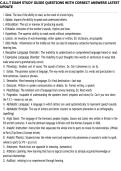
1. Alexia: The loss of the ability to read, as the result of a brain injury.
2. Apasia: Impairs the ability to speak and understand others.
3. Articulation: The act or manner of producing sounds.
4. Echolalia: Imitation of the mother's sounds, rhythm and tone.
5. Hyperlexia: The superior ability to reads words without comprehension.
6. Lexicon: An inventory of word knowledge, either spoken or written. EX: dictionary, encyclopedia
7. Otitis Media: Inflammation of the middle ear that can lead to temporary conductive hearing loss or permanent
hearing loss.
8. Receptive Language Disorder: The inability to understand or comprehend language heard or read.
9. Expressive Language Disorder: The inability to put thoughts into words or sentences in ways that
make sense and is grammatically correct.
10. Phonology: Smallest unit of sound. The sounds of letters. Ex: Cat=3 phonemes (c) (a) (t).
11. Syntax: The grammar system of language. The way words are strung together. Ex: words and punctuation to
form sentences, clauses or phrases.
12. Semantics: Word meaning in language. Ex: final destination = last stop
13. Discourse: Written or spoken communication or debate. Ex: Formal writing, a speech.
14. Morphology: The smallest unit of language that convey meaning. Ex: Root words
15. Pragmatics: Incapable of understanding the speakers intent (requests and tones) Ex: Can't you turn down
the T.V.? = means no; not yes.
16. Alphabetic Language: A language in which letters are used systematically to represent speech sounds.
17. Alphabetic Principle: The use of letters and letter clusters to represent phonemes in an orthography.
(spelling)
18. Anglo Saxon: The language of the Germanic peoples (Angles, Saxons and Jutes) who settles in Britain in the
5th and 6th centuries. It was the dominant language in Britain until the Norman Conquest in 1066.
19. Analytic Instruction: Instruction that separates the whole into its parts to reveal its relationships. (Whole
to Part) (Top Down) (Concept driven)
20. Analytic Phonics: Students hear the whole word and segment into phonemes or sounds in order to spell.
(whole to part) Ex: Pit = (p) (i) (t)
21. Antonyms: Words that are opposite in meaning. (semantics)
22. Arbitrary Learning: New learning that has no logical connection to already acquired knowledge or
practical relationships.
23. Auditory: relating to or experienced through hearing.
1/
10
,C.A.L.T EXAM STUDY GUIDE QUESTIONS WITH CORRECT ANSWERS LATEST
UPDATE
24. Visual Acuity: Sharpness of vision, measured by the ability to discern letters or numbers at a given distance
according to a fixed standard. EX: 20/20 vision
25. Bottom-up Process: Theoretical view of reading as a process that consists of accurate sequential reading
of every word. Comprehension is viewed as text driven rather than concept driven. (Part to whole) (Start from the
bottom)
26. Concept Driven Process: Theoretical view of reading as a process that consists of using one's experi-
ences and expectations to react to text. Also called top-down process. (Whole to part)
27. Cooperative Learning: Instructional approach in which students work together rather than compete to
solve a problem or complete a task.Ex: group work or PBL
28. Corrective Feedback: Teacher responses during and following practice of a skill that is sensitive to a
student's level and that guides him or her closer to mastery.
29. Cumulative: Having a new learning that is based upon previously learned elements. Ex: Building knowledge
as we go.
30. Diagnostic Teaching: Teaching that uses observation and formal and informal assessments to measure
student progress against expected performance standards. Systematic, guided diagnoses of academic barriers.
(Prescriptive teaching)
31. Direct Instruction: Instruction that is delivered without vagueness or ambiguity, leaving no question as to
the meaning. (Explicit Instruction)
32. Domains of Language: Language systems. Phonology, syntax, morphology and orthography are lan-
guage systems that deal with the form of language. Semantics deals with content of lang. and pragmatics deals with
the use of lang.
33. Embedded Phonics: Phonological awareness and phonics taught implicitly through the reading of real
words in text. (whole language)
34. Etymology: The history of word origins and development.
35. Euphony: Pleasing to the ear. Having a pleasing sound. Ex: illogical; not inlogical. (Chameleon Prefix)
36. Explicit Instruction: Instruction delivered without vagueness or ambiguity, leaving no questions as to the
meaning. (Direct Instruction)
37. Fernald Method: Technique for learning words that involves the visual, auditory, kinesthetic, and tactile
(VAKT) modalities. EX: The student looks at the word while saying and tracing it.
38. Figurative Language: Language that avoids the use of the exact meaning of words and uses exaggera-
tion, metaphors and embellishments.
39. Greek: The language of the ancient Greeks whose morphemes form scientific terms.
2/
10
UPDATE
1. Alexia: The loss of the ability to read, as the result of a brain injury.
2. Apasia: Impairs the ability to speak and understand others.
3. Articulation: The act or manner of producing sounds.
4. Echolalia: Imitation of the mother's sounds, rhythm and tone.
5. Hyperlexia: The superior ability to reads words without comprehension.
6. Lexicon: An inventory of word knowledge, either spoken or written. EX: dictionary, encyclopedia
7. Otitis Media: Inflammation of the middle ear that can lead to temporary conductive hearing loss or permanent
hearing loss.
8. Receptive Language Disorder: The inability to understand or comprehend language heard or read.
9. Expressive Language Disorder: The inability to put thoughts into words or sentences in ways that
make sense and is grammatically correct.
10. Phonology: Smallest unit of sound. The sounds of letters. Ex: Cat=3 phonemes (c) (a) (t).
11. Syntax: The grammar system of language. The way words are strung together. Ex: words and punctuation to
form sentences, clauses or phrases.
12. Semantics: Word meaning in language. Ex: final destination = last stop
13. Discourse: Written or spoken communication or debate. Ex: Formal writing, a speech.
14. Morphology: The smallest unit of language that convey meaning. Ex: Root words
15. Pragmatics: Incapable of understanding the speakers intent (requests and tones) Ex: Can't you turn down
the T.V.? = means no; not yes.
16. Alphabetic Language: A language in which letters are used systematically to represent speech sounds.
17. Alphabetic Principle: The use of letters and letter clusters to represent phonemes in an orthography.
(spelling)
18. Anglo Saxon: The language of the Germanic peoples (Angles, Saxons and Jutes) who settles in Britain in the
5th and 6th centuries. It was the dominant language in Britain until the Norman Conquest in 1066.
19. Analytic Instruction: Instruction that separates the whole into its parts to reveal its relationships. (Whole
to Part) (Top Down) (Concept driven)
20. Analytic Phonics: Students hear the whole word and segment into phonemes or sounds in order to spell.
(whole to part) Ex: Pit = (p) (i) (t)
21. Antonyms: Words that are opposite in meaning. (semantics)
22. Arbitrary Learning: New learning that has no logical connection to already acquired knowledge or
practical relationships.
23. Auditory: relating to or experienced through hearing.
1/
10
,C.A.L.T EXAM STUDY GUIDE QUESTIONS WITH CORRECT ANSWERS LATEST
UPDATE
24. Visual Acuity: Sharpness of vision, measured by the ability to discern letters or numbers at a given distance
according to a fixed standard. EX: 20/20 vision
25. Bottom-up Process: Theoretical view of reading as a process that consists of accurate sequential reading
of every word. Comprehension is viewed as text driven rather than concept driven. (Part to whole) (Start from the
bottom)
26. Concept Driven Process: Theoretical view of reading as a process that consists of using one's experi-
ences and expectations to react to text. Also called top-down process. (Whole to part)
27. Cooperative Learning: Instructional approach in which students work together rather than compete to
solve a problem or complete a task.Ex: group work or PBL
28. Corrective Feedback: Teacher responses during and following practice of a skill that is sensitive to a
student's level and that guides him or her closer to mastery.
29. Cumulative: Having a new learning that is based upon previously learned elements. Ex: Building knowledge
as we go.
30. Diagnostic Teaching: Teaching that uses observation and formal and informal assessments to measure
student progress against expected performance standards. Systematic, guided diagnoses of academic barriers.
(Prescriptive teaching)
31. Direct Instruction: Instruction that is delivered without vagueness or ambiguity, leaving no question as to
the meaning. (Explicit Instruction)
32. Domains of Language: Language systems. Phonology, syntax, morphology and orthography are lan-
guage systems that deal with the form of language. Semantics deals with content of lang. and pragmatics deals with
the use of lang.
33. Embedded Phonics: Phonological awareness and phonics taught implicitly through the reading of real
words in text. (whole language)
34. Etymology: The history of word origins and development.
35. Euphony: Pleasing to the ear. Having a pleasing sound. Ex: illogical; not inlogical. (Chameleon Prefix)
36. Explicit Instruction: Instruction delivered without vagueness or ambiguity, leaving no questions as to the
meaning. (Direct Instruction)
37. Fernald Method: Technique for learning words that involves the visual, auditory, kinesthetic, and tactile
(VAKT) modalities. EX: The student looks at the word while saying and tracing it.
38. Figurative Language: Language that avoids the use of the exact meaning of words and uses exaggera-
tion, metaphors and embellishments.
39. Greek: The language of the ancient Greeks whose morphemes form scientific terms.
2/
10


