
Functional Anatomy and Physiology of
Neuromuscular System (NMS)
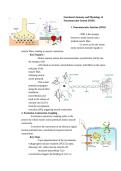
1. Neuromuscular Junction (NMJ)
-
- NMJ is the synapse
between a motor neuron and a
skeletal muscle fiber.
- It serves as the site where
motor neurons transmit signals to
muscle fibers, leading to muscle contraction.
- Key Features -
- Motor neurons release the neurotransmitter acetylcholine (ACh) into
the synaptic cleft.
- ACh binds to nicotinic acetylcholine receptors (nAChRs) on the motor
end plate of the
muscle fiber,
initiating muscle
action potential.
- This action
potential propagates
along the muscle fiber
membrane
(sarcolemma) and
leads to the release of
calcium ions (Ca2+)
from the sarcoplasmic
reticulum (SR), triggering muscle contraction.
2. Excitation-Contraction Coupling -
- Excitation-contraction coupling refers to the
process by which muscle action potentials lead to muscle
contraction.
- It involves the conversion of an electrical signal
(action potential) into a mechanical response (muscle
contraction).
- Key Steps -
- Upon depolarization of the sarcolemma,
voltage-gated calcium channels (VGCCs) open,
allowing Ca2+ influx into the muscle cell.
- Increased intracellular Ca2+
concentration triggers the binding of Ca2+ to
, troponin, leading to a conformational change in the troponin-tropomyosin
complex.
- This conformational change exposes myosin-binding sites on actin
filaments, allowing myosin heads to bind to actin and initiate muscle contraction
via the sliding filament mechanism.
3. Anatomy and Physiology of
Postural Reflexes -
- Postural reflexes are
automatic responses that maintain
posture and balance in response to
changes in body position or external
perturbations.
- They involve sensory input
from proprioceptors (e.g., muscle
spindles, Golgi tendon organs) and
integration within the central nervous
system (CNS) to generate appropriate
motor output.
-Key Concepts -
- Reflex arcs involving sensory receptors, afferent neurons, interneurons
within the spinal cord, and efferent neurons contribute to postural control.
- Feedback
mechanisms adjust muscle tone
and activate muscles to
counteract deviations from the
desired posture, ensuring
stability and equilibrium.
4. Neural Components and Networks of Voluntary Movement -
Neuromuscular System (NMS)
1. Neuromuscular Junction (NMJ)
-
- NMJ is the synapse
between a motor neuron and a
skeletal muscle fiber.
- It serves as the site where
motor neurons transmit signals to
muscle fibers, leading to muscle contraction.
- Key Features -
- Motor neurons release the neurotransmitter acetylcholine (ACh) into
the synaptic cleft.
- ACh binds to nicotinic acetylcholine receptors (nAChRs) on the motor
end plate of the
muscle fiber,
initiating muscle
action potential.
- This action
potential propagates
along the muscle fiber
membrane
(sarcolemma) and
leads to the release of
calcium ions (Ca2+)
from the sarcoplasmic
reticulum (SR), triggering muscle contraction.
2. Excitation-Contraction Coupling -
- Excitation-contraction coupling refers to the
process by which muscle action potentials lead to muscle
contraction.
- It involves the conversion of an electrical signal
(action potential) into a mechanical response (muscle
contraction).
- Key Steps -
- Upon depolarization of the sarcolemma,
voltage-gated calcium channels (VGCCs) open,
allowing Ca2+ influx into the muscle cell.
- Increased intracellular Ca2+
concentration triggers the binding of Ca2+ to
, troponin, leading to a conformational change in the troponin-tropomyosin
complex.
- This conformational change exposes myosin-binding sites on actin
filaments, allowing myosin heads to bind to actin and initiate muscle contraction
via the sliding filament mechanism.
3. Anatomy and Physiology of
Postural Reflexes -
- Postural reflexes are
automatic responses that maintain
posture and balance in response to
changes in body position or external
perturbations.
- They involve sensory input
from proprioceptors (e.g., muscle
spindles, Golgi tendon organs) and
integration within the central nervous
system (CNS) to generate appropriate
motor output.
-Key Concepts -
- Reflex arcs involving sensory receptors, afferent neurons, interneurons
within the spinal cord, and efferent neurons contribute to postural control.
- Feedback
mechanisms adjust muscle tone
and activate muscles to
counteract deviations from the
desired posture, ensuring
stability and equilibrium.
4. Neural Components and Networks of Voluntary Movement -


