
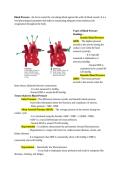
Blood Pressure - the force exerted by circulating blood against the walls of blood vessels. It is a
vital physiological parameter that helps in maintaining adequate tissue perfusion and
oxygenation throughout the body.
Types of Blood Pressure
Readings -
Systolic Blood Pressure
(SBP) - The highest pressure
exerted in the arteries during the
cardiac cycle when the heart
contracts (systole).
- It is typically
measured in millimeters of
mercury (mmHg).
- Normal SBP is
considered to be around 90-
120 mmHg.
Diastolic Blood Pressure
(DBP) - The lowest pressure
exerted in the arteries when the
heart relaxes (diastole) between contractions.
- It is also measured in mmHg.
- Normal DBP is around 60-80 mmHg.
Terms related to Blood Pressure
Pulse Pressure - The difference between systolic and diastolic blood pressure.
- It provides information about the elasticity and compliance of arteries.
- Pulse pressure = SBP - DBP.
Mean Arterial Pressure (MAP) - The average pressure in the arteries during one
cardiac cycle.
- It is calculated using the formula: MAP = DBP + 1/3(SBP - DBP).
- MAP is a crucial determinant of tissue perfusion.
- Normal MAP is around 70-100 mmHg.
Hypertension - A condition characterized by persistently elevated blood pressure.
- Hypertension is a major risk factor for cardiovascular diseases, stroke, and
kidney diseases.
- It is diagnosed when SBP is consistently above 130 mmHg or DBP is
consistently above 80 mmHg.
Hypotension - Abnormally low blood pressure.
- It can lead to inadequate tissue perfusion and result in symptoms like
dizziness, fainting, and fatigue.
, Neural/Cardiovascular Reflexes Mediating Acute
Responses to Changes in Blood Pressure
Acute Control: The Baroreceptor Reflex
- an essential mechanism for short-term regulation of
blood pressure. It involves specialized sensory receptors
called baroreceptors, which are primarily located in the
carotid sinus and aortic arch. These receptors detect changes
in blood pressure and send signals to the cardiovascular
control center in the brain, specifically the medulla oblongata.
The control center then initiates appropriate adjustments to
maintain blood pressure within the normal range.
-Location- Baroreceptors are specialized sensory
receptors primarily located in the carotid sinus and aortic arch.
- Detection - Baroreceptors detect changes in blood
pressure by sensing the stretch in arterial walls.
Response Mechanism-
When blood pressure rises:
- Baroreceptors detect the stretch in arterial walls due
to increased pressure.
- Afferent signals are sent to the cardiovascular control center.
- Parasympathetic stimulation is increased, leading to decreased heart rate (negative
chronotropic effect) and vasodilation, thereby reducing blood pressure.
When blood pressure drops:
- Baroreceptors detect decreased stretch in arterial walls.
- Afferent signals are sent to the cardiovascular control center.
- Sympathetic stimulation is increased, leading to increased heart rate (positive
chronotropic effect) and vasoconstriction, thereby elevating blood pressure.
Timeframe -
- The baroreceptor reflex acts rapidly, providing immediate adjustments to sudden
changes in blood pressure.
Chemoreceptor Reflex -
- Location - Chemoreceptors are located in the carotid bodies and aortic bodies.
-Detection -Chemoreceptors primarily sense changes in oxygen (O2), carbon
dioxide (CO2), and pH levels in the blood.
- Response Mechanism -
vital physiological parameter that helps in maintaining adequate tissue perfusion and
oxygenation throughout the body.
Types of Blood Pressure
Readings -
Systolic Blood Pressure
(SBP) - The highest pressure
exerted in the arteries during the
cardiac cycle when the heart
contracts (systole).
- It is typically
measured in millimeters of
mercury (mmHg).
- Normal SBP is
considered to be around 90-
120 mmHg.
Diastolic Blood Pressure
(DBP) - The lowest pressure
exerted in the arteries when the
heart relaxes (diastole) between contractions.
- It is also measured in mmHg.
- Normal DBP is around 60-80 mmHg.
Terms related to Blood Pressure
Pulse Pressure - The difference between systolic and diastolic blood pressure.
- It provides information about the elasticity and compliance of arteries.
- Pulse pressure = SBP - DBP.
Mean Arterial Pressure (MAP) - The average pressure in the arteries during one
cardiac cycle.
- It is calculated using the formula: MAP = DBP + 1/3(SBP - DBP).
- MAP is a crucial determinant of tissue perfusion.
- Normal MAP is around 70-100 mmHg.
Hypertension - A condition characterized by persistently elevated blood pressure.
- Hypertension is a major risk factor for cardiovascular diseases, stroke, and
kidney diseases.
- It is diagnosed when SBP is consistently above 130 mmHg or DBP is
consistently above 80 mmHg.
Hypotension - Abnormally low blood pressure.
- It can lead to inadequate tissue perfusion and result in symptoms like
dizziness, fainting, and fatigue.
, Neural/Cardiovascular Reflexes Mediating Acute
Responses to Changes in Blood Pressure
Acute Control: The Baroreceptor Reflex
- an essential mechanism for short-term regulation of
blood pressure. It involves specialized sensory receptors
called baroreceptors, which are primarily located in the
carotid sinus and aortic arch. These receptors detect changes
in blood pressure and send signals to the cardiovascular
control center in the brain, specifically the medulla oblongata.
The control center then initiates appropriate adjustments to
maintain blood pressure within the normal range.
-Location- Baroreceptors are specialized sensory
receptors primarily located in the carotid sinus and aortic arch.
- Detection - Baroreceptors detect changes in blood
pressure by sensing the stretch in arterial walls.
Response Mechanism-
When blood pressure rises:
- Baroreceptors detect the stretch in arterial walls due
to increased pressure.
- Afferent signals are sent to the cardiovascular control center.
- Parasympathetic stimulation is increased, leading to decreased heart rate (negative
chronotropic effect) and vasodilation, thereby reducing blood pressure.
When blood pressure drops:
- Baroreceptors detect decreased stretch in arterial walls.
- Afferent signals are sent to the cardiovascular control center.
- Sympathetic stimulation is increased, leading to increased heart rate (positive
chronotropic effect) and vasoconstriction, thereby elevating blood pressure.
Timeframe -
- The baroreceptor reflex acts rapidly, providing immediate adjustments to sudden
changes in blood pressure.
Chemoreceptor Reflex -
- Location - Chemoreceptors are located in the carotid bodies and aortic bodies.
-Detection -Chemoreceptors primarily sense changes in oxygen (O2), carbon
dioxide (CO2), and pH levels in the blood.
- Response Mechanism -


