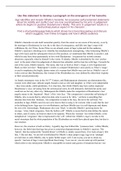
Use this statement to develop a paragraph on the emergence of his hamartia.
Iago identifies and reveals Othello’s hamartia; his excessive self-proclaimed statements
about his nobility and ‘perfect soul’ are now overshadowed by his error in judgement
where he begins to question Desdemona’s fidelity. This error in judgement results in a
destructively jealous aspect in his character…
Find a structure/language feature which shows he is becoming jealous and discuss
what it suggests, how it links to tragedy and how it affects audience.
Othello’s hamartia reveals itself somewhat quickly, from the outset we are aware of his naivety, even by
his marriage to Desdemona, he was shy to the idea of consequence, and falls into Iago’s traps with
willfulness. By Act Three, Scene Three we are already aware of Iago’s plan and for the audience,
Othello’s reaction is shocking in its volatility but simultaneously unsurprising. After witnessing Othello’s
rage with Cassio and the subsequent removal of his position, we understand that Othello is sensitive, and
whilst he may have been passionately in love with Desdemona – his passion lies in both extreme
directions, especially when he himself is the victim. Evidently, Othello is absorbed by his own ‘perfect
soul,’ to the point where his judgement of character has subsided, and his trust lies with Iago. Towards the
end of the scene, Othello laments, ‘Her name, that was as fresh as Dian’s visage, is now begrimed and
black as mine own face.’ Shakespeare’s simile, to compare Desdemona’s once-purity as ‘Dian’s visage,’
is used to emphasize the fragile, dainty nature of a woman that Othello once saw her as. Othello’s use of
it also conveys that Desdemona, like women of the Elizabethan era, were defined by either their virginity
or their sexual promiscuity.
As female stereotypes were in the 16/17th Century, and Shakespearean characters can demonstrate this,
women were either pure, delicate angels bound to men as wife and daughter, or if they were independent
– they were unruly, sinful prostitutes. It is clear here, that whilst Othello may have earlier respected
Desdemona’s voice, deviating from the stereotypical norm, he still ultimately cherished her purity and
could not see her any other way. Shakespeare has Othello make the comparison of Desdemona’s lost
angelic nature to the ‘begrimed’ ‘black’ of his ‘own face.’ This comparison is somewhat self-pitying of
Othello, who is aware that by others his skin color is seen to be ‘dirty,’ yet there is something that
detaches him from that ‘dirtiness,’ the comparison is made to his face, but not to his self/soul. Not
unsimilar to Iago, Othello uses his race as he knows that in using it, he worsens what is said, that his race
is the defining factor. Iago uses it to stir Brabantio, and here Othello uses it to self-deprecate and shame
his own wife. Interestingly, Shakespeare also uses ‘black’ to describe Othello’s growing desire for
revenge, ‘Arise, black vengeance, from thy hollow cell!’ Othello is aware that his skin defines his nature
to others, and of course, he believes them to be separate. Where the ‘monster’ lies within Othello, is the
metaphorical ‘vengeance’ that is imprisoned in the ‘cell’ within him. Othello’s rage is not due to the
racial stereotype that the white population of the Elizabethan era would have placed upon him, but due to
true emotion.
However, this emotion is built on falsity. Arguably Iago has birthed this ‘tyrannous hate,’ within Othello,
however, the little hints that Iago has given is somewhat disproportionate to Othello’s reaction. This
‘hatred,’ that has replaced the ‘hearted throne’ in Othello is simply caused from, if we look at Iago’s first
line, ‘I like not that,’ we are left overwhelmed by Othello’s sheer jump to rage. Iago even ‘attempts’
several times to calm Othello, only to ignite further anger, with ‘I am to pray you not to strain my
speech.’ And one of Iago’s most significant lines being, ‘I see you sir, you are eaten up with passion,’
which refers to my initial point. Othello is susceptible to rumors and queries of situations that are ‘not
Iago identifies and reveals Othello’s hamartia; his excessive self-proclaimed statements
about his nobility and ‘perfect soul’ are now overshadowed by his error in judgement
where he begins to question Desdemona’s fidelity. This error in judgement results in a
destructively jealous aspect in his character…
Find a structure/language feature which shows he is becoming jealous and discuss
what it suggests, how it links to tragedy and how it affects audience.
Othello’s hamartia reveals itself somewhat quickly, from the outset we are aware of his naivety, even by
his marriage to Desdemona, he was shy to the idea of consequence, and falls into Iago’s traps with
willfulness. By Act Three, Scene Three we are already aware of Iago’s plan and for the audience,
Othello’s reaction is shocking in its volatility but simultaneously unsurprising. After witnessing Othello’s
rage with Cassio and the subsequent removal of his position, we understand that Othello is sensitive, and
whilst he may have been passionately in love with Desdemona – his passion lies in both extreme
directions, especially when he himself is the victim. Evidently, Othello is absorbed by his own ‘perfect
soul,’ to the point where his judgement of character has subsided, and his trust lies with Iago. Towards the
end of the scene, Othello laments, ‘Her name, that was as fresh as Dian’s visage, is now begrimed and
black as mine own face.’ Shakespeare’s simile, to compare Desdemona’s once-purity as ‘Dian’s visage,’
is used to emphasize the fragile, dainty nature of a woman that Othello once saw her as. Othello’s use of
it also conveys that Desdemona, like women of the Elizabethan era, were defined by either their virginity
or their sexual promiscuity.
As female stereotypes were in the 16/17th Century, and Shakespearean characters can demonstrate this,
women were either pure, delicate angels bound to men as wife and daughter, or if they were independent
– they were unruly, sinful prostitutes. It is clear here, that whilst Othello may have earlier respected
Desdemona’s voice, deviating from the stereotypical norm, he still ultimately cherished her purity and
could not see her any other way. Shakespeare has Othello make the comparison of Desdemona’s lost
angelic nature to the ‘begrimed’ ‘black’ of his ‘own face.’ This comparison is somewhat self-pitying of
Othello, who is aware that by others his skin color is seen to be ‘dirty,’ yet there is something that
detaches him from that ‘dirtiness,’ the comparison is made to his face, but not to his self/soul. Not
unsimilar to Iago, Othello uses his race as he knows that in using it, he worsens what is said, that his race
is the defining factor. Iago uses it to stir Brabantio, and here Othello uses it to self-deprecate and shame
his own wife. Interestingly, Shakespeare also uses ‘black’ to describe Othello’s growing desire for
revenge, ‘Arise, black vengeance, from thy hollow cell!’ Othello is aware that his skin defines his nature
to others, and of course, he believes them to be separate. Where the ‘monster’ lies within Othello, is the
metaphorical ‘vengeance’ that is imprisoned in the ‘cell’ within him. Othello’s rage is not due to the
racial stereotype that the white population of the Elizabethan era would have placed upon him, but due to
true emotion.
However, this emotion is built on falsity. Arguably Iago has birthed this ‘tyrannous hate,’ within Othello,
however, the little hints that Iago has given is somewhat disproportionate to Othello’s reaction. This
‘hatred,’ that has replaced the ‘hearted throne’ in Othello is simply caused from, if we look at Iago’s first
line, ‘I like not that,’ we are left overwhelmed by Othello’s sheer jump to rage. Iago even ‘attempts’
several times to calm Othello, only to ignite further anger, with ‘I am to pray you not to strain my
speech.’ And one of Iago’s most significant lines being, ‘I see you sir, you are eaten up with passion,’
which refers to my initial point. Othello is susceptible to rumors and queries of situations that are ‘not