
ACTUS REUS = the act
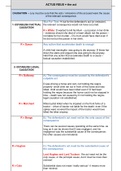
CAUSATION – Jury must be sure that the acts / omissions of the accused were the cause
of the relevant consequence.
‘But For’ Test but for the defendant’s act (or omission),
1- ESTABLISH FACTUAL the relevant consequence would not have occurred.
CAUSATION
R v White: D wanted to kill his Mum – put poison in her drink
– evidence should she died of a heart attach not the poison –
not liable for her murder – D’s mum would have died even if
he did not but the poison in her drink.
R v Dyson Any action that accelerates death is enough
A child had meningitis- was going to die anyway- D threw her
down the stairs and argued she was going to die anyway.
Held that any action that accelerates death is a cause –
factual causation established.
2- ESTABLISH LEGAL
CAUSATION
R v Dalloway A.) The consequence must be caused by the defendant’s
culpable act
D was driving a horse and cart- not holding the reigns
properly- small child ran out in front of the horse and was
killed- child would have been killed even if D had been
holding the reigns because the horse could not be stopped in
time – death was not caused by D not holding the reigns-
legal causation not established.
R v Marchant Motorcyclist killed when he impaled on the front forks of a
tractor – driver of tractor not liable for the death- even if the
spikes were covered the impact of the tractor would have
killed the biker anyway.
R v Benge B.) The defendant’s act need not be the only cause of the
consequence
There can be several causes operating at the same time- as
long as it can be shown that D was negligent, and his
negligence was the substantial cause of the consequence,
the other causes are immaterial.
R v Hughes C.) The defendant’s act must be the substantial cause of
the consequence
Lord Hughes and Lord Toulson: ‘the act need not be the
only cause, or the principle cause, but it must be more than
minimal’.
R v Cato Substantial does not mean ‘really serious’- it means more
than minimal.
CAUSATION – Jury must be sure that the acts / omissions of the accused were the cause
of the relevant consequence.
‘But For’ Test but for the defendant’s act (or omission),
1- ESTABLISH FACTUAL the relevant consequence would not have occurred.
CAUSATION
R v White: D wanted to kill his Mum – put poison in her drink
– evidence should she died of a heart attach not the poison –
not liable for her murder – D’s mum would have died even if
he did not but the poison in her drink.
R v Dyson Any action that accelerates death is enough
A child had meningitis- was going to die anyway- D threw her
down the stairs and argued she was going to die anyway.
Held that any action that accelerates death is a cause –
factual causation established.
2- ESTABLISH LEGAL
CAUSATION
R v Dalloway A.) The consequence must be caused by the defendant’s
culpable act
D was driving a horse and cart- not holding the reigns
properly- small child ran out in front of the horse and was
killed- child would have been killed even if D had been
holding the reigns because the horse could not be stopped in
time – death was not caused by D not holding the reigns-
legal causation not established.
R v Marchant Motorcyclist killed when he impaled on the front forks of a
tractor – driver of tractor not liable for the death- even if the
spikes were covered the impact of the tractor would have
killed the biker anyway.
R v Benge B.) The defendant’s act need not be the only cause of the
consequence
There can be several causes operating at the same time- as
long as it can be shown that D was negligent, and his
negligence was the substantial cause of the consequence,
the other causes are immaterial.
R v Hughes C.) The defendant’s act must be the substantial cause of
the consequence
Lord Hughes and Lord Toulson: ‘the act need not be the
only cause, or the principle cause, but it must be more than
minimal’.
R v Cato Substantial does not mean ‘really serious’- it means more
than minimal.


