

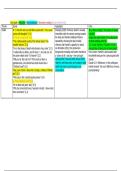
Key quote | Key critic | Key production | Alternative reading | Cross-theme link |
Theme Quote Adaptation Critic
Death ★ “O that this too too solid flesh would melt” / “His canon Branagh (1996): Polonius’ death is visually ★ G. Wilson Knight: “The theme of Hamlet
’gainst self-slaughter” (1.2) intensified, with the camera moving towards is death.”
★ “To be, or not to be” (3.1) the body and Hamlet stabbing Polonius Knight also calls Hamlet “the ambassador
“The undiscovered country, from whose bourn / No repeatedly, stressing the play’s bodily of death walking amid life”.
traveller returns” (3.1) violence and Hamlet’s capacity for action. C.S. Lewis: Hamlet is “haunted, not by a
“For in that sleep of death what dreams may come” (3.1) Ian McKellen (2021): the production physical fear of dying, but of being dead”.
“A villain kills my father; and for that, / I, his sole son, do foregrounds mortality and frames Hamlet as Paul Cantor: Hamlet is preoccupied with
this same villain send / To heaven” (3.3) a “prince of all - and any - time and age”. the afterlife because he is preoccupied with
“Will you ha’ the truth on’t? If this had not been a ★Doran/RSC Tennant (2008, filmed 2009): suicide.
gentlewoman, she should have been buried out o’ Hamlet’s self-destruction and isolation make Claude C.H. Williamson: in the soliloquies,
Christian burial” (5.1) death feel inward, psychological, and Hamlet renews “his soul’s different, nervous
“Alas, poor Yorick! I knew him, Horatio, a fellow of infinite unavoidable. procrastinating”.
jest” (5.1)
“Who was in life a foolish prating knave” (3.4)
★ “The readiness is all” (5.2)
“He is dead and gone, lady” (4.5)
“Why thy canonized bones, hearsed in death, / Have burst
their cerements” (1.4)
, Morality / ★ “Thus conscience does make cowards of us all” (3.1) Branagh (1996): in the prayer scene, the Goethe: Hamlet is a “lovely, pure and moral
religion / “O, what a rogue and peasant slave am I!” (2.2) camera probes Claudius’ guilt and Hamlet’s nature” unequal to the deed imposed on
conscience “O, what a rash and bloody deed is this!” (3.4) calculation, making morality theatrical and him.
“O heart, lose not thy nature; let not ever / The soul of psychological at once. A.C. Bradley: Hamlet feels “moral repulsion
Nero enter this firm bosom” (3.2) Zeffirelli (1990): Claudius praying before to the deed”.
“May one be pardoned and retain th’ offence?” (3.3) Christ’s crucifixion sharpens the Christian ★ Paul Cantor: Hamlet must consider
“My crown, mine own ambition, and my queen” (3.3) problem of sin, repentance, and damnation. whether his actions will lead him to be
“They are not near my conscience” (5.2) Olivier (1948): the narrowed psychological “saved or damned”.
focus places the moral problem inside Eleanor Prosser: Hamlet is disturbed
Hamlet’s consciousness rather than the because he cannot know whether revenge
wider political state. is lawful or spiritually damning.
Kenneth Muir: Hamlet must work out his
salvation “in fear and trembling”.
Delay ★ “How all occasions do inform against me, / And spur my ★ Olivier (1948): opens by framing Hamlet Coleridge: Hamlet has “almost enormous
dull revenge!” (4.4) as “the tragedy of a man who could not make intellectual activity”.
★ “Thinking too precisely on th’ event” (4.4) up his mind”. ★ Coleridge: Hamlet is incapable of acting
“Now might I do it pat” (3.3) David Tennant in Doran/RSC (2008, filmed because “he thinks too much”.
“And now I’ll do’t. And so he goes to heaven” (3.3) 2009): Hamlet curls up in a small ball in the Schlegel: Hamlet “loses himself in
“What would he do / Had he the motive and the cue for first soliloquy, stressing paralysis and self- labyrinths of thought”.
passion / That I have?” (2.2) division. A.C. Bradley: “The main cause of Hamlet’s
“O, what a rogue and peasant slave am I!” (2.2) Cumberbatch (Barbican 2015): Hamlet plays delay is melancholic disgust and apathy.”
“Pigeon-livered” (2.2) with toys in the castle, making delay partly a Harley Granville-Barker: “A tragedy of
“The spirit that I have seen / May be a devil” (2.2) sign of immaturity and arrested development. inaction.”
“The play’s the thing / Wherein I’ll catch the conscience of H.A. Taine: “He is not master of his acts;
the king” (2.2) occasion dictates them; he cannot plan a
“From this time forth, / My thoughts be bloody, or be murder, but must improvise it.”
nothing worth!” (4.4)
Revenge ★ “Revenge his foul and most unnatural murder” (1.5) Branagh (1996): Hamlet’s violent stabbing of Samuel Johnson: “Hamlet is rather an
“O cursed spite, / That ever I was born to set it right!” (1.5) Claudius through the partition gives him force instrument than an agent.”
Theme Quote Adaptation Critic
Death ★ “O that this too too solid flesh would melt” / “His canon Branagh (1996): Polonius’ death is visually ★ G. Wilson Knight: “The theme of Hamlet
’gainst self-slaughter” (1.2) intensified, with the camera moving towards is death.”
★ “To be, or not to be” (3.1) the body and Hamlet stabbing Polonius Knight also calls Hamlet “the ambassador
“The undiscovered country, from whose bourn / No repeatedly, stressing the play’s bodily of death walking amid life”.
traveller returns” (3.1) violence and Hamlet’s capacity for action. C.S. Lewis: Hamlet is “haunted, not by a
“For in that sleep of death what dreams may come” (3.1) Ian McKellen (2021): the production physical fear of dying, but of being dead”.
“A villain kills my father; and for that, / I, his sole son, do foregrounds mortality and frames Hamlet as Paul Cantor: Hamlet is preoccupied with
this same villain send / To heaven” (3.3) a “prince of all - and any - time and age”. the afterlife because he is preoccupied with
“Will you ha’ the truth on’t? If this had not been a ★Doran/RSC Tennant (2008, filmed 2009): suicide.
gentlewoman, she should have been buried out o’ Hamlet’s self-destruction and isolation make Claude C.H. Williamson: in the soliloquies,
Christian burial” (5.1) death feel inward, psychological, and Hamlet renews “his soul’s different, nervous
“Alas, poor Yorick! I knew him, Horatio, a fellow of infinite unavoidable. procrastinating”.
jest” (5.1)
“Who was in life a foolish prating knave” (3.4)
★ “The readiness is all” (5.2)
“He is dead and gone, lady” (4.5)
“Why thy canonized bones, hearsed in death, / Have burst
their cerements” (1.4)
, Morality / ★ “Thus conscience does make cowards of us all” (3.1) Branagh (1996): in the prayer scene, the Goethe: Hamlet is a “lovely, pure and moral
religion / “O, what a rogue and peasant slave am I!” (2.2) camera probes Claudius’ guilt and Hamlet’s nature” unequal to the deed imposed on
conscience “O, what a rash and bloody deed is this!” (3.4) calculation, making morality theatrical and him.
“O heart, lose not thy nature; let not ever / The soul of psychological at once. A.C. Bradley: Hamlet feels “moral repulsion
Nero enter this firm bosom” (3.2) Zeffirelli (1990): Claudius praying before to the deed”.
“May one be pardoned and retain th’ offence?” (3.3) Christ’s crucifixion sharpens the Christian ★ Paul Cantor: Hamlet must consider
“My crown, mine own ambition, and my queen” (3.3) problem of sin, repentance, and damnation. whether his actions will lead him to be
“They are not near my conscience” (5.2) Olivier (1948): the narrowed psychological “saved or damned”.
focus places the moral problem inside Eleanor Prosser: Hamlet is disturbed
Hamlet’s consciousness rather than the because he cannot know whether revenge
wider political state. is lawful or spiritually damning.
Kenneth Muir: Hamlet must work out his
salvation “in fear and trembling”.
Delay ★ “How all occasions do inform against me, / And spur my ★ Olivier (1948): opens by framing Hamlet Coleridge: Hamlet has “almost enormous
dull revenge!” (4.4) as “the tragedy of a man who could not make intellectual activity”.
★ “Thinking too precisely on th’ event” (4.4) up his mind”. ★ Coleridge: Hamlet is incapable of acting
“Now might I do it pat” (3.3) David Tennant in Doran/RSC (2008, filmed because “he thinks too much”.
“And now I’ll do’t. And so he goes to heaven” (3.3) 2009): Hamlet curls up in a small ball in the Schlegel: Hamlet “loses himself in
“What would he do / Had he the motive and the cue for first soliloquy, stressing paralysis and self- labyrinths of thought”.
passion / That I have?” (2.2) division. A.C. Bradley: “The main cause of Hamlet’s
“O, what a rogue and peasant slave am I!” (2.2) Cumberbatch (Barbican 2015): Hamlet plays delay is melancholic disgust and apathy.”
“Pigeon-livered” (2.2) with toys in the castle, making delay partly a Harley Granville-Barker: “A tragedy of
“The spirit that I have seen / May be a devil” (2.2) sign of immaturity and arrested development. inaction.”
“The play’s the thing / Wherein I’ll catch the conscience of H.A. Taine: “He is not master of his acts;
the king” (2.2) occasion dictates them; he cannot plan a
“From this time forth, / My thoughts be bloody, or be murder, but must improvise it.”
nothing worth!” (4.4)
Revenge ★ “Revenge his foul and most unnatural murder” (1.5) Branagh (1996): Hamlet’s violent stabbing of Samuel Johnson: “Hamlet is rather an
“O cursed spite, / That ever I was born to set it right!” (1.5) Claudius through the partition gives him force instrument than an agent.”


