
Task 8 Understand Children and Young Person’s Development
Part A
Explain the sequence and rate of each aspect of development that would normally be expected in
children and young people from birth – 19 years. (9449.1.1)
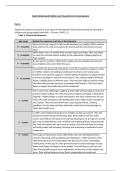
Table 1: Physical development
Age range Explain the sequence and rate of development
Between this age range the child usually develops very rapidly. Within weeks a
0 – 3 months baby will start to smile and respond to sounds and the environment around
them.
When they reach 3-6 months their muscles begin to develop. They may begin
3 – 6 months to reach for and hold objects leading to the exploration of placing objects in
their mouths.
By the age of 6 months a child's birth weight can have doubled and may also
6 – 9 months have tripled by the end of their first year.
Around this age group and certainly by a year they would have begun to crawl
or shuffle, maybe even pulling or pushing on furniture and cruising using
furniture or an adult for support. A child's sitting will progress to being unaided
9 – 12 months and they may begin to roll from front to back. They will pass objects between
hands, handling them in different ways. They may also begin to look for things
that they hide and their hand eye coordination will improve. Their first teeth
begin to appear and solid foods will be introduced.
This is where the child begins walking and the child will also begin to push and
pull toys whilst walking. The child may pick up objects and begin to bang them
together. Children begin to make small towers and show a preference for one
1 – 2 years hand. The child will explore with feeding themselves finger foods and begin to
use a spoon. They may also drink from a cup using two hands . Waving
goodbye is fun for them and they will point to what they want and begin to
shake their head for no.
A child's mark making will progress to scribbles as they use pencils. They will
experiment with kicking and throwing balls. Bricks will be built into taller
towers and children will experiment with pouring liquids. At the age of 3 a child
2 – 4 years gains more independence, their mobility and climbing skills are advancing and
the child will explore with new ways of moving. The child will show increasing
skill with puzzles and threading. Dressing and undressing is assisted but more
cooperative.
4 – 7 years At the age of 4 boys gross motor skills tend to be more developed when it
comes to throwing, aiming, building and climbing etc. Unlike girls fine motor
skills that tend to be more developed with the use of scissors and holding
writing tools. At the age of 5 they gain more pencil control and begin to copy
letters and shapes and begin to draw people. They will hop on one foot and
skip. Dressing will become more independent as they learn to do buttons and
laces. Their writing becomes more fluent, progressing into words and
, sentences using greater pencil control. They begin to ride bikes as their
confidence increases.
Children play team games as they are now hitting a ball, running, jumping,
7 – 12 years skipping and swinging. However until around the age of 9 they may misjudge
their ability.
Between childhood and adulthood this is known as adolescence. Physical
development during this period is different in each child, as some may just be
beginning to mature physically, whereas others may have reached full physical
12 – 16 years maturity. Boys begin adolescence around 14 years which is later than girls.
Their body shape will change as their muscles grow and they will develop body
hair. Their strength and coordination increase greatly and their voice will
change to become deeper.
In early stages of puberty testicals and scrotum will begin to grow, penis
growth will start later but continue for longer. Girls breasts will begin to swell
from around the age of 10 and continue. They will also develop hair in their
pubic region. A girls body shape will change to become more rounded and
16 – 19 years curvy. Some girls may be physically mature by the age of 15 and nearly at their
full adult height although she may still develop larger breasts and a fuller
figure. This is of course dependant on age of which she begins puberty. The
average age of menstruation is 13.
Reference:
Development matters in the EYFS on 21.2.17 @ 18.10pm. (0-4years) Page 22-27.
Homelearningcollege.com/docs/default-source/course-contents/ncfe-level-2-
supporting-teaching-and-learning-sample.pdf on 21.2.17 @ 18.50pm
Table 2: Intellectual and Cognitive Development
Age range Explain the sequence and rate of development
At this age they can see objects clearly, focus on moving objects including
faces. They begin to notice differences between sweet, salty, bitter and sour
0 – 3 months
tastes. They will detect the difference in pitch and volume and they respond to
the environment with facial expressions.
At this age and stage the child will recognise familiar faces, respond to facial
3 – 6 months expressions of others, imitate these facial expressions and recognise and react
to familiar sounds.
Now the child can understand the differences between animate and inanimate
objects. Tell the difference between pictures depicting different number of
6 – 9 months objects. The child will be able to gaze for longer at impossible things, such as
object suspended in mid air.
At this age a child likes looking at picture books, imitates gestures and some
9 – 12 months
basic actions. They may also manipulate objects by turning over or trying to put
, objects inside another.
At this age a child can tell the difference between ‘me and you’, identify objects
that are similar, imitate actions and languages of others. They may also
1 – 2 years understand and respond to words. Child learn through exploration and will
point out familiar objects and people in picture books.
At this age the child can sort objects by category including shape and size.
Imitate more complex actions and Identify their reflection in a mirror by name.
2 – 4 years They may seek answers to questions and their attention span will last for
around 5-15 minutes.
Now a child can begin to rhyme, name and identify colours. They may draw the
4 – 7 years shape of a person, count to 5, be able to tell someone where they live and
draw detailed pictures that they name and describe.
Children begin to think logically about a concrete event and understand
concepts of a conversation. Their thinking also becomes more organised. They
7 – 12 years may fuse an inductive logic or reasoning from specific information to get a
general principal.
A young adolescent enters a crucial stage in life transitioning from junior to
secondary, they will envelop ability to use initiative. Teenagers become less
12 – 16 years sociable towards parents and peers. Communication is less aggressive. At this
age it is important to them to fit in with peers and not appear different. Their
image is very important to them.
Now they are beginning to think about the future, thinking about 6 th form or
college, others may go to work. Adolescents develop ability to speak out rather
that act out and relationships with their parents and peers will improve and
16 – 19 years become more honest and open. Their peer group relationships may be
replaced by individual friendships and by this age a number of youths
experience intimate relationships and some may have children themselves.
References:
Verywell.com/a-summary-of-piagets-stages-2795075 @18:15pm on 25.2.17


