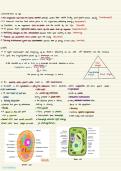
* characteristics of life
>
-
All
organisms can move to some extent , animals control their whole
body and plants move slowly /movement)
> A
-
chemical reaction that takes
place in all
organisms releasing energy (respiration)
,
> Increase
-
in an
organisms size or mass over the course of its life /Growth)
>
-
A process that replicates/ makes more of the same kind of organism (reproduction)
>
-
Noticing changes in the environment around them and
reacting to them (sensitivity)
>
-
Removal of unwanted toxic waste
from the
body (Excution]
>
Taking substances
from the environment around them cells (nutrition)
-
for energy or new
* cells
A 1500X allowing cell structures like
magnify the nucleus
>
light microscope can to us to see
-
up
- To
find the
magnification power of a microscope
Final
we can :
length
magnification power = Actual
length
A the diameter cell actual Final
·
of a is 10cm in a
microscope. The diameter is 0 .
01cm
Final length Length
magnification power = Actual
length
a = 1000
Magnification
the Actual length
power of the microscope is 1000X power
>
-
All animal and plant cells have a cell membrane .
Inside like called organelles
>
-
is the
cytoplasm ,
a
jelly substance . Small structures are also found inside .
·
cell membrane Cell wall
·
·
Cytoplasm
· A thin layer of fat and · Is made of cellulose ↳ Made of water
protein ·
only present in plant cells * Dissolves substances
metobolic reactions take
-
Partially Permeable · The cellulose forms a luffice *
Many
· Controls the flow of substances making it strong place in the
cytoplasm
·
Vacuole ·
Chloroplast ·
Nucleus
· A
space in the cell filled · Only present in plants Contains
·
genetic information
with a solution · shloroplasts have chlorophyll * DNA helps cells reproduce
· Animal cells have small vacuoles ·
chlorophyll absorbs light energy
Plant
· cells have larger vacuoles for photosynthesis
Plant cell
Animal cell
, Features Animal cells Plant cells
Cell
· wall Not present Present
·
Chloroplasts Not present Present
·
Carbohydrate In the form In the form
storage starch
of glycogen of
vacuole Not usually present Present and
·
or are
temporary are
large
Shape can
change shape ; fixed shape ;
*
rounded rectangular
A
light microscope has and lens and objective lens .
>
-
eyepiece a
total (objective magnification)
magnification =
(eyepice lens magnification) x lens
size of image
magnification =
size
of object
size
of
image
size
magni- of
fication object
-
cells adapted for specific functions plants animals.
-Many are in and
Cell Function Location
&
Root hair absorb water Near the end
cell and salt the plant
of roots
Palisade Beneath epidermis
·
Photosynthesis the
of the leaf
·
Red blood Transport of In the blood
cell oxygen of mammals
·
Sperm and
Fuse together Testes
cells and form a
zygote and ovaries
egg
· ciliated cells more mucus Line the
upwards tracked and bronchi
>
-
Diffusion is the movement of particles from an area of high concentration to an area
of low concentration ,
until there is
an equal spread of particles /equilibrium) . This only occurs in fluids.
Sinceraia
no moving particles in solids , diffusion does o
not a
-
·
...
-
:i
·
-
High
concentration
,> There
-
are
four factors which affect the rate of diffusion :
· concentration gradient .
Temperature . Travel distance
for a
particle ·
Surface area
> Diluted solutions have small amount solute dissolved into solvent
of
-
a a .
> concentrated of solute
A solution has
high amount compared to the solvent
-
a
>
-
Saturated solutions have the maximum amount of dissolved solute a solvent can contain
>
-
Osmosis is the movement of water from an area of high concentration to an area of low concentration
through a
partially permeable membrane
cell membrane separates the the solutions outside it
· The
cytoplasm from .
When the solution around the the cell becomes
>
-
plant cell is saturated , plasmolysed , as all the water leaves
the cell by osmosis .
>
-
when the solution around the plant cell is concentrated , the cell remains flaccid , as the water leaves and
enters the cell equally by osmosis .
> When
-
the solution around the cell is diluted ,
the cell becomes turgid , as a
large amount of water
enters the cell by osmosis.
> The cell wall is much than the membrane
stronger
-
which prevents the cell from bursting
>
-
The outward pressure of the Cytoplasm on the
cell wall is called turgor pressure
molecules
*
Biological
>
-
Almost 80 % of the
body is made up of water. Water acts as a solvent for most of the chemicals
in the body .
>
-
Metabolic reactions can only occur after chemicals are dissolved in water.
their reaction stops and the organism dies
>
-
If cells dry out ,
the .
Plasma liquid part of blood that substances like
glucose can dissolve in it
>
-
the , contains a lot of water so .
,
>
-
Most molecules fall under these 3
categories : Carbohydrates Proteins , ,
and Lipids (fats). They all contain carbon
and are described as organic compounds.
· Molecule chemical elements
·
Carbohydrate Carbon , oxygen , hydrogen
· Protein carbon , oxygen hydrogen , , nitrogen sulfur ,
(a little bit)
Carbon
·
Lipid ,
oxygen hydrogen ,
>
-
Carbohydrates include starches and sugars .
>
-
Sugars known as monosaccharides are the
simplest of sugars.
>
-
Glucose molecules ,
which are simple sugars ,
are made of 6 carbon ,
12
hydrogen and boxygen atoms . ((6H1206).
>
-
Simple sugar molecules are small and solvable in water.
>
-
Large molecules are made of smaller ones .
two
glucose molecules join together maltose is formed.
>
-
when
Sucrose
>
-
(used in beverages) and maltose [malt sugar) are examples of complex sugars
, >
Many simple sugars join together to form polysaccharides
-
.
>
-
They can even have thousands of sugar molecules·
> Cellulose and starch are both polysaccharides are both found in plants
they
-
, .
>
-
Glycogen is the form of polysaccharide found in animal sells .
>
-
Most polysaccharides are an insolute ,
and don't taste sweet .
>
-
functions of carbohydrates in plants and animals are :
· In Plants :
· They are created through photosynthesis Stored .
in the body of the plant (fruits , vegtables)
·
In animals
·
provide
energy as
they are broken down through cellular respiration.
>
-
Most lipids in the body are made
up of triglycerides.
· this means they made of 1 glycerol molecule and three fatty acid chains
>
-
Fats are solid at room temperature and oils are liquids at room temperature. These are both lipids .
>
-
Proteins are made up of amino acids joined together in a
long chain .
· There are around 20 different types of amino acids .
these molecules tests
> we
-
can test for through food
· Test for glucose /benedict's solution test)
·
Add the Benedicts solution into the sample solution in the test tube
·
Heat at 60-70 % in the water bath for 5 minutes
Take the test tube out and observe the colour
positive test will blue to brick red
· A change from orange or
· Test for starch
· Prepare iodine
· Put a
few drops onto the sample food
· It positive ,
it will turn blue/black .
Test
·
for protein
· Add a
few drops of Biuret solution to a food sample
positive test will show change
· A a
of colour from
blue to
purple
-
* Enzymes
>
-
Enzymes are biological catalysts. They help speed up metabolic reactions .
> In the
alimentary canal help speed
they digestion.
-
can
, up
>
Starch digested
-
is into sugar by amylase (enzyme).
Protein
>
-
is digested into amino acids by protease (enzyme).
>
-
Enzymes can make and break molecule
>
-
All
organisms can move to some extent , animals control their whole
body and plants move slowly /movement)
> A
-
chemical reaction that takes
place in all
organisms releasing energy (respiration)
,
> Increase
-
in an
organisms size or mass over the course of its life /Growth)
>
-
A process that replicates/ makes more of the same kind of organism (reproduction)
>
-
Noticing changes in the environment around them and
reacting to them (sensitivity)
>
-
Removal of unwanted toxic waste
from the
body (Excution]
>
Taking substances
from the environment around them cells (nutrition)
-
for energy or new
* cells
A 1500X allowing cell structures like
magnify the nucleus
>
light microscope can to us to see
-
up
- To
find the
magnification power of a microscope
Final
we can :
length
magnification power = Actual
length
A the diameter cell actual Final
·
of a is 10cm in a
microscope. The diameter is 0 .
01cm
Final length Length
magnification power = Actual
length
a = 1000
Magnification
the Actual length
power of the microscope is 1000X power
>
-
All animal and plant cells have a cell membrane .
Inside like called organelles
>
-
is the
cytoplasm ,
a
jelly substance . Small structures are also found inside .
·
cell membrane Cell wall
·
·
Cytoplasm
· A thin layer of fat and · Is made of cellulose ↳ Made of water
protein ·
only present in plant cells * Dissolves substances
metobolic reactions take
-
Partially Permeable · The cellulose forms a luffice *
Many
· Controls the flow of substances making it strong place in the
cytoplasm
·
Vacuole ·
Chloroplast ·
Nucleus
· A
space in the cell filled · Only present in plants Contains
·
genetic information
with a solution · shloroplasts have chlorophyll * DNA helps cells reproduce
· Animal cells have small vacuoles ·
chlorophyll absorbs light energy
Plant
· cells have larger vacuoles for photosynthesis
Plant cell
Animal cell
, Features Animal cells Plant cells
Cell
· wall Not present Present
·
Chloroplasts Not present Present
·
Carbohydrate In the form In the form
storage starch
of glycogen of
vacuole Not usually present Present and
·
or are
temporary are
large
Shape can
change shape ; fixed shape ;
*
rounded rectangular
A
light microscope has and lens and objective lens .
>
-
eyepiece a
total (objective magnification)
magnification =
(eyepice lens magnification) x lens
size of image
magnification =
size
of object
size
of
image
size
magni- of
fication object
-
cells adapted for specific functions plants animals.
-Many are in and
Cell Function Location
&
Root hair absorb water Near the end
cell and salt the plant
of roots
Palisade Beneath epidermis
·
Photosynthesis the
of the leaf
·
Red blood Transport of In the blood
cell oxygen of mammals
·
Sperm and
Fuse together Testes
cells and form a
zygote and ovaries
egg
· ciliated cells more mucus Line the
upwards tracked and bronchi
>
-
Diffusion is the movement of particles from an area of high concentration to an area
of low concentration ,
until there is
an equal spread of particles /equilibrium) . This only occurs in fluids.
Sinceraia
no moving particles in solids , diffusion does o
not a
-
·
...
-
:i
·
-
High
concentration
,> There
-
are
four factors which affect the rate of diffusion :
· concentration gradient .
Temperature . Travel distance
for a
particle ·
Surface area
> Diluted solutions have small amount solute dissolved into solvent
of
-
a a .
> concentrated of solute
A solution has
high amount compared to the solvent
-
a
>
-
Saturated solutions have the maximum amount of dissolved solute a solvent can contain
>
-
Osmosis is the movement of water from an area of high concentration to an area of low concentration
through a
partially permeable membrane
cell membrane separates the the solutions outside it
· The
cytoplasm from .
When the solution around the the cell becomes
>
-
plant cell is saturated , plasmolysed , as all the water leaves
the cell by osmosis .
>
-
when the solution around the plant cell is concentrated , the cell remains flaccid , as the water leaves and
enters the cell equally by osmosis .
> When
-
the solution around the cell is diluted ,
the cell becomes turgid , as a
large amount of water
enters the cell by osmosis.
> The cell wall is much than the membrane
stronger
-
which prevents the cell from bursting
>
-
The outward pressure of the Cytoplasm on the
cell wall is called turgor pressure
molecules
*
Biological
>
-
Almost 80 % of the
body is made up of water. Water acts as a solvent for most of the chemicals
in the body .
>
-
Metabolic reactions can only occur after chemicals are dissolved in water.
their reaction stops and the organism dies
>
-
If cells dry out ,
the .
Plasma liquid part of blood that substances like
glucose can dissolve in it
>
-
the , contains a lot of water so .
,
>
-
Most molecules fall under these 3
categories : Carbohydrates Proteins , ,
and Lipids (fats). They all contain carbon
and are described as organic compounds.
· Molecule chemical elements
·
Carbohydrate Carbon , oxygen , hydrogen
· Protein carbon , oxygen hydrogen , , nitrogen sulfur ,
(a little bit)
Carbon
·
Lipid ,
oxygen hydrogen ,
>
-
Carbohydrates include starches and sugars .
>
-
Sugars known as monosaccharides are the
simplest of sugars.
>
-
Glucose molecules ,
which are simple sugars ,
are made of 6 carbon ,
12
hydrogen and boxygen atoms . ((6H1206).
>
-
Simple sugar molecules are small and solvable in water.
>
-
Large molecules are made of smaller ones .
two
glucose molecules join together maltose is formed.
>
-
when
Sucrose
>
-
(used in beverages) and maltose [malt sugar) are examples of complex sugars
, >
Many simple sugars join together to form polysaccharides
-
.
>
-
They can even have thousands of sugar molecules·
> Cellulose and starch are both polysaccharides are both found in plants
they
-
, .
>
-
Glycogen is the form of polysaccharide found in animal sells .
>
-
Most polysaccharides are an insolute ,
and don't taste sweet .
>
-
functions of carbohydrates in plants and animals are :
· In Plants :
· They are created through photosynthesis Stored .
in the body of the plant (fruits , vegtables)
·
In animals
·
provide
energy as
they are broken down through cellular respiration.
>
-
Most lipids in the body are made
up of triglycerides.
· this means they made of 1 glycerol molecule and three fatty acid chains
>
-
Fats are solid at room temperature and oils are liquids at room temperature. These are both lipids .
>
-
Proteins are made up of amino acids joined together in a
long chain .
· There are around 20 different types of amino acids .
these molecules tests
> we
-
can test for through food
· Test for glucose /benedict's solution test)
·
Add the Benedicts solution into the sample solution in the test tube
·
Heat at 60-70 % in the water bath for 5 minutes
Take the test tube out and observe the colour
positive test will blue to brick red
· A change from orange or
· Test for starch
· Prepare iodine
· Put a
few drops onto the sample food
· It positive ,
it will turn blue/black .
Test
·
for protein
· Add a
few drops of Biuret solution to a food sample
positive test will show change
· A a
of colour from
blue to
purple
-
* Enzymes
>
-
Enzymes are biological catalysts. They help speed up metabolic reactions .
> In the
alimentary canal help speed
they digestion.
-
can
, up
>
Starch digested
-
is into sugar by amylase (enzyme).
Protein
>
-
is digested into amino acids by protease (enzyme).
>
-
Enzymes can make and break molecule