
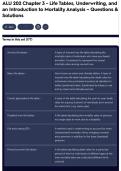
ALU 202 Chapter 3 - Life Tables, Underwriting, and
an Introduction to Mortality Analysis – Questions &
Solutions
Save
Terms in this set (177)
Annuity life tables - A type of insured lives life table tabulating the
mortality rates of individuals who have purchased
annuities. Considered to represent the lowest
mortality rates among insured lives.
Basic life tables - Also known as select and ultimate tables. A type of
insured lives life table tabulating the death rates for
individuals who purchased insurance at standard or
better (preferred) rates. Subdivided by tobacco use
and by select and ultimate periods.
Cohort (generation) life table - A type of life table tabulating the year-to-year death
rates for a group (cohort) of individuals born around
the same time ( e.g. same year).
Disabled lives life tables - A life table tabulating the mortality rates of persons
no longer able to work due to a disability
Flat extra rating (FE) - A method used in underwriting to account for extra
(substandard) mortality risk by charging constant
extra premium in addition to the base (standard)
premium.
Period (current) life tables - A life table tabulating death rates for a particular
period of time for individuals of different ages at the
time mortality data was collected (different birth
cohorts).
,Population life table - A life table tabulating death rates for large segments
of the population without regard to individual health,
socioeconomic status, or employment status.
Select factors - Scalar factors applied to life tables to reduce
projected mortality rates to levels thought to be
attractive to potential life insurance buyers while
maintaining achievable mortality goals through the
combination of target market selection, underwriting,
and anticipated secular (general population)
mortality improvements.
Select period - The period from life insurance policy issue to the
time at which the effect of underwriting has been
assumed to no longer be effective in selecting
standard or better risks from among the entire pool
of insured persons (often considered to be about 20
to 25 years).
Social security (pension) life tables - A type of population life table tabulating the
mortality rates of individuals who were actively
employed at some time.
Standard and ordinary life tables- Aggregate insured lives life tables in which select
and ultimate mortality rates are combined to arrive at
aggregate death rates for each age, thus ignoring
most of the effect of selection resulting from
underwriting. Death rates in such a table are
somewhat higher (more conservative) than those in
the basic select and ultimate tables.
Table rating - A method used in underwriting to account for extra
(substandard) mortality risk by charging extra
premium based on a multiple of the base (standard)
premium.
, Ultimate period - The period after the select period during which the
effect of underwriting is assumed to no longer be
effective in selecting standard or better risks from
the entire pool of insured persons, (often considered
to be the period beyond 20 to 25 years after
underwriting).
Interval Deaths, d_x Number of deaths occurring during the interval, x to
x+ 1
Interval probability of death, q_x Probability of death during the interval, x to x+ 1
Number of deaths occurring during the interval
divided by the interval exposure, dx/Ex
Interval probability of survival, p_x Probability of survival during the interval, x to x+1
1-qx, also Px/P_x+1
Interval excess death rate, edr_x Excess death rate during the interval, x to x+1. It is the
observed death rate less the expected death rate
during interval x. Usually expressed as the number of
extra deaths per 1000 individuals exposed to the risk
of dying during the interval, x
Interval mortality ratio, mr The ratio of the observed death rate (q) to the
expected death rate (q') during interval, x.
Number of lives entering interval x, 1_x Number of individuals exposed to the risk of dying at
the beginning of interval, x. It is equal to the number
of individuals entering the previous interval (x-1) less
the number of individuals withdrawn or lost to
follow-up and the number of individuals dying during
the previous interval
Average number of individuals alive The average number of individuals alive during an
during the interval, x, L_x interval is equal to the number of individuals entering
the interval less half of those dying during the
interval
an Introduction to Mortality Analysis – Questions &
Solutions
Save
Terms in this set (177)
Annuity life tables - A type of insured lives life table tabulating the
mortality rates of individuals who have purchased
annuities. Considered to represent the lowest
mortality rates among insured lives.
Basic life tables - Also known as select and ultimate tables. A type of
insured lives life table tabulating the death rates for
individuals who purchased insurance at standard or
better (preferred) rates. Subdivided by tobacco use
and by select and ultimate periods.
Cohort (generation) life table - A type of life table tabulating the year-to-year death
rates for a group (cohort) of individuals born around
the same time ( e.g. same year).
Disabled lives life tables - A life table tabulating the mortality rates of persons
no longer able to work due to a disability
Flat extra rating (FE) - A method used in underwriting to account for extra
(substandard) mortality risk by charging constant
extra premium in addition to the base (standard)
premium.
Period (current) life tables - A life table tabulating death rates for a particular
period of time for individuals of different ages at the
time mortality data was collected (different birth
cohorts).
,Population life table - A life table tabulating death rates for large segments
of the population without regard to individual health,
socioeconomic status, or employment status.
Select factors - Scalar factors applied to life tables to reduce
projected mortality rates to levels thought to be
attractive to potential life insurance buyers while
maintaining achievable mortality goals through the
combination of target market selection, underwriting,
and anticipated secular (general population)
mortality improvements.
Select period - The period from life insurance policy issue to the
time at which the effect of underwriting has been
assumed to no longer be effective in selecting
standard or better risks from among the entire pool
of insured persons (often considered to be about 20
to 25 years).
Social security (pension) life tables - A type of population life table tabulating the
mortality rates of individuals who were actively
employed at some time.
Standard and ordinary life tables- Aggregate insured lives life tables in which select
and ultimate mortality rates are combined to arrive at
aggregate death rates for each age, thus ignoring
most of the effect of selection resulting from
underwriting. Death rates in such a table are
somewhat higher (more conservative) than those in
the basic select and ultimate tables.
Table rating - A method used in underwriting to account for extra
(substandard) mortality risk by charging extra
premium based on a multiple of the base (standard)
premium.
, Ultimate period - The period after the select period during which the
effect of underwriting is assumed to no longer be
effective in selecting standard or better risks from
the entire pool of insured persons, (often considered
to be the period beyond 20 to 25 years after
underwriting).
Interval Deaths, d_x Number of deaths occurring during the interval, x to
x+ 1
Interval probability of death, q_x Probability of death during the interval, x to x+ 1
Number of deaths occurring during the interval
divided by the interval exposure, dx/Ex
Interval probability of survival, p_x Probability of survival during the interval, x to x+1
1-qx, also Px/P_x+1
Interval excess death rate, edr_x Excess death rate during the interval, x to x+1. It is the
observed death rate less the expected death rate
during interval x. Usually expressed as the number of
extra deaths per 1000 individuals exposed to the risk
of dying during the interval, x
Interval mortality ratio, mr The ratio of the observed death rate (q) to the
expected death rate (q') during interval, x.
Number of lives entering interval x, 1_x Number of individuals exposed to the risk of dying at
the beginning of interval, x. It is equal to the number
of individuals entering the previous interval (x-1) less
the number of individuals withdrawn or lost to
follow-up and the number of individuals dying during
the previous interval
Average number of individuals alive The average number of individuals alive during an
during the interval, x, L_x interval is equal to the number of individuals entering
the interval less half of those dying during the
interval


