

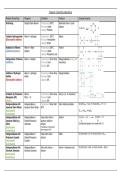
Organic Chemistry Reactions
Reaction Name/Type Reagents Conditions Products Example Equation
Reforming Straight-chain alkanes Temperature: 500°C Branched chain or cyclic
Pressure: 40atm alkanes
Catalyst: Platinum
Catalytic Hydrogenation Alkene + Hydrogen Temperature: 150°C Alkane
(Electrophilic Addition) Pressure: Atmospheric
Catalyst: Nickel
Hydration of Alkenes Alkene + Water Temperature: 300°C Alcohol
(Addition/Hydration) (Steam) Pressure: 65atm
Catalyst: Phosphoric acid
Halogenation of Alkenes Alkene + Halogen Temperature: Room temp Halogenoalkane (orange
(Addition) Pressure: 1atm colourless)
Catalyst: N/A
Addition of Hydrogen Alkene + Hydrogen Temperature: Room temp Halogenoalkane
Halides Halide Pressure: 1atm
(Electrophilic Addition) Catalyst: N/A
Oxidation by Potassium Alkene Temperature: Room temp Diol (purple colourless)
Manganate (VII) MnO4- + H+ Pressure: 1atm
(Redox) Catalyst: N/A
Halogenoalkane with Halogenoalkane + Temperature: Water bath Silver halide precipitate CH3CH2Cl(aq) + H2O(l) CH3CH2OH(aq) + H+ + Cl-
Aqueous Silver Nitrate Aqueous Silver Nitrate 60°C
(Nucleophilic Cl-(aq) + Ag+(aq) AgCl(s)
Substitution)
Halogenoalkane with Halogenoalkane + Heat under reflux in Alcohol
Aqueous Alkali (e.g. Sodium/Potassium aqueous solution +
KOH) Hydroxide ethanol (Substitution happens more readily with 1°)
(Nucleophilic *Substitution is favoured by
warm aqueous KOH
Substitution)
Halogenoalkane with Halogenoalkane + Heat under reflux + Nitrile CH3CH2CH2Br + CN- CH3CH2CH2CN + Br-(aq)
Potassium Cyanide Sodium/Potassium ethanol
(Nucleophilic Cyanide
Substitution)
Halogenoalkane with Halogenoalkane + Warm the mixture + Amine + Ammonium salt CH3CH2CH2Cl + 2NH3 CH3CH2CH2NH2 + NH4Cl
Alcoholic Ammonia Alcoholic Ammonia ethanol
(Nucleophilic
Substitution)
, Halogenoalkane with Halogenoalkane + Heat under reflux + Alkene CH3CH2CH2CH2Cl + OH- CH3CH2CH=CH2 + H2O + Cl-
Ethanolic Alkali (e.g. Concentrated KOH ethanol (Elimination happens more readily with 2° or 3°)
KOH) *Elimination is favoured by hot
ethanolic KOH
(Elimination)
Chlorination of Alcohols Alcohol + Solid Mix with dry alcohol (no CHLOROALKANE + CH3CH2OH(l) + PCl5(s) CH3CH2Cl(l) + HCl(g) + POCl3(l)
(Substitution) Phosphorus (V) water) at room Hydrogen Chloride + (Qualitative test for –OH groups)
Chloride (PCl5) temperature Phosphoryl chloride
(Steamy fumes of HCl seen)
Bromination of Alcohols Alcohol + KBr + 50% Heat under reflux Hydrogen bromide first KBr + H2SO4 KHSO4 + HBr
(Substitution) Sulfuric acid (prevent produced, which reacts with Then…
HBr being oxidised to alcohol to form HBr + CH3CH2OH CH3CH2Br + H2O
Br2) BROMOALKANE
Iodination of Alcohols Alcohol + Moist red Warm the mixture IODOALKANE + Phosphoric 2P + 3I2 2PI3
(Substitution) phosphorus + Iodine (moisture to allow solids acid PI3 + 3CH3CH2OH 3CH3CH2I + H3PO3
P and I2 to react)
Oxidation of a Primary 1° alcohol + Potassium Add the oxidising agent Aldehyde CH3CH2OH + [O] CH3CHO + H2O
Alcohol to an Aldehyde Dichromate (VI) + to a mixture of hot If aldehyde not separated, it will be rapidly oxidised to the
Carboxylic Acid Sulfuric acid ethanol and acid and carboxylic acid:
(Oxidation) distil off the aldehyde as CH3CHO + [O] CH3COOH
it forms
Orange Green
Oxidation of a 2° alcohol + Potassium Heat under reflux Ketone CH3CH(OH)CH3 + [O] CH3COCH3 + H2O
Secondary Alcohol to a Dichromate (VI) +
Ketone Sulfuric acid
(Oxidation)
Dehydration of Alcohols Alcohol + Catalyst e.g. Heat alcohol with catalyst Alkene
Al2O3 to remove water (also
works with conc.
H2SO4/phosphoric acid)
Silver Mirror Test with Aldehyde + Heat Carboxylic acid + Silver CH3CHO + Ag(NH3)2+ + H2O CH3COOH + Ag + 2NH4+
Tollens’s Reagent Ammoniacal Silver (Grey precipitate / silver
(Redox) Nitrate (Tollens’s mirror effect)
reagent)
Oxidation with Fehling’s Aldehyde + Fehling’s Heat Carboxylic acid + Copper CH3CHO + 2Cu2+ + 2H2O CH3COOH + 4H+ + Cu2O
Solution Solution (Cu2+ solution) (IV) oxide (Blue solution
(Redox) fades, red precipitate forms)
Oxidation with Aldehyde + K2Cr2O7 + Heat Carboxylic acid + Cr3+ 3CH3CHO + Cr2O72- + 8H+ 3CH3COOH + 2Cr3+ + 4H2O
Dichromate Solution H2SO4 solution (orange green)
(Redox)
Reduction of Carbonyl Ketone/Aldehyde + Dry ether solvent, H+ 1° or 2° alcohol CH3COCH3 + 2[H] CH3CH(OH)CH3
Compounds LiAlH4 (lithium
(Reduction / Addition) aluminium hydride)
Reaction Name/Type Reagents Conditions Products Example Equation
Reforming Straight-chain alkanes Temperature: 500°C Branched chain or cyclic
Pressure: 40atm alkanes
Catalyst: Platinum
Catalytic Hydrogenation Alkene + Hydrogen Temperature: 150°C Alkane
(Electrophilic Addition) Pressure: Atmospheric
Catalyst: Nickel
Hydration of Alkenes Alkene + Water Temperature: 300°C Alcohol
(Addition/Hydration) (Steam) Pressure: 65atm
Catalyst: Phosphoric acid
Halogenation of Alkenes Alkene + Halogen Temperature: Room temp Halogenoalkane (orange
(Addition) Pressure: 1atm colourless)
Catalyst: N/A
Addition of Hydrogen Alkene + Hydrogen Temperature: Room temp Halogenoalkane
Halides Halide Pressure: 1atm
(Electrophilic Addition) Catalyst: N/A
Oxidation by Potassium Alkene Temperature: Room temp Diol (purple colourless)
Manganate (VII) MnO4- + H+ Pressure: 1atm
(Redox) Catalyst: N/A
Halogenoalkane with Halogenoalkane + Temperature: Water bath Silver halide precipitate CH3CH2Cl(aq) + H2O(l) CH3CH2OH(aq) + H+ + Cl-
Aqueous Silver Nitrate Aqueous Silver Nitrate 60°C
(Nucleophilic Cl-(aq) + Ag+(aq) AgCl(s)
Substitution)
Halogenoalkane with Halogenoalkane + Heat under reflux in Alcohol
Aqueous Alkali (e.g. Sodium/Potassium aqueous solution +
KOH) Hydroxide ethanol (Substitution happens more readily with 1°)
(Nucleophilic *Substitution is favoured by
warm aqueous KOH
Substitution)
Halogenoalkane with Halogenoalkane + Heat under reflux + Nitrile CH3CH2CH2Br + CN- CH3CH2CH2CN + Br-(aq)
Potassium Cyanide Sodium/Potassium ethanol
(Nucleophilic Cyanide
Substitution)
Halogenoalkane with Halogenoalkane + Warm the mixture + Amine + Ammonium salt CH3CH2CH2Cl + 2NH3 CH3CH2CH2NH2 + NH4Cl
Alcoholic Ammonia Alcoholic Ammonia ethanol
(Nucleophilic
Substitution)
, Halogenoalkane with Halogenoalkane + Heat under reflux + Alkene CH3CH2CH2CH2Cl + OH- CH3CH2CH=CH2 + H2O + Cl-
Ethanolic Alkali (e.g. Concentrated KOH ethanol (Elimination happens more readily with 2° or 3°)
KOH) *Elimination is favoured by hot
ethanolic KOH
(Elimination)
Chlorination of Alcohols Alcohol + Solid Mix with dry alcohol (no CHLOROALKANE + CH3CH2OH(l) + PCl5(s) CH3CH2Cl(l) + HCl(g) + POCl3(l)
(Substitution) Phosphorus (V) water) at room Hydrogen Chloride + (Qualitative test for –OH groups)
Chloride (PCl5) temperature Phosphoryl chloride
(Steamy fumes of HCl seen)
Bromination of Alcohols Alcohol + KBr + 50% Heat under reflux Hydrogen bromide first KBr + H2SO4 KHSO4 + HBr
(Substitution) Sulfuric acid (prevent produced, which reacts with Then…
HBr being oxidised to alcohol to form HBr + CH3CH2OH CH3CH2Br + H2O
Br2) BROMOALKANE
Iodination of Alcohols Alcohol + Moist red Warm the mixture IODOALKANE + Phosphoric 2P + 3I2 2PI3
(Substitution) phosphorus + Iodine (moisture to allow solids acid PI3 + 3CH3CH2OH 3CH3CH2I + H3PO3
P and I2 to react)
Oxidation of a Primary 1° alcohol + Potassium Add the oxidising agent Aldehyde CH3CH2OH + [O] CH3CHO + H2O
Alcohol to an Aldehyde Dichromate (VI) + to a mixture of hot If aldehyde not separated, it will be rapidly oxidised to the
Carboxylic Acid Sulfuric acid ethanol and acid and carboxylic acid:
(Oxidation) distil off the aldehyde as CH3CHO + [O] CH3COOH
it forms
Orange Green
Oxidation of a 2° alcohol + Potassium Heat under reflux Ketone CH3CH(OH)CH3 + [O] CH3COCH3 + H2O
Secondary Alcohol to a Dichromate (VI) +
Ketone Sulfuric acid
(Oxidation)
Dehydration of Alcohols Alcohol + Catalyst e.g. Heat alcohol with catalyst Alkene
Al2O3 to remove water (also
works with conc.
H2SO4/phosphoric acid)
Silver Mirror Test with Aldehyde + Heat Carboxylic acid + Silver CH3CHO + Ag(NH3)2+ + H2O CH3COOH + Ag + 2NH4+
Tollens’s Reagent Ammoniacal Silver (Grey precipitate / silver
(Redox) Nitrate (Tollens’s mirror effect)
reagent)
Oxidation with Fehling’s Aldehyde + Fehling’s Heat Carboxylic acid + Copper CH3CHO + 2Cu2+ + 2H2O CH3COOH + 4H+ + Cu2O
Solution Solution (Cu2+ solution) (IV) oxide (Blue solution
(Redox) fades, red precipitate forms)
Oxidation with Aldehyde + K2Cr2O7 + Heat Carboxylic acid + Cr3+ 3CH3CHO + Cr2O72- + 8H+ 3CH3COOH + 2Cr3+ + 4H2O
Dichromate Solution H2SO4 solution (orange green)
(Redox)
Reduction of Carbonyl Ketone/Aldehyde + Dry ether solvent, H+ 1° or 2° alcohol CH3COCH3 + 2[H] CH3CH(OH)CH3
Compounds LiAlH4 (lithium
(Reduction / Addition) aluminium hydride)


