

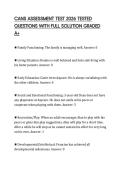
CANS ASSESSMENT TEST 2026 TESTED
QUESTIONS WITH FULL SOLUTION GRADED
A+
◉ Family Functioning: The family is managing well. Answer: 0
◉ Living Situation: Ronnie is well behaved and feels safe living with
his foster parents. Answer: 0
◉ Early Education: Gavin loves daycare. He is always socializing with
the other children. Answer: 0
◉ Social and Emotional Functioning: 3-year-old Dean does not have
any playmates at daycare. He does not smile at his peers or
cooperate when playing with them. Answer: 3
◉ Recreation/Play: When an adult encourages Alan to play with his
peers or gives him play suggestions, Alan will play for a short time.
After a while he will stop as he cannot sustain his effort for very long
on his own. Answer: 1
◉ Developmental/Intellectual: Francine has achieved all
developmental milestones. Answer: 0
,◉ Motor: 5-year-old Tilden is unable to walk but can manage hand-
related tasks. Answer: 3
◉ Communication: Donnelle has selective mutism and refuses to
speak. He also refuses to point to aid in communication. Answer: 3
◉ Medical/Physical: 4-year-old Paula has leukemia and her doctors
say that she might not live for more than one year. Answer:
◉ Sleep: Doris has night terrors that wake her up in a panic nearly
every night. She has become afraid of falling asleep and tries to stay
up all night. Answer: 3
◉ Relationship Permanence: 4-year-old Natasha is living in her third
foster home. Her permanency plan calls for her to live with her
mother; her mother participates fully in supervised visitation.
Answer: 2
◉ Strengths Domain Answer: For the Strengths Domain, use the
following categories and action levels: 0 Well-developed, centerpiece
strength; may be used as a centerpiece in an intervention/action
plan. 1 Identified and useful strength. Strength will be used,
maintained, or built upon as part of the plan. May require some
effort to develop strength into a centerpiece strength. 2 Strengths
, have been identified but require strength-building efforts before
they can be effectively utilized as part of a plan. Identified but not
useful. 3 An area in which no current strength is identified; efforts
may be recommended to develop a strength in this area.
◉ Family Strengths: Bruce is in foster care but has an uncle with
whom he is close. Answer: 1
◉ Extended Family Relations: Yale's grandmother is actively
involved in her life. Sometimes her grandma and mom fight, but they
always make up Answer: 1
◉ Family Cultural Identity: Thomas' family has a strong sense of
identity in his Polish community. They feel highly connected to the
people around them. Answer: 0
◉ Interpersonal: 4-year-old Marquis has some acquaintances and
can get along with peers, but has no real friends. Answer: 2
◉ Resiliency (Persistence and Adaptability): 2-year old Maria
usually continues to attempt challenging tasks. Sometimes her
mother assists her. Answer: 1
◉ Tina is a 4-year-old child residing with her biological mother. In
pre-school, her teachers observed that even though Tina does not
QUESTIONS WITH FULL SOLUTION GRADED
A+
◉ Family Functioning: The family is managing well. Answer: 0
◉ Living Situation: Ronnie is well behaved and feels safe living with
his foster parents. Answer: 0
◉ Early Education: Gavin loves daycare. He is always socializing with
the other children. Answer: 0
◉ Social and Emotional Functioning: 3-year-old Dean does not have
any playmates at daycare. He does not smile at his peers or
cooperate when playing with them. Answer: 3
◉ Recreation/Play: When an adult encourages Alan to play with his
peers or gives him play suggestions, Alan will play for a short time.
After a while he will stop as he cannot sustain his effort for very long
on his own. Answer: 1
◉ Developmental/Intellectual: Francine has achieved all
developmental milestones. Answer: 0
,◉ Motor: 5-year-old Tilden is unable to walk but can manage hand-
related tasks. Answer: 3
◉ Communication: Donnelle has selective mutism and refuses to
speak. He also refuses to point to aid in communication. Answer: 3
◉ Medical/Physical: 4-year-old Paula has leukemia and her doctors
say that she might not live for more than one year. Answer:
◉ Sleep: Doris has night terrors that wake her up in a panic nearly
every night. She has become afraid of falling asleep and tries to stay
up all night. Answer: 3
◉ Relationship Permanence: 4-year-old Natasha is living in her third
foster home. Her permanency plan calls for her to live with her
mother; her mother participates fully in supervised visitation.
Answer: 2
◉ Strengths Domain Answer: For the Strengths Domain, use the
following categories and action levels: 0 Well-developed, centerpiece
strength; may be used as a centerpiece in an intervention/action
plan. 1 Identified and useful strength. Strength will be used,
maintained, or built upon as part of the plan. May require some
effort to develop strength into a centerpiece strength. 2 Strengths
, have been identified but require strength-building efforts before
they can be effectively utilized as part of a plan. Identified but not
useful. 3 An area in which no current strength is identified; efforts
may be recommended to develop a strength in this area.
◉ Family Strengths: Bruce is in foster care but has an uncle with
whom he is close. Answer: 1
◉ Extended Family Relations: Yale's grandmother is actively
involved in her life. Sometimes her grandma and mom fight, but they
always make up Answer: 1
◉ Family Cultural Identity: Thomas' family has a strong sense of
identity in his Polish community. They feel highly connected to the
people around them. Answer: 0
◉ Interpersonal: 4-year-old Marquis has some acquaintances and
can get along with peers, but has no real friends. Answer: 2
◉ Resiliency (Persistence and Adaptability): 2-year old Maria
usually continues to attempt challenging tasks. Sometimes her
mother assists her. Answer: 1
◉ Tina is a 4-year-old child residing with her biological mother. In
pre-school, her teachers observed that even though Tina does not


