
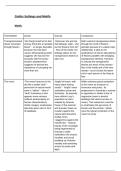
Gothic Settings and Motifs
Motifs
Theme/Motif Dorian Dracula Comparison
Transgressive/evil “she flung herself at his feet “whenever she got into Both examine transgressive desire
desire conveyed and lay there like a trampled that lethargic state…she through the motif of flowers -
through flowers flower” - no longer desirable put the flowers from her” perhaps because it’s a taboo topic.
because she has been - Fear of the inside, her Additionally, it adds to the
ruined, dehumanising simile lethargy allows for her aestheticism of Dorian (decadence
suggests she has lost her transgressive desires to of flowers parallels with indulging
humanity with her purity - take over. transgressive desires). However,
Dorian’s abandonment in Dracula the transgressive
suggests he desired the desires are those of the woman -
experience of corrupting her fear of the inside and of the new
more than her. woman - but in Dorian the latent
evil in each person is the thing to
fear.
The moon “The moon hung low in the “bright full moon, with Wilde subverts typical symbolism
sky like a yellow skull” - heavy black driving of the moon as a beacon of
perversion of natural world clouds” - “bright” moon innocence and purity - its
seen in “yellow” - idea of symbolises purity and progression to humanity is actively
“skull” humanises it and femininity - its passivity in opposition to Stoker’s fear of
appears more ominous here reflects Lucy’s regression (seen in derelict
(reflects portrait taking on powerless as she’s buildings that restrict access to
human characteristics). violated by Dracula. moon). This subversion could be
Gothic imagery emphasises Power of the external to emphasise the perversity of
idea that opium den is form and transient (seen as Dorian and the portrait - Stoker
of katabasis. invader) against the uses the typical symbolism of the
natural (and therefore moon for purity
Godly) moon.
“Jagged line against the
moonlit sky” - Natural
beauty of the moonlight
being fragmented by
Dracula’s castle
symbolises the arcane,
ritualistic and occult
breaking up Victorian
morality and restricting
access to purity (and
light)
, Natural imagery The external world and The external world seen The fear (and yet subtle
knowledge of it seen to be to be a threat: “lay like a idolisation) of naturalism present in
corrupting - prelapsarian filthy leech”, “lizard both, but for different purposes;
imagery. fashion”, “the howling of Wilde suggests the beauty of
Flowers often reflect the wolves around us, nature has the power to corrupt -
Dorian’s own corruption, as if they were following parallels critique of Hedonism and
while drawing attention to in a moving circle” aestheticism by suggesting its
his agelessness (and Natural world seen to be fixation on beauty hides darker
therefore sin) through their possessed and exploited truth. Stoker, meanwhile,
own transience) by evil - symbolises fear prioritises being natural (Dracula is
of regression a threat because he perverts
(traditionalism is nature) yet suggests it is a tool for
positive, but the danger - thus acclaiming
devolution and imperialism, industrialism, and
dehumanisation of British progress
“leech” and “lizard”
connote non naturalism).
Pushes agenda of
progress and distance
from savagery and
atavism (imperialist
ideal)
Blood “scarlet dew that spotted the Represents sexual acts: Blood is more figurative,
hand seemed brighter” - “feel his own life blood representative of sin in Dorian, but
metaphor of “dew” drawn away into the rarely enacting it (except for
associates the blood with veins of the woman he Basil’s murder - shows
natural world (Hedonism loves” - while animalisation of Dorian). Perhaps
and aestheticism) intangible heterosexuality briefly suggests Wilde critiques the
comparison distances saves Lucy (her union facade of gentility in aristocratic
Dorian from his own with Arthur) - her sin is corruption - idea they don’t involve
violence. Suggests part of in her promiscuity themselves in physical violence
his sin derives from his (three). makes their evil no more figurative
romanticisation of it. Alludes Dracula taking blood can and doesn’t absolve them. Stoker
to Lady Macbeth - suggests be interpreted as uses blood as a vehicle for sin
his evil will cause insanity symbolic of rape and (stigmatisation of sexuality), both
“though your sins be as deflowering animalising and sexualising it.
scarlet, yet I will make them (emphasised by “spot of Suggests in Wilde the evil is far
white as snow” blood”) - suggesting the more figurative, while in Stoker the
“crept with silent blood- foreigner’s threat to literal nature of the monster and
stained feet into his brain” - England is by tainting his threat embodied in tangibility of
personification, while it the purity of English blood symbolism
makes the memory a more women (stigma of
distinct threat, also interracial relationships)
distances Dorian from the
brutality.
Motifs
Theme/Motif Dorian Dracula Comparison
Transgressive/evil “she flung herself at his feet “whenever she got into Both examine transgressive desire
desire conveyed and lay there like a trampled that lethargic state…she through the motif of flowers -
through flowers flower” - no longer desirable put the flowers from her” perhaps because it’s a taboo topic.
because she has been - Fear of the inside, her Additionally, it adds to the
ruined, dehumanising simile lethargy allows for her aestheticism of Dorian (decadence
suggests she has lost her transgressive desires to of flowers parallels with indulging
humanity with her purity - take over. transgressive desires). However,
Dorian’s abandonment in Dracula the transgressive
suggests he desired the desires are those of the woman -
experience of corrupting her fear of the inside and of the new
more than her. woman - but in Dorian the latent
evil in each person is the thing to
fear.
The moon “The moon hung low in the “bright full moon, with Wilde subverts typical symbolism
sky like a yellow skull” - heavy black driving of the moon as a beacon of
perversion of natural world clouds” - “bright” moon innocence and purity - its
seen in “yellow” - idea of symbolises purity and progression to humanity is actively
“skull” humanises it and femininity - its passivity in opposition to Stoker’s fear of
appears more ominous here reflects Lucy’s regression (seen in derelict
(reflects portrait taking on powerless as she’s buildings that restrict access to
human characteristics). violated by Dracula. moon). This subversion could be
Gothic imagery emphasises Power of the external to emphasise the perversity of
idea that opium den is form and transient (seen as Dorian and the portrait - Stoker
of katabasis. invader) against the uses the typical symbolism of the
natural (and therefore moon for purity
Godly) moon.
“Jagged line against the
moonlit sky” - Natural
beauty of the moonlight
being fragmented by
Dracula’s castle
symbolises the arcane,
ritualistic and occult
breaking up Victorian
morality and restricting
access to purity (and
light)
, Natural imagery The external world and The external world seen The fear (and yet subtle
knowledge of it seen to be to be a threat: “lay like a idolisation) of naturalism present in
corrupting - prelapsarian filthy leech”, “lizard both, but for different purposes;
imagery. fashion”, “the howling of Wilde suggests the beauty of
Flowers often reflect the wolves around us, nature has the power to corrupt -
Dorian’s own corruption, as if they were following parallels critique of Hedonism and
while drawing attention to in a moving circle” aestheticism by suggesting its
his agelessness (and Natural world seen to be fixation on beauty hides darker
therefore sin) through their possessed and exploited truth. Stoker, meanwhile,
own transience) by evil - symbolises fear prioritises being natural (Dracula is
of regression a threat because he perverts
(traditionalism is nature) yet suggests it is a tool for
positive, but the danger - thus acclaiming
devolution and imperialism, industrialism, and
dehumanisation of British progress
“leech” and “lizard”
connote non naturalism).
Pushes agenda of
progress and distance
from savagery and
atavism (imperialist
ideal)
Blood “scarlet dew that spotted the Represents sexual acts: Blood is more figurative,
hand seemed brighter” - “feel his own life blood representative of sin in Dorian, but
metaphor of “dew” drawn away into the rarely enacting it (except for
associates the blood with veins of the woman he Basil’s murder - shows
natural world (Hedonism loves” - while animalisation of Dorian). Perhaps
and aestheticism) intangible heterosexuality briefly suggests Wilde critiques the
comparison distances saves Lucy (her union facade of gentility in aristocratic
Dorian from his own with Arthur) - her sin is corruption - idea they don’t involve
violence. Suggests part of in her promiscuity themselves in physical violence
his sin derives from his (three). makes their evil no more figurative
romanticisation of it. Alludes Dracula taking blood can and doesn’t absolve them. Stoker
to Lady Macbeth - suggests be interpreted as uses blood as a vehicle for sin
his evil will cause insanity symbolic of rape and (stigmatisation of sexuality), both
“though your sins be as deflowering animalising and sexualising it.
scarlet, yet I will make them (emphasised by “spot of Suggests in Wilde the evil is far
white as snow” blood”) - suggesting the more figurative, while in Stoker the
“crept with silent blood- foreigner’s threat to literal nature of the monster and
stained feet into his brain” - England is by tainting his threat embodied in tangibility of
personification, while it the purity of English blood symbolism
makes the memory a more women (stigma of
distinct threat, also interracial relationships)
distances Dorian from the
brutality.


