
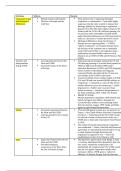
Syllabus Effects Details
Long-term rivalry Mutual mistrust and hostility Deep mistrust due to opposing ideologies
and ideological Division of Europe and the (capitalism v communism) -> both sides highly
differences Cold War suspicious that the other wanted to impose their
ideology globally by destroying its opposition ->
Russian Civil War (the West supply troops for the
Whites) and the US & GB’s delayed opening of a
second front until 1944 (Hitler invaded USSR
under Operation Barbarossa in 1941) perceived by
Stalin as a decision to weaken the Soviet Union
Ideological differences led to the division of
Europe into two opposing Blocs -> USSR’s
‘sphere of influence’ over Eastern Europe led to
the division of the continent into a communist
camp (‘the Eastern Bloc’) and capitalist camp ->
polarisation increased further when two rival
alliances set up NATO (1949) and the Warsaw Pact
(1955)
Tensions and Growing mistrust between the Stalin growing increasingly paranoid by US and
disagreements West and USSR GB delaying opening of a second front (opened in
during WWII Increased tension of the future 1944 but Hitler had invaded USSR under
of Europe Operation Barbarossa in 1941) and USA dropping
atomic bombs on Hiroshima and Nagasaki
concerned Stalin who believed the US may use
such bombs on the USSR in the future
Around 10 million Soviet soldiers killed in WWII
(US and GB both lost around 400,000 soldiers in
comparison -> estimated at a ratio of fifty Soviet
soldiers killed for every one American) -> Stalin
desperate for a ‘buffer zone’ to protect from
further invasions -> resulted in disagreements at
the Yalta Conference (Feb. 1945) over Poland
PRIOR TO WWII:
Munich Agreement, September 1938: British and
French had given into Hitler’s demands for
Czechoslovakia without even consulting Stalin
Nazi-Soviet Pact, August 1939: Stalin and Hitler
agreed to split Poland between them
Tehran Increased cooperation between USA and GB agreed to open up a second front in
the West and the USSR France -> the Grand Alliance discussed ‘Operation
Laid the ground for the creation Overlord’ -> Stalin pleased that the USSR would
of the UN be relieved of some of the pressure of the war ->
USSR also to keep land it had seized from Poland
in 1939
The outline of broader international cooperation
was established -> Stalin, Churchill and Roosevelt
agreed that an international body should be set up
to settle disputes through discussion and
negotiation as opposed to war -> led to the
establishment of the UN in February 1945
Yalta Improved relations between the The Big Three agreed upon many things at Yalta -
West and the USSR > Germany (demilitarised & denazified, split into
Provided temporary four zones, reparations commission to be
reassurance to the West about established), all would join the UN, USSR would
the fate of Eastern Europe join the war against Japan three months after
Germany’s defeat, USSR given a ‘sphere of
influence’ in Eastern Europe, but free elections
, must take place -> Stalin pleased with decisions
about Eastern Europe
The Declaration of Liberated Europe promised
“the earliest possible establishment through free
elections of governments responsive to the will of
the people” -> eased US and British concern about
Eastern Europe esp. Poland -> however Soviet
troops were not being removed from countries
they had liberated which became a point of tension
at Potsdam
Potsdam Worsened relations between the Allies had lost the common enemy and Attlee
West and USSR (more concerned about returning to Britain) and
Increased tension over the issue Truman (far more suspicious of Stalin) had taken
of nuclear weapons over as the Western leaders -> open disagreement
over Germany as Stalin wanted heavy reparations
to cripple the country but Truman did not want a
repeat of ToV -> Truman also perceived Stalin’s
actions in E. E. as aggressive and wanted less
communist influence in the region (Stalin was in
the process of setting up a communist govt. in
Poland)
16 July 1945: USA successfully exploded an
atomic bomb at their test site in the New Mexico
desert -> Truman told Stalin at the conference that
the US possessed ‘a new weapon of unusual
destructive force’ -> threatened the USSR and led
to the arms race
The attitudes of Increased distrust between the Truman openly suspicious of Stalin (far more than
Truman and USA and USSR Roosevelt) & his delayed announcement of the
Stalin Increased hostility between the atomic bomb increased Stalin’s suspicions of him
USA and USSR -> Stalin also determined to protect Soviet
interests and expand its influence in E. E. ->
Truman saw this as aggressive
Truman open and confrontational with Stalin at
Potsdam (objected to Stalin’s actions in E. E. esp.
Poland) -> Stalin felt threatened by USA’s atomic
power -> relationship grew more hostile as neither
side willing to back down -> development of the
arms race
Soviet Expansion Increased polarisation ‘Salami tactics’ -> Stalin seized power of Romania
in Eastern Europe Increased tension between the (establishment of communist-led coalition in late
USA and USSR 1944 when Red Army began occupation), Bulgaria
(rigged elections in Nov. 1945), Poland (rigged
elections in Jan. 1947 -> intimidation of non-
communist politicians), Hungary (rigged elections
in August 1947 -> Red Army intimidated voters)
and Czechslovakia (only communists allowed to
stand at the 1948 elections) -> Stalin had set up his
‘buffer zone’ through the creation of satellite states
-> Europe divided into two opposing Blocs
USA viewed Stalin’s as a direct breach of
agreements made at the Yalta conference
(Declaration of Liberated Europe) -> led to
Truman’s policy of containment (Truman Doctrine
and Marshall Aid) -> Stalin viewed these actions
as a threat to his influence
Churchill and the Contributed to the decline in Churchill declared that ‘an iron curtain has



