Written by students who passed Immediately available after payment Read online or as PDF Wrong document? Swap it for free 4.6 TrustPilot
logo-home
Document preview thumbnail
Preview 1 out of 3 pages
Summary

Summary Liability of Strangers Sumamry notes- Equity and Trusts

Document preview thumbnail
Preview 1 out of 3 pages

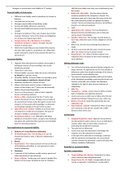
These are notes on liability of strangers created in 2019. They follow a structured format which condenses the relevant case law, statutory provisions and academic opinion that are relevant to the topic to aid with exam revision.

Content preview

Strangers as constructive trust (liability of 3rd parties) still held to be liable even there was no dishonesty from
the trustee
Personal liability of third parties:  Brinks Ltd v Abu-Saleh – Must be shown that the
 Different from liability owed to beneficiary by trustee or accessory assisted in the enterprise or breach. The
fiduciary assistance need not to have been the cause of the loss
 Can take form in two ways but must have been positive as opposed to passive
 Strangers may be liable to beneficiary under conduct. Merely accompanying someone committing a
 Accessorial liability (dishonest assistance) breach is not relevant assistance
 Receipt based liability (knowing receipt) (unconscionable 4. Fault-
receipt)  Agip (Africa) Ltd v Jackson- The true distinction is
 Strangers are liable as if they were trustees due to their between honesty and dishonesty and not between
improper behaviour. Some of the duties and obligations various levels of knowledge
of a trustee are imposed upon them  Zambia v Meer Care- The stranger must be shown to
 Paragon Finance Plc v DB Thakerar & Co/Dubai have had a dishonest state of mind, negligence will not
Aluminium Company v Salaam- Strangers become suffice
trustees in all but name  Before Tan, the test was knowledge based (Barnes v
 Where the trustee/fiduciary has retained the property, Addy)
the claim will usually be a proprietary one. When third  No loner concerned with the state of mind of trustee
parties improperly acquire trust property the claim is a after Tan, breach of trust is always breach
personal one  Royal Brunei v Tan- What is honest conduct is not
subjective and is not based on the moral standing of
Accessorial liability: each individual

 Happens when third party has assisted, encouraged or Defining dishonesty- fault:
facilitated a breach of trust resulting in loss to the
beneficiary principle  Tan- Old test of knowing assistance/Baden categories no
 Takes form in two ways longer relevant. An appropriate test for fault should be
 Primary liability- accessory liable due to the commission dishonesty rather than simple knowledge of the breach,
by himself of a primary wrong move towards a more objective test
 Secondary liability- Accessory liable in a secondary sense  Two issues in determining liability which are the extent
for encouraging or assisting in a breach of trust of the defendant knowledge concerning the breach and
 Dishonest assistance in a breach of trust: would a reasonable man consider the defendant
 Where a third party assist a trustee or fiduciary in culpable in the light of what he knew (element of
breach of their duties, the 3rd party may be personally subjectivity)
liable to the principal/beneficiary  After Tan
 Focus is on the accessory’s state of mind, originally  Twinsectra v Yardale- Courts chose to follow a hybrid
known as knowing assistance tests of subjective and objective elements
 Barnes v Addy- requirement that the 3rd party must  Courts were unsure which case to follow after this but
assist in the breach of trust. Strangers are not made to should have followed Twinsectra as it was a HOL case
be constructive trustees unless the agents receive trust  Barlow v Eurotrust- Stated the appropriate test was
property, or they assist with knowledge in a dishonest reflected in Tan
and fraudulent design on the part of the trustees  Abou-Rahmah v Abacha- Followed Tan (Privy Council)
 Agip (Africa) Ltd v Jackson- Liability of accessory does over Twinsectra, HOL did not consider the conflict
not depend on receipt of trust property, the basis of between these three cases
stranger’s liability is participation in fraud Current state:
 Royal Brunei Airlines v Tan- Difficulties with fixing
liability as constructive trustee, company went bankrupt  Starglade Properties v Nash- Objective test preferred
but agent who authorised they payment was held liable and demanded for policy reasons, focus on defendant’s
based on knowing assistance conduct rather state of mind. Policy reasons are
protecting the beneficiaries/principal.
Four requirements for accessorial liability:  Two part test for dishonesty:
1. Existence of a trust/fiduciary relationship  Courts must asses the defendant’s knowledge and
 JD Weatherspoon Plc v Van De Berg & Co Ltd- No suspicion as to the enterprise in question
formal trust needs to exist, a fiduciary relationship is  In the light of the defendant’s knowledge, combined
sufficient with his experience and expertise, the court should
2. Breach consider whether the defendant’s actions fell below the
 Royal Brunei v Tan- Innocent breach of trust on the part ordinary standard of dishonesty
of the fiduciary will suffice, it’s not necessary to show Remedies for accessorial liability:
fraud of dishonesty
3. Assistance Equitable compensation:
 A question of fact/evidence usually involves agents and
other fiduciaries but not exclusively  Target Holdings Ltd v Returns- Restorative in nature,
 Eaves v Hickson- Trustee pays out money to people they returns what has been misappropriated
believe are the proper beneficiaries but are mistaken,  Grupo Torras SA v Al- Sabah- Compensation for loss
caused as opposed to restitutionary compensation

Connected book
 image
Graham Virgo, Graham Virgo The Principles of Equity & Trusts
Publisher: Unknown ISBN: 9780198726180 Edition: 2

Document information

Summarized whole book?
Yes
Uploaded on
April 30, 2021
Number of pages
3
Written in
2019/2020
Type
Summary
£7.48

Wrong document? Swap it for free Within 14 days of purchase and before downloading, you can choose a different document. You can simply spend the amount again.
Written by students who passed
Immediately available after payment
Read online or as PDF

Seller avatar
Reputation scores are based on the amount of documents a seller has sold for a fee and the reviews they have received for those documents. There are three levels: Bronze, Silver and Gold. The better the reputation, the more your can rely on the quality of the sellers work.
Sold
18
Followers
4
Items
9
Last sold
2 year ago


Why students choose Stuvia

Created by fellow students, verified by reviews

Quality you can trust: written by students who passed their exams and reviewed by others who've used these revision notes.

Didn't get what you expected? Choose another document

No problem! You can straightaway pick a different document that better suits what you're after.

Pay as you like, start learning straight away

No subscription, no commitments. Pay the way you're used to via credit card and download your PDF document instantly.

Student with book image

“Bought, downloaded, and smashed it. It really can be that simple.”

Alisha Student

Working on your references?

Create accurate citations in APA, MLA and Harvard with our free citation generator.

Working on your references?

Frequently asked questions