Written by students who passed Immediately available after payment Read online or as PDF Wrong document? Swap it for free 4.6 TrustPilot
logo-home
Document preview thumbnail
Preview 1 out of 2 pages
Summary

Tracing Summary Notes- Equity and Trusts

Document preview thumbnail
Preview 1 out of 2 pages

These are notes on tracing created in 2019. They follow a structured format which condenses the relevant case law, statutory provisions and academic opinion that are relevant to the topic to aid with exam revision.

Content preview

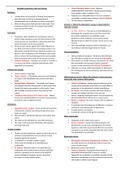
Equitable proprietary claim and tracing:  Chase Manhattan Bank v Israel- Fiduciary
relationship/duty arose when a brank received money
Definition: from another under a mistake of fact
 Tracing refers to the process of tracing trust property  Property is in a traceable form, if it is not a remedy is
from the point at which it is misappropriated unavailable as equity does nothing in vain (Re Diplock)
(unauthorized use) to the point at which it dissipated  Can be used for mixed funds
 Refers to the process itself and not to the claim. Once Scenario 1- Where the defendant’s money is mixed with the
property has been traced, the claimant must decide claimant’s money:
were to base their claim
 Re Tiley’s Will Trust - The onus is on the defendant to
Two types: distinguish the separate assets and if he cannot then
 Proprietary claim: Reclaim he trust property and any they will be subjected to an equitable charge.
profits made/substitute assets/ All claims based on the Beneficiary will be entitled to every portion of the
tracing process are proprietary in nature because they blended property which the trustee cannot prove to be
attach themselves to the trust property. his own
 Personal claim: Action against the trustee/fiduciary or  Once the equitable charge has been established, you
any third party who has been in knowing receipt or has must look at what has happened to the money
dishonestly assisted the breach. All personal claims are Two presumptions:
based on the wrongdoing of the defendant and require
them to restore the trust/principal to the same position  Normal/Hallet presumption- will be that the defendant
they would have been in prior to the wrong occurring has intended to spend his own money first (Re Hallet)
 Foskett v Mckeown – Tracing is not a claim or remedy, it  If this leads to an unfair outcome, the claimant can rebut
is a process by which a claimant demonstrates what this presumption and presume that the claimant’s
happened to his property money has ben spend first (Re Oatway Presumption)
 Claimant can choose which presumption to follow and
Common law tracing: this will depend on the circumstances and what will suit
 Claim is based on legal title them best
 Taylor v Plumer - A beneficiary may trace trust property Mixed funds and assets- Where the claimant’s money becomes
as long as it still identifiable and unmixed with other mixed with other innocent third parties:
funds
 Banque Belge v Hambrouk – This applies even where  Sinclair v Brougham - Before being transferred out the
the property has been transferred to a third party. Even money will be presumed to be held on an equal basis in
though the money was passed to a third party, it was proportion to the defendant’s relative contribution
still traceable at common law as the funds had not  Re Clayton- For current accounts, when the money is
mixed moved out it follows the first in, first out rule
 Trustees of the Property of FC Jones v Locks – Where  Rule is a rebuttal presumption which can be rebutted by
trustee has invested property at a profit, tracing extends demonstrating that it will lead to an unjust result
to profit as well as original property  Barlow v Vaughan- The rule in Clayton will not apply in 3
situations
Limitations: 1. It would be impractical (because of difficulty or expense
 Agip (Africa) Ltd v Jackson - Funds cannot be traced into involved in ascertaining order of payments)
mixed assets, common law tracing breaks down when 2. It would result in an injustice
funds are mixed 3. It would be contrary to the party’s intentions
 Must be able to identify the physical asset (rather than When tracing fails:
value)
 The claim can be defeated by a bona fide purchaser  Dissipation of the asset (asset is gone)
 The claim is personal and is directed to the claimant’s  Roscoe v Winder- Lowest intermediate balance, the
personal funds only beneficiaries cannot claim anything above the lowest
balance to which the account sank after the rust money
Tracing in equity: was paid in, any money deposited after the trust money
 Usually used by beneficiaries against trustees because in was deposited is not claimable
common law beneficiaries have no interest in trust Backwards tracing:
property against the trustees
 3 conditions for tracing to apply in equity  Bishopsgate Investment Management v Hoffman- This
 Claim must be founded on an initial fiduciary describes the process of attempts made to trace into
relationship assets already owned
 Re Diplock- Whenever there is an initial fiduciary  Backward tracing is not allowed
relationship, the beneficial owner of then equitable  Foskett v Mckeown- Recognized the principle of
interest in property can be traced in the hands of backwards tracing but didn’t come to a verdict.
anyone holding the property except a bona fide Suggested the availability of equitable remedies should
purchaser for value without notice. depend on the substance of the transaction and not the
strict order in which events happen

Connected book
 image
Graham Virgo, Graham Virgo The Principles of Equity & Trusts
Publisher: Unknown ISBN: 9780198726180 Edition: 2

Document information

Summarized whole book?
Yes
Uploaded on
April 30, 2021
Number of pages
2
Written in
2019/2020
Type
Summary
£7.48

Wrong document? Swap it for free Within 14 days of purchase and before downloading, you can choose a different document. You can simply spend the amount again.
Written by students who passed
Immediately available after payment
Read online or as PDF

Seller avatar
Reputation scores are based on the amount of documents a seller has sold for a fee and the reviews they have received for those documents. There are three levels: Bronze, Silver and Gold. The better the reputation, the more your can rely on the quality of the sellers work.
Sold
18
Followers
4
Items
9
Last sold
2 year ago


Why students choose Stuvia

Created by fellow students, verified by reviews

Quality you can trust: written by students who passed their exams and reviewed by others who've used these revision notes.

Didn't get what you expected? Choose another document

No problem! You can straightaway pick a different document that better suits what you're after.

Pay as you like, start learning straight away

No subscription, no commitments. Pay the way you're used to via credit card and download your PDF document instantly.

Student with book image

“Bought, downloaded, and smashed it. It really can be that simple.”

Alisha Student

Working on your references?

Create accurate citations in APA, MLA and Harvard with our free citation generator.

Working on your references?

Frequently asked questions