Emergency Medicine Final Exam, Key Concepts: for quick study and exam preparation.
Emergency Medicine Final Exam, Key Concepts
Study online at https://quizlet.com/_igejsr
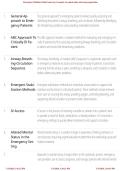
1. General Ap- The general approach to emergency patients involves quickly assessing and
proach to Emer- stabilizing the patient's airway, breathing, and circulation, followed by identifying
gency Patients life-threatening conditions and providing immediate treatment.
2. ABC Approach To The ABC approach involves a stepwise method for evaluating and managing crit-
Critically Ill Pa- ically ill patients by first assessing and treating Airway, Breathing, and Circulation
tient to detect and correct life-threatening conditions.
3. Airway-Breath- The airway–breathing–circulation (ABC) sequence is a systematic approach used
ing-Circulation in emergency medicine to assess and manage critically ill patients. It prioritizes
Sequence ensuring that the airway is open, breathing is adequate, and circulation is stable
before addressing other problems.
4. Emergent Stabi- Emergent stabilization methods are immediate actions taken to support and
lization Methods maintain vital functions in critically ill patients. These methods include interven-
tions such as securing the airway, providing oxygen, controlling bleeding, and
supporting blood circulation to prevent further deterioration.
5. IV Access IV access is the process of inserting a needle or catheter into a patient's vein
to provide a route for fluids, medications, or blood products. It is essential in
emergency settings to quickly deliver treatments and support circulation.
6. Altered Mental Altered mental status is a sudden change in awareness, thinking, behavior, or
Status in the consciousness requiring urgent evaluation to determine the underlying cause and
Emergency Set- initiate treatment.
ting
7. Approach to mental status changes refers to the systematic process emergency
care providers use to assess, diagnose, and manage patients with altered mental
3/31/2026, 3:01:22 PM 3/31/2026, 3:01:21 PM 3/31/2026, 3:01:19 PM
, Emergency Medicine Final Exam, Key Concepts: for quick study and exam preparation.
Emergency Medicine Final Exam, Key Concepts
Study online at https://quizlet.com/_igejsr
Approach to status. This includes checking vital signs, reviewing the patient's history, perform-
Mental Status ing a physical exam, and ordering appropriate tests to find the underlying cause.
Changes
8. Cardiac Arrest Cardiac arrest is the sudden loss of heart function, leading to the absence of a
pulse and breathing, and requires immediate resuscitation efforts.
9. Advanced Resus- Advanced resuscitation methods are specialized medical procedures used during
citation Methods cardiac arrest when basic measures are not enough. These include advanced
airway management, intravenous medications, and cardiac monitoring, usually
performed by trained healthcare professionals.
10. Epinephrine Epinephrine is a medication used during cardiac arrest to help restore a heart-
beat. It works by increasing blood flow to the heart and brain and improving the
chances of successful resuscitation.
11. Reversible Caus- Reversible causes are underlying conditions that can lead to cardiac arrest but
es can be treated or corrected during resuscitation, such as low oxygen, low blood
volume, or electrolyte imbalances.
12. AED Use AED use refers to the application of an automated external defibrillator, a portable
device that analyzes a person's heart rhythm and, if needed, delivers an electrical
shock to help restore a normal heartbeat during cardiac arrest.
13. Chest Compres- Chest compressions are repeated, rhythmic presses on a patient's chest that help
sions manually pump blood through the heart and to the rest of the body during cardiac
arrest.
14.
3/31/2026, 3:01:22 PM 3/31/2026, 3:01:21 PM 3/31/2026, 3:01:19 PM
, Emergency Medicine Final Exam, Key Concepts: for quick study and exam preparation.
Emergency Medicine Final Exam, Key Concepts
Study online at https://quizlet.com/_igejsr
Chest Pain in the Chest pain in the emergency setting indicates discomfort in the chest area,
Emergency Set- which needs urgent evaluation to identify serious causes such as heart attack or
ting pulmonary embolism.
15. Basic Bedside In- Basic bedside investigations are quick diagnostic procedures performed near the
vestigations patient, such as vital signs measurement, electrocardiogram (ECG), and pulse
oximetry, to gather important information needed to assess chest pain in the
emergency setting.
16. ECG ECG stands for electrocardiogram, a medical test that measures the electrical
activity of the heart. In emergency rooms, doctors use ECGs to quickly detect
problems like a heart attack in patients with chest pain.
17. Troponin Troponin is a type of protein found in heart muscle cells. Elevated levels of troponin
in the blood are a sign of heart muscle injury and are often used to help diagnose
a heart attack in emergency situations.
18. Prioritization of Prioritization of lethal causes is the process of quickly identifying and addressing
Lethal Causes life-threatening conditions, such as heart attack or aortic dissection, in an emer-
gency patient with chest pain, in order to provide proper and timely treatment.
19. Myocardial In- Myocardial infarction, also called a heart attack, is a condition where there is a
farction sudden loss of blood flow to a part of the heart muscle, causing tissue damage.
This usually happens when a coronary artery becomes blocked by a blood clot.
20. Gastrointestinal Gastrointestinal bleeding is the loss of blood from any part of the digestive
Bleeding tract, presenting with symptoms like vomiting blood or black stool. It may be
life-threatening and needs urgent diagnosis and management.
3/31/2026, 3:01:22 PM 3/31/2026, 3:01:21 PM 3/31/2026, 3:01:19 PM
, Emergency Medicine Final Exam, Key Concepts: for quick study and exam preparation.
Emergency Medicine Final Exam, Key Concepts
Study online at https://quizlet.com/_igejsr
21. Urgent Care Pri- Urgent care priorities refer to the immediate actions and management steps
orities needed to stabilize a patient with gastrointestinal bleeding. These include assess-
ing vital signs, maintaining airway and circulation, initiating intravenous access,
and preparing for further diagnostic or therapeutic interventions.
22. Blood Transfu- Blood transfusion is the process of giving blood or blood products to a patient
sion through a vein. In cases of gastrointestinal bleeding, transfusions are used to
replace lost blood and improve circulation.
23. Headache in the Headache in the emergency setting refers to head pain that may signal a serious
Emergency Set- underlying condition and needs rapid assessment to rule out emergencies.
ting
24. Emergency De- The emergency department approach refers to the systematic process used by
partment Ap- healthcare professionals to assess and manage patients with headaches in the
proach emergency setting. This includes taking a detailed history, performing a physical
and neurological examination, identifying warning signs of serious illness, and
deciding on appropriate investigations and treatments.
25. Non-Contrast CT Non-contrast CT is a type of computed tomography (CT) brain scan done without
giving the patient a contrast dye. It helps quickly check for serious causes of
headache, such as bleeding in the brain, in the emergency setting.
26. Multiple Trauma Multiple trauma refers to injuries affecting multiple organ systems or parts of
the body, usually caused by major accidents, requiring coordinated and rapid
emergency care.
27.
3/31/2026, 3:01:22 PM 3/31/2026, 3:01:21 PM 3/31/2026, 3:01:19 PM
Emergency Medicine Final Exam, Key Concepts
Study online at https://quizlet.com/_igejsr
1. General Ap- The general approach to emergency patients involves quickly assessing and
proach to Emer- stabilizing the patient's airway, breathing, and circulation, followed by identifying
gency Patients life-threatening conditions and providing immediate treatment.
2. ABC Approach To The ABC approach involves a stepwise method for evaluating and managing crit-
Critically Ill Pa- ically ill patients by first assessing and treating Airway, Breathing, and Circulation
tient to detect and correct life-threatening conditions.
3. Airway-Breath- The airway–breathing–circulation (ABC) sequence is a systematic approach used
ing-Circulation in emergency medicine to assess and manage critically ill patients. It prioritizes
Sequence ensuring that the airway is open, breathing is adequate, and circulation is stable
before addressing other problems.
4. Emergent Stabi- Emergent stabilization methods are immediate actions taken to support and
lization Methods maintain vital functions in critically ill patients. These methods include interven-
tions such as securing the airway, providing oxygen, controlling bleeding, and
supporting blood circulation to prevent further deterioration.
5. IV Access IV access is the process of inserting a needle or catheter into a patient's vein
to provide a route for fluids, medications, or blood products. It is essential in
emergency settings to quickly deliver treatments and support circulation.
6. Altered Mental Altered mental status is a sudden change in awareness, thinking, behavior, or
Status in the consciousness requiring urgent evaluation to determine the underlying cause and
Emergency Set- initiate treatment.
ting
7. Approach to mental status changes refers to the systematic process emergency
care providers use to assess, diagnose, and manage patients with altered mental
3/31/2026, 3:01:22 PM 3/31/2026, 3:01:21 PM 3/31/2026, 3:01:19 PM
, Emergency Medicine Final Exam, Key Concepts: for quick study and exam preparation.
Emergency Medicine Final Exam, Key Concepts
Study online at https://quizlet.com/_igejsr
Approach to status. This includes checking vital signs, reviewing the patient's history, perform-
Mental Status ing a physical exam, and ordering appropriate tests to find the underlying cause.
Changes
8. Cardiac Arrest Cardiac arrest is the sudden loss of heart function, leading to the absence of a
pulse and breathing, and requires immediate resuscitation efforts.
9. Advanced Resus- Advanced resuscitation methods are specialized medical procedures used during
citation Methods cardiac arrest when basic measures are not enough. These include advanced
airway management, intravenous medications, and cardiac monitoring, usually
performed by trained healthcare professionals.
10. Epinephrine Epinephrine is a medication used during cardiac arrest to help restore a heart-
beat. It works by increasing blood flow to the heart and brain and improving the
chances of successful resuscitation.
11. Reversible Caus- Reversible causes are underlying conditions that can lead to cardiac arrest but
es can be treated or corrected during resuscitation, such as low oxygen, low blood
volume, or electrolyte imbalances.
12. AED Use AED use refers to the application of an automated external defibrillator, a portable
device that analyzes a person's heart rhythm and, if needed, delivers an electrical
shock to help restore a normal heartbeat during cardiac arrest.
13. Chest Compres- Chest compressions are repeated, rhythmic presses on a patient's chest that help
sions manually pump blood through the heart and to the rest of the body during cardiac
arrest.
14.
3/31/2026, 3:01:22 PM 3/31/2026, 3:01:21 PM 3/31/2026, 3:01:19 PM
, Emergency Medicine Final Exam, Key Concepts: for quick study and exam preparation.
Emergency Medicine Final Exam, Key Concepts
Study online at https://quizlet.com/_igejsr
Chest Pain in the Chest pain in the emergency setting indicates discomfort in the chest area,
Emergency Set- which needs urgent evaluation to identify serious causes such as heart attack or
ting pulmonary embolism.
15. Basic Bedside In- Basic bedside investigations are quick diagnostic procedures performed near the
vestigations patient, such as vital signs measurement, electrocardiogram (ECG), and pulse
oximetry, to gather important information needed to assess chest pain in the
emergency setting.
16. ECG ECG stands for electrocardiogram, a medical test that measures the electrical
activity of the heart. In emergency rooms, doctors use ECGs to quickly detect
problems like a heart attack in patients with chest pain.
17. Troponin Troponin is a type of protein found in heart muscle cells. Elevated levels of troponin
in the blood are a sign of heart muscle injury and are often used to help diagnose
a heart attack in emergency situations.
18. Prioritization of Prioritization of lethal causes is the process of quickly identifying and addressing
Lethal Causes life-threatening conditions, such as heart attack or aortic dissection, in an emer-
gency patient with chest pain, in order to provide proper and timely treatment.
19. Myocardial In- Myocardial infarction, also called a heart attack, is a condition where there is a
farction sudden loss of blood flow to a part of the heart muscle, causing tissue damage.
This usually happens when a coronary artery becomes blocked by a blood clot.
20. Gastrointestinal Gastrointestinal bleeding is the loss of blood from any part of the digestive
Bleeding tract, presenting with symptoms like vomiting blood or black stool. It may be
life-threatening and needs urgent diagnosis and management.
3/31/2026, 3:01:22 PM 3/31/2026, 3:01:21 PM 3/31/2026, 3:01:19 PM
, Emergency Medicine Final Exam, Key Concepts: for quick study and exam preparation.
Emergency Medicine Final Exam, Key Concepts
Study online at https://quizlet.com/_igejsr
21. Urgent Care Pri- Urgent care priorities refer to the immediate actions and management steps
orities needed to stabilize a patient with gastrointestinal bleeding. These include assess-
ing vital signs, maintaining airway and circulation, initiating intravenous access,
and preparing for further diagnostic or therapeutic interventions.
22. Blood Transfu- Blood transfusion is the process of giving blood or blood products to a patient
sion through a vein. In cases of gastrointestinal bleeding, transfusions are used to
replace lost blood and improve circulation.
23. Headache in the Headache in the emergency setting refers to head pain that may signal a serious
Emergency Set- underlying condition and needs rapid assessment to rule out emergencies.
ting
24. Emergency De- The emergency department approach refers to the systematic process used by
partment Ap- healthcare professionals to assess and manage patients with headaches in the
proach emergency setting. This includes taking a detailed history, performing a physical
and neurological examination, identifying warning signs of serious illness, and
deciding on appropriate investigations and treatments.
25. Non-Contrast CT Non-contrast CT is a type of computed tomography (CT) brain scan done without
giving the patient a contrast dye. It helps quickly check for serious causes of
headache, such as bleeding in the brain, in the emergency setting.
26. Multiple Trauma Multiple trauma refers to injuries affecting multiple organ systems or parts of
the body, usually caused by major accidents, requiring coordinated and rapid
emergency care.
27.
3/31/2026, 3:01:22 PM 3/31/2026, 3:01:21 PM 3/31/2026, 3:01:19 PM