The Biological Approach
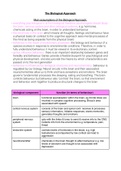
Main assumptions of the Biological Approach:
- everything psychological is at first biological therefore psychologists should study
the brain, nervous system and other biological systems, e.g. hormones,
chemicals acting on the brain, in order to understand behaviour
- the mind lives in the brain which means all thoughts, feelings and behaviour have
a physical basis (in contrast to the cognitive approach sees mental processes of
the mind as being separate from the physical brain)
- behaviour is the result of evolutionary processes: the biology and behaviour of a
species evolves in response to environmental conditions. Therefore, in order to
fully understand behaviour, it must be viewed in its evolutionary context
- genes influence behaviour: there is an important relationship between genes and
heredity and behaviour. Genes provide a flexible blueprint for psychological and
physical development, and also provide the means by which characteristics are
passed on to the next generation
- behaviour is influenced by biological structures and neurochemistry: behaviour is
regulated by our biology. Neural circuits in the brain and their associated
neurochemistries allow us to think and have sensations and emotions. The brain
governs fundamental processes like sleeping, eating and breathing. The brain
controls behaviour but behaviour also ‘controls’ the brain, so that environment
and behaviour work together to produce structural changes to the brain
biological component function (in terms of behaviour)
brain functional specialisation within the brain, eg frontal lobes are
involved in complex cognitive processing, Broca’s area
associated with speech
central nervous system consists of the brain and spinal cord- receives & processes
sensory information, initiates responses, stores memories,
generates thoughts and emotions
peripheral nervous acts with the limbs & torso to send & receive info to the CNS.
system Collects info from the environment e.g. temperature, pain,
threat
endocrine system controls levels of hormones in the blood, e.g. high
testosterone accompanied by low cortisol can lead to
aggression
neurotransmitter chemicals in the brain thought to affect behaviour e.g. low
levels of serotonin are thought to be associated with
depression
Main assumptions of the Biological Approach:
- everything psychological is at first biological therefore psychologists should study
the brain, nervous system and other biological systems, e.g. hormones,
chemicals acting on the brain, in order to understand behaviour
- the mind lives in the brain which means all thoughts, feelings and behaviour have
a physical basis (in contrast to the cognitive approach sees mental processes of
the mind as being separate from the physical brain)
- behaviour is the result of evolutionary processes: the biology and behaviour of a
species evolves in response to environmental conditions. Therefore, in order to
fully understand behaviour, it must be viewed in its evolutionary context
- genes influence behaviour: there is an important relationship between genes and
heredity and behaviour. Genes provide a flexible blueprint for psychological and
physical development, and also provide the means by which characteristics are
passed on to the next generation
- behaviour is influenced by biological structures and neurochemistry: behaviour is
regulated by our biology. Neural circuits in the brain and their associated
neurochemistries allow us to think and have sensations and emotions. The brain
governs fundamental processes like sleeping, eating and breathing. The brain
controls behaviour but behaviour also ‘controls’ the brain, so that environment
and behaviour work together to produce structural changes to the brain
biological component function (in terms of behaviour)
brain functional specialisation within the brain, eg frontal lobes are
involved in complex cognitive processing, Broca’s area
associated with speech
central nervous system consists of the brain and spinal cord- receives & processes
sensory information, initiates responses, stores memories,
generates thoughts and emotions
peripheral nervous acts with the limbs & torso to send & receive info to the CNS.
system Collects info from the environment e.g. temperature, pain,
threat
endocrine system controls levels of hormones in the blood, e.g. high
testosterone accompanied by low cortisol can lead to
aggression
neurotransmitter chemicals in the brain thought to affect behaviour e.g. low
levels of serotonin are thought to be associated with
depression