
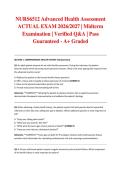
NURS6512 Advanced Health Assessment
ACTUAL EXAM 2026/2027 | Midterm
Examination | Verified Q&A | Pass
Guaranteed - A+ Graded
SECTION 1: COMPREHENSIVE HEALTH HISTORY (10 Questions)
Q1: An adult patient presents for an initial health assessment. During the interview, the patient
becomes tearful when discussing recent personal stressors. What is the most appropriate response from
the advanced practice nurse?
A. Redirect the patient to the focused health history questions
B. Offer a tissue and sit quietly to allow expression of emotion [CORRECT]
C. Move to the physical examination portion of the visit
D. Provide reassurance that everything will be fine
Rationale: **[CORRECT]** Allowing the patient to express emotion with a supportive presence
demonstrates therapeutic communication and validates the patient's feelings.
Q2: When obtaining a family health history, the patient reports that both parents died of myocardial
infarctions in their 50s and a sibling has type 2 diabetes. Which additional question is most important to
ask?
A. "Does your sibling take insulin?"
B. "What was your parents' diet like?"
C. "What were the exact ages of your parents at death?" [CORRECT]
D. "Have you ever had your cholesterol checked?"
Rationale: **[CORRECT]** Exact ages at death for first-degree relatives with cardiovascular disease
provide critical information for calculating cardiovascular risk and screening recommendations.
Q3: A 45-year-old female patient reports irregular menstrual cycles and hot flashes. Which component
of the health history is most important to explore?
,A. Sexual history
B. Menstrual and gynecological history [CORRECT]
C. Occupational history
D. Travel history
Rationale: **[CORRECT]** Menstrual irregularities and hot flashes in a 45-year-old female suggest
perimenopause; detailed menstrual history including cycle length, flow, and associated symptoms
guides assessment and management.
Q4: During a health history interview, the patient states, "I drink alcohol occasionally." Which
motivational interviewing technique is most appropriate to assess quantity?
A. "How much alcohol do you drink?"
B. "What do you mean by occasionally?"
C. "Tell me about your drinking pattern over the past week" [CORRECT]
D. "Do you think you drink too much?"
Rationale: **[CORRECT]** Asking about specific drinking patterns over a defined time period elicits
more accurate information than vague or judgmental questions.
Q5: A patient from a different cultural background maintains minimal eye contact during the interview.
Which interpretation is most appropriate?
A. The patient is being evasive and hiding information
B. The patient is showing respect according to cultural norms [CORRECT]
C. The patient has a visual impairment
D. The patient is experiencing depression
Rationale: **[CORRECT]** Many cultures view direct eye contact as disrespectful or challenging; the
advanced practice nurse should interpret this behavior within the patient's cultural context.
Q6: When assessing a geriatric patient's cognitive function, which screening tool is most appropriate for
detecting early dementia?
A. Glasgow Coma Scale
B. Mini-Mental State Examination (MMSE)
C. Montreal Cognitive Assessment (MoCA) [CORRECT]
D. Confusion Assessment Method (CAM)
, Rationale: **[CORRECT]** The MoCA is more sensitive than the MMSE for detecting mild cognitive
impairment and early dementia, assessing executive function and attention.
Q7: A patient reports taking multiple herbal supplements and prescription medications. Which question
is most important to prevent drug interactions?
A. "Do you believe these supplements are effective?"
B. "What specific supplements and doses do you take daily?" [CORRECT]
C. "Have you discussed these with your physician?"
D. "Why do you prefer natural remedies?"
Rationale: **[CORRECT]** Specific information about supplement types and doses is essential to
identify potential interactions with prescription medications.
Q8: During a psychosocial assessment, the patient reports feeling "overwhelmed" caring for elderly
parents while working full-time. Which screening tool is most appropriate?
A. Patient Health Questionnaire-9 (PHQ-9)
B. Zarit Burden Interview [CORRECT]
C. Generalized Anxiety Disorder-7 (GAD-7)
D. Mini-Cog
Rationale: **[CORRECT]** The Zarit Burden Interview specifically assesses the physical, emotional, and
financial burden experienced by caregivers of elderly or disabled individuals.
Q9: A patient reports a 20-pound weight loss over 3 months without dieting. Which component of the
history is the priority to investigate?
A. Dietary preferences
B. Review of systems for systemic symptoms [CORRECT]
C. Exercise routine
D. Food allergies
Rationale: **[CORRECT]** Unintentional weight loss requires systematic investigation for underlying
pathology including malignancy, endocrine disorders, infection, or psychiatric conditions.
Q10: When obtaining a sexual history, which approach demonstrates cultural sensitivity and therapeutic
communication?
ACTUAL EXAM 2026/2027 | Midterm
Examination | Verified Q&A | Pass
Guaranteed - A+ Graded
SECTION 1: COMPREHENSIVE HEALTH HISTORY (10 Questions)
Q1: An adult patient presents for an initial health assessment. During the interview, the patient
becomes tearful when discussing recent personal stressors. What is the most appropriate response from
the advanced practice nurse?
A. Redirect the patient to the focused health history questions
B. Offer a tissue and sit quietly to allow expression of emotion [CORRECT]
C. Move to the physical examination portion of the visit
D. Provide reassurance that everything will be fine
Rationale: **[CORRECT]** Allowing the patient to express emotion with a supportive presence
demonstrates therapeutic communication and validates the patient's feelings.
Q2: When obtaining a family health history, the patient reports that both parents died of myocardial
infarctions in their 50s and a sibling has type 2 diabetes. Which additional question is most important to
ask?
A. "Does your sibling take insulin?"
B. "What was your parents' diet like?"
C. "What were the exact ages of your parents at death?" [CORRECT]
D. "Have you ever had your cholesterol checked?"
Rationale: **[CORRECT]** Exact ages at death for first-degree relatives with cardiovascular disease
provide critical information for calculating cardiovascular risk and screening recommendations.
Q3: A 45-year-old female patient reports irregular menstrual cycles and hot flashes. Which component
of the health history is most important to explore?
,A. Sexual history
B. Menstrual and gynecological history [CORRECT]
C. Occupational history
D. Travel history
Rationale: **[CORRECT]** Menstrual irregularities and hot flashes in a 45-year-old female suggest
perimenopause; detailed menstrual history including cycle length, flow, and associated symptoms
guides assessment and management.
Q4: During a health history interview, the patient states, "I drink alcohol occasionally." Which
motivational interviewing technique is most appropriate to assess quantity?
A. "How much alcohol do you drink?"
B. "What do you mean by occasionally?"
C. "Tell me about your drinking pattern over the past week" [CORRECT]
D. "Do you think you drink too much?"
Rationale: **[CORRECT]** Asking about specific drinking patterns over a defined time period elicits
more accurate information than vague or judgmental questions.
Q5: A patient from a different cultural background maintains minimal eye contact during the interview.
Which interpretation is most appropriate?
A. The patient is being evasive and hiding information
B. The patient is showing respect according to cultural norms [CORRECT]
C. The patient has a visual impairment
D. The patient is experiencing depression
Rationale: **[CORRECT]** Many cultures view direct eye contact as disrespectful or challenging; the
advanced practice nurse should interpret this behavior within the patient's cultural context.
Q6: When assessing a geriatric patient's cognitive function, which screening tool is most appropriate for
detecting early dementia?
A. Glasgow Coma Scale
B. Mini-Mental State Examination (MMSE)
C. Montreal Cognitive Assessment (MoCA) [CORRECT]
D. Confusion Assessment Method (CAM)
, Rationale: **[CORRECT]** The MoCA is more sensitive than the MMSE for detecting mild cognitive
impairment and early dementia, assessing executive function and attention.
Q7: A patient reports taking multiple herbal supplements and prescription medications. Which question
is most important to prevent drug interactions?
A. "Do you believe these supplements are effective?"
B. "What specific supplements and doses do you take daily?" [CORRECT]
C. "Have you discussed these with your physician?"
D. "Why do you prefer natural remedies?"
Rationale: **[CORRECT]** Specific information about supplement types and doses is essential to
identify potential interactions with prescription medications.
Q8: During a psychosocial assessment, the patient reports feeling "overwhelmed" caring for elderly
parents while working full-time. Which screening tool is most appropriate?
A. Patient Health Questionnaire-9 (PHQ-9)
B. Zarit Burden Interview [CORRECT]
C. Generalized Anxiety Disorder-7 (GAD-7)
D. Mini-Cog
Rationale: **[CORRECT]** The Zarit Burden Interview specifically assesses the physical, emotional, and
financial burden experienced by caregivers of elderly or disabled individuals.
Q9: A patient reports a 20-pound weight loss over 3 months without dieting. Which component of the
history is the priority to investigate?
A. Dietary preferences
B. Review of systems for systemic symptoms [CORRECT]
C. Exercise routine
D. Food allergies
Rationale: **[CORRECT]** Unintentional weight loss requires systematic investigation for underlying
pathology including malignancy, endocrine disorders, infection, or psychiatric conditions.
Q10: When obtaining a sexual history, which approach demonstrates cultural sensitivity and therapeutic
communication?


