Hondros NUR 200 final Exam Test with Answers Graded A+
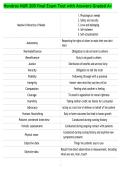
1. Physiological needs
2. Safety and security
Maslow's Hierarchy of Needs 3. Love and belonging
4. Self-esteem
5. Self-actualization
Respecting the rights of others to make their own deci-
Autonomy
sions
Nonmaleficence Obligation to do no harm to others
Beneficence Duty to do good to others
Justice Distribution of benefits and services fairly
Veracity Obligation to tell the truth
Fidelity Following through with a promise
Integrity Honest--does what they say they will do
Compassion Feeling what another is feeling
Courage To stand in opposition for moral rightness
Humility Taking neither credit nor blame for a situation
Advocacy Acting as a last line of defense on behalf of the patient
Human flourishing Duty to foster outcomes that lead to human growth
Patient centered interview Conducted during nursing history
Periodic assessment Conducted during ongoing contact with patients
Conducted during nursing history and anytime new
Physical exam
symptoms present
Subjective data Things the patients says to you
Result from direct observation or measurement. Including
Objective data
what you see, hear, touch
1/7
, Hondros NUR 200 final Exam Test with Answers Graded A+
1. Orientation/setting the agenda
3 phases of the interview process 2. Working phase--collecting assessment data
3. Termination of interview
Regulates the scope of practice
Nurse practice act -Ditterent in each state
-Protects the public from unsafe nurses
Defines nursing and the values
Scope of practice -Tells the nurse what you can and cannot do
-Regulated by the state and individual facilities
Expected to be able to perform certain duties.
Standards of Practice
-Regulated by ANA
High quality care
Standards of Professional Performance
-Regulated by ANA
Ideals of right and wrong
Code of Ethics
-Regulated by ANA
Novice Nursing student--beginner
Graduate nurse
Advanced beginner
-step by step approach
Competent 2-3 years experience in the same unit
Proficient Addresses issues without going step by step
Expert Diverse experience, focuses on problem at hand
Something you see with the patient--a sign
Patient cues
-shuffling gait, wheezing, warm skin, foul odor from
drainage
A conclusion based on the observed cue
Inference
2/7
1. Physiological needs
2. Safety and security
Maslow's Hierarchy of Needs 3. Love and belonging
4. Self-esteem
5. Self-actualization
Respecting the rights of others to make their own deci-
Autonomy
sions
Nonmaleficence Obligation to do no harm to others
Beneficence Duty to do good to others
Justice Distribution of benefits and services fairly
Veracity Obligation to tell the truth
Fidelity Following through with a promise
Integrity Honest--does what they say they will do
Compassion Feeling what another is feeling
Courage To stand in opposition for moral rightness
Humility Taking neither credit nor blame for a situation
Advocacy Acting as a last line of defense on behalf of the patient
Human flourishing Duty to foster outcomes that lead to human growth
Patient centered interview Conducted during nursing history
Periodic assessment Conducted during ongoing contact with patients
Conducted during nursing history and anytime new
Physical exam
symptoms present
Subjective data Things the patients says to you
Result from direct observation or measurement. Including
Objective data
what you see, hear, touch
1/7
, Hondros NUR 200 final Exam Test with Answers Graded A+
1. Orientation/setting the agenda
3 phases of the interview process 2. Working phase--collecting assessment data
3. Termination of interview
Regulates the scope of practice
Nurse practice act -Ditterent in each state
-Protects the public from unsafe nurses
Defines nursing and the values
Scope of practice -Tells the nurse what you can and cannot do
-Regulated by the state and individual facilities
Expected to be able to perform certain duties.
Standards of Practice
-Regulated by ANA
High quality care
Standards of Professional Performance
-Regulated by ANA
Ideals of right and wrong
Code of Ethics
-Regulated by ANA
Novice Nursing student--beginner
Graduate nurse
Advanced beginner
-step by step approach
Competent 2-3 years experience in the same unit
Proficient Addresses issues without going step by step
Expert Diverse experience, focuses on problem at hand
Something you see with the patient--a sign
Patient cues
-shuffling gait, wheezing, warm skin, foul odor from
drainage
A conclusion based on the observed cue
Inference
2/7