

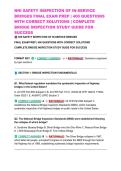
NHI SAFETY INSPECTION OF IN-SERVICE
BRIDGES FINAL EXAM PREP | 400 QUESTIONS
WITH CORRECT SOLUTIONS | COMPLETE
BRIDGE INSPECTION STUDY GUIDE FOR
SUCCESS
NHI SAFETY INSPECTION OF IN-SERVICE BRIDGES
FINAL EXAM PREP | 400 QUESTIONS WITH CORRECT SOLUTIONS
COMPLETE BRIDGE INSPECTION STUDY GUIDE FOR SUCCESS
FORMAT KEY: = CORRECT ANSWER | = RATIONALE | Questions organized
by topic sections
SECTION 1: BRIDGE INSPECTION FUNDAMENTALS
Q1. What federal regulation mandates the systematic inspection of highway
bridges in the United States?
A. 23 CFR Part 650 Subpart C B. 49 CFR Part 172 C. OSHA 29 CFR 1926 D. FHWA
Order 5520.1 E. AASHTO LRFD Section 3
CORRECT ANSWER: A RATIONALE: 23 CFR Part 650 Subpart C
establishes the National Bridge Inspection Standards (NBIS), which mandates
systematic inspection of all highway bridges on public roads in the United States.
Q2. The National Bridge Inspection Standards (NBIS) were established following
the collapse of which bridge?
A. Sunshine Skyway Bridge B. Silver Bridge over the Ohio River C. Mianus River Bridge
D. I-35W Mississippi River Bridge E. Fern Hollow Bridge
CORRECT ANSWER: B RATIONALE: The Silver Bridge collapse in 1967,
which killed 46 people, prompted Congress to mandate the NBIS through the Federal
Aid Highway Act of 1968, establishing systematic bridge inspection requirements.
,Q3. Under NBIS, what is the maximum routine inspection interval for most
highway bridges?
A. 12 months B. 18 months C. 24 months D. 36 months E. 48 months
CORRECT ANSWER: C RATIONALE: NBIS requires routine inspections at
intervals not exceeding 24 months (2 years) for most highway bridges, though states
may establish more frequent intervals based on bridge condition.
Q4. Which organization publishes the Bridge Inspector's Reference Manual
(BIRM)?
A. AASHTO B. ASCE C. FHWA D. TRB E. NCHRP
CORRECT ANSWER: C RATIONALE: The Federal Highway Administration
(FHWA) publishes the Bridge Inspector's Reference Manual, which serves as the
primary training and reference document for bridge inspectors across the country.
Q5. What does the acronym NBI stand for in bridge inspection?
A. National Bridge Inventory B. National Bridge Inspection C. New Bridge Infrastructure
D. National Bureau of Infrastructure E. Network Bridge Index
CORRECT ANSWER: A RATIONALE: NBI stands for National Bridge
Inventory, which is a database maintained by FHWA containing information on all
highway bridges in the U.S. on public roads with spans greater than 20 feet.
Q6. A bridge must be included in the National Bridge Inventory if it has a total
length greater than:
A. 10 feet B. 15 feet C. 20 feet D. 25 feet E. 30 feet
CORRECT ANSWER: C RATIONALE: Under NBIS, any bridge on a public
road with a total length greater than 20 feet must be included in the National Bridge
Inventory and inspected according to NBIS requirements.
Q7. Which type of bridge inspection is performed in response to an extreme event
such as an earthquake or flood?
,A. Routine inspection B. In-depth inspection C. Damage inspection D. Underwater
inspection E. Fracture-critical inspection
CORRECT ANSWER: C RATIONALE: Damage inspections are unscheduled
inspections performed after extreme events (floods, earthquakes, collisions, fires) to
assess damage and determine if the bridge is safe for continued use.
Q8. Who is responsible for ensuring that bridge inspections are performed
according to NBIS requirements?
A. The FHWA Division Administrator B. The State Transportation Agency C. The county
government D. The bridge owner of record E. The inspection team leader
CORRECT ANSWER: B RATIONALE: State transportation agencies are
responsible for ensuring all bridges within their jurisdiction are inspected in accordance
with NBIS requirements, even if they delegate inspection duties to local agencies.
Q9. What is the minimum qualification requirement for a Bridge Inspection Team
Leader under NBIS?
A. A bachelor's degree in civil engineering only B. A licensed professional engineer with
2 years of experience C. A combination of education and experience as defined by
NBIS D. Completion of the NHI bridge inspection course only E. 5 years of construction
experience
CORRECT ANSWER: C RATIONALE: NBIS defines team leader
qualifications based on a combination of education and experience. This includes
options such as a licensed PE, or meeting specific combinations of education in
engineering/related fields and hands-on bridge inspection experience.
Q10. What type of inspection examines individual members more closely than a
routine inspection using special equipment or access?
A. Damage inspection B. Fracture-critical inspection C. In-depth inspection D. Special
inspection E. Underwater inspection
CORRECT ANSWER: C RATIONALE: An in-depth inspection is a close-up,
hands-on inspection of all or part of a bridge that requires special equipment or access
methods, used to assess a specific condition or concern identified in a routine
inspection.
, Q11. Which condition rating code in the NBI system indicates the bridge is in
CRITICAL condition?
A. 2 B. 3 C. 4 D. 1 E. 0
CORRECT ANSWER: A RATIONALE: NBI condition rating of 2 indicates
"Critical condition – advanced deterioration of primary structural elements." A rating of 1
indicates "Imminent failure condition" and 0 indicates failure/out of service.
Q12. The term "sufficiency rating" is used to:
A. Rate the structural condition of bridge members B. Determine the load-carrying
capacity of a bridge C. Indicate the overall adequacy of a bridge for its current use D.
Classify the type of bridge superstructure E. Identify bridges eligible for federal
replacement funding
CORRECT ANSWER: C RATIONALE: The Sufficiency Rating is a formula-
based value (0-100) that indicates the overall adequacy of a bridge to remain in service.
It considers structural adequacy, serviceability, and essentiality for public use.
Q13. A bridge rated "structurally deficient" means:
A. The bridge will collapse imminently B. The bridge has restricted load capacity or
significant deterioration C. The bridge must be immediately closed D. The bridge has
failed an underwater inspection E. The bridge deck has been rated poor or worse
CORRECT ANSWER: B RATIONALE: A structurally deficient rating means the
bridge has significant deterioration, damage, or inadequate load capacity requiring
corrective action. It does NOT mean the bridge is unsafe or will collapse — it may still
be open to traffic with restrictions.
Q14. What is the primary purpose of a routine bridge inspection?
A. To determine the load rating of the bridge B. To identify and evaluate deficiencies that
may affect safety C. To update NBI coding items D. To fulfill federal funding eligibility
requirements E. To satisfy state DOT reporting requirements
BRIDGES FINAL EXAM PREP | 400 QUESTIONS
WITH CORRECT SOLUTIONS | COMPLETE
BRIDGE INSPECTION STUDY GUIDE FOR
SUCCESS
NHI SAFETY INSPECTION OF IN-SERVICE BRIDGES
FINAL EXAM PREP | 400 QUESTIONS WITH CORRECT SOLUTIONS
COMPLETE BRIDGE INSPECTION STUDY GUIDE FOR SUCCESS
FORMAT KEY: = CORRECT ANSWER | = RATIONALE | Questions organized
by topic sections
SECTION 1: BRIDGE INSPECTION FUNDAMENTALS
Q1. What federal regulation mandates the systematic inspection of highway
bridges in the United States?
A. 23 CFR Part 650 Subpart C B. 49 CFR Part 172 C. OSHA 29 CFR 1926 D. FHWA
Order 5520.1 E. AASHTO LRFD Section 3
CORRECT ANSWER: A RATIONALE: 23 CFR Part 650 Subpart C
establishes the National Bridge Inspection Standards (NBIS), which mandates
systematic inspection of all highway bridges on public roads in the United States.
Q2. The National Bridge Inspection Standards (NBIS) were established following
the collapse of which bridge?
A. Sunshine Skyway Bridge B. Silver Bridge over the Ohio River C. Mianus River Bridge
D. I-35W Mississippi River Bridge E. Fern Hollow Bridge
CORRECT ANSWER: B RATIONALE: The Silver Bridge collapse in 1967,
which killed 46 people, prompted Congress to mandate the NBIS through the Federal
Aid Highway Act of 1968, establishing systematic bridge inspection requirements.
,Q3. Under NBIS, what is the maximum routine inspection interval for most
highway bridges?
A. 12 months B. 18 months C. 24 months D. 36 months E. 48 months
CORRECT ANSWER: C RATIONALE: NBIS requires routine inspections at
intervals not exceeding 24 months (2 years) for most highway bridges, though states
may establish more frequent intervals based on bridge condition.
Q4. Which organization publishes the Bridge Inspector's Reference Manual
(BIRM)?
A. AASHTO B. ASCE C. FHWA D. TRB E. NCHRP
CORRECT ANSWER: C RATIONALE: The Federal Highway Administration
(FHWA) publishes the Bridge Inspector's Reference Manual, which serves as the
primary training and reference document for bridge inspectors across the country.
Q5. What does the acronym NBI stand for in bridge inspection?
A. National Bridge Inventory B. National Bridge Inspection C. New Bridge Infrastructure
D. National Bureau of Infrastructure E. Network Bridge Index
CORRECT ANSWER: A RATIONALE: NBI stands for National Bridge
Inventory, which is a database maintained by FHWA containing information on all
highway bridges in the U.S. on public roads with spans greater than 20 feet.
Q6. A bridge must be included in the National Bridge Inventory if it has a total
length greater than:
A. 10 feet B. 15 feet C. 20 feet D. 25 feet E. 30 feet
CORRECT ANSWER: C RATIONALE: Under NBIS, any bridge on a public
road with a total length greater than 20 feet must be included in the National Bridge
Inventory and inspected according to NBIS requirements.
Q7. Which type of bridge inspection is performed in response to an extreme event
such as an earthquake or flood?
,A. Routine inspection B. In-depth inspection C. Damage inspection D. Underwater
inspection E. Fracture-critical inspection
CORRECT ANSWER: C RATIONALE: Damage inspections are unscheduled
inspections performed after extreme events (floods, earthquakes, collisions, fires) to
assess damage and determine if the bridge is safe for continued use.
Q8. Who is responsible for ensuring that bridge inspections are performed
according to NBIS requirements?
A. The FHWA Division Administrator B. The State Transportation Agency C. The county
government D. The bridge owner of record E. The inspection team leader
CORRECT ANSWER: B RATIONALE: State transportation agencies are
responsible for ensuring all bridges within their jurisdiction are inspected in accordance
with NBIS requirements, even if they delegate inspection duties to local agencies.
Q9. What is the minimum qualification requirement for a Bridge Inspection Team
Leader under NBIS?
A. A bachelor's degree in civil engineering only B. A licensed professional engineer with
2 years of experience C. A combination of education and experience as defined by
NBIS D. Completion of the NHI bridge inspection course only E. 5 years of construction
experience
CORRECT ANSWER: C RATIONALE: NBIS defines team leader
qualifications based on a combination of education and experience. This includes
options such as a licensed PE, or meeting specific combinations of education in
engineering/related fields and hands-on bridge inspection experience.
Q10. What type of inspection examines individual members more closely than a
routine inspection using special equipment or access?
A. Damage inspection B. Fracture-critical inspection C. In-depth inspection D. Special
inspection E. Underwater inspection
CORRECT ANSWER: C RATIONALE: An in-depth inspection is a close-up,
hands-on inspection of all or part of a bridge that requires special equipment or access
methods, used to assess a specific condition or concern identified in a routine
inspection.
, Q11. Which condition rating code in the NBI system indicates the bridge is in
CRITICAL condition?
A. 2 B. 3 C. 4 D. 1 E. 0
CORRECT ANSWER: A RATIONALE: NBI condition rating of 2 indicates
"Critical condition – advanced deterioration of primary structural elements." A rating of 1
indicates "Imminent failure condition" and 0 indicates failure/out of service.
Q12. The term "sufficiency rating" is used to:
A. Rate the structural condition of bridge members B. Determine the load-carrying
capacity of a bridge C. Indicate the overall adequacy of a bridge for its current use D.
Classify the type of bridge superstructure E. Identify bridges eligible for federal
replacement funding
CORRECT ANSWER: C RATIONALE: The Sufficiency Rating is a formula-
based value (0-100) that indicates the overall adequacy of a bridge to remain in service.
It considers structural adequacy, serviceability, and essentiality for public use.
Q13. A bridge rated "structurally deficient" means:
A. The bridge will collapse imminently B. The bridge has restricted load capacity or
significant deterioration C. The bridge must be immediately closed D. The bridge has
failed an underwater inspection E. The bridge deck has been rated poor or worse
CORRECT ANSWER: B RATIONALE: A structurally deficient rating means the
bridge has significant deterioration, damage, or inadequate load capacity requiring
corrective action. It does NOT mean the bridge is unsafe or will collapse — it may still
be open to traffic with restrictions.
Q14. What is the primary purpose of a routine bridge inspection?
A. To determine the load rating of the bridge B. To identify and evaluate deficiencies that
may affect safety C. To update NBI coding items D. To fulfill federal funding eligibility
requirements E. To satisfy state DOT reporting requirements


