
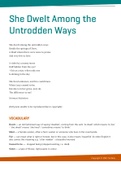
She Dwelt Among the
Untrodden Ways
She dwelt among the untrodden ways
Beside the springs of Dove,
A Maid whom there were none to praise
And very few to love:
A violet by a mossy stone
Half hidden from the eye!
—Fair as a star, when only one
Is shining in the sky.
She lived unknown, and few could know
When Lucy ceased to be;
But she is in her grave, and, oh,
The difference to me!
Norman Nicholson
(Full poem unable to be reproduced due to copyright)
VOCABULARY
Dwelt — an old fashioned way of saying ‘dwelled’, coming from the verb ‘to dwell’ which means ‘to live’
- ‘she dwelt’ means ‘she lived’ / sometimes means ‘to think’.
Maid — a female worker, often a farm worker or someone who lives in the countryside.
Fair — can mean what is right or honest, but in this case, it also means ‘beautiful’ (in older English it
also carries this meaning e.g. ‘a fair maiden’ - a beautiful woman).
Ceased to be — stopped being (stopped existing, i.e. died).
Violet — a type of flower, light purple in colour.
Copyright © 2021 Scrbbly
, STORY / SUMMARY
Stanza 1: The speaker starts telling us about a woman, who lived next to
the River Dove (in Derbyshire) — “among untrodden ways” — meaning in a
place that not many people know about or visit. We assume that this is the
countryside and a very remote location. We learn that she didn’t have a good
life, or perhaps that she was just a bit lonely and solitary — there were “few
to praise” her, meaning that not many people gave her compliments and
positive messages, and “very few to love” her, meaning she hadn’t yet found
love or a husband.
Stanza 2: We feel that the woman was a very different kind of person to the
usual type of person. She is compared to a lonely but beautiful star and a
violet flower that hides near mossy stones. She was “half hidden” from the
world, which makes her both special but tragic and lonely.
Stanza 3: We learn that her name was Lucy and that she has died. There is
a sense that no one appreciated her when she was alive, and no one cared
much about her after she died — apart from the speaker, upon whom it has
made a huge impact. We feel that she didn’t live a fulfilled life to her full
potential.
LANGUAGE FEATURES
• Metaphor — “She dwelt among untrodden ways” suggests through metaphor that the girl lived
unusually, she was somehow different — the paths she chose in life were different.
• “A violet by a mossy stone” — this metaphor conjures a natural, pastoral image of the girl being
a beautiful flower surrounded by a boring and drab environment as if her beauty and delicateness
stand out from others.
• Symbolism — “star” — stars tend to symbolize independence, however, in this context, it
symbolizes loneliness - as if the woman is the “only” star in the sky, the only shining beacon. Stars
can also symbolise the idea of being “star-crossed”, which suggests that the fate of the girl is
doomed.
• Visual imagery — “springs of Dove” this is referring to the River Dove in the Peak District,
Derbyshire, it conjures a beautiful, peaceful, idyllic image of a countryside landscape with forests,
mountains, valleys. It may also be used metaphorically / symbolically to represent peace and an
idyllic existence - doves are traditionally a symbol of peace and purity.
• Simplistic, natural register — Wordsworth uses simple language to describe the subject, giving her
dignity and respect as well as capturing the essence of her personality.
Copyright © 2021 Scrbbly


