

NEU2004 – Neuroanatomy
Workshop 3 – Brainstem, Cranial Nerves & Diencephalon
Activity 1 – Brainstem
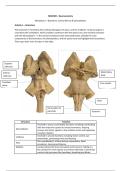
The brainstem is formed by the medulla oblongata, the pons, and the midbrain. Its dorsal aspect is
covered by the cerebellum, while caudally it continues with the spinal cord, and rostrally continues
with the diencephalon. In the ventral and dorsal views illustrated below, identify the main
components of the brainstem, the diencephalon, and the spinal cord and highlight their boundaries.
Then input their main function in the table.
Superior
colliculus
Inferior Mammillary
colliculus body
Trochlear Crus cerebri
nerve
Olive
Decussation of
pyramids Pyramid
Structure Function
Involved in many crucial bodily functions including coordinating
with the endocrine system to release hormones, relaying
diencephalon
sensory and motor signals to the cerebral cortex and regulating
circadian rhythms
Involved in several functions including motor control, eye
midbrain
movements, processing vision and hearing
The coordination’s of face and eye movements, facial
Pons
sensations, hearing and balance
Medulla Located where the brain and spinal cord connect, making it a
key conduit for nerve signals to and from the body. It also helps
control vital processes like heartbeat, breathing and blood
, pressure.
The three primary roles of the spinal cord are to send motor
command from the brain to the body, send sensory
Spinal cord
information from the body to the brain and coordinate
reflexes.
Activity 2 – Cranial nerves
Twelve pairs of cranial nerves emerge from the base of the brain. The first two are part of the central
nervous system, while the rest are like the spinal nerves in that they contain axons of the peripheral
nervous system. In the illustration below, identify each of the cranial nerves, and add their main
function to the table.
Mid brain
III, IV
Pons
V,VI,VII,VIII
Medulla
IX,X,XI,XII
Cranial nerve Function
1) Olfactory smell
2) Optic vision
3) Oculomotor Eye ball movement
4) Trochlear Eyeball movement
5) Trigeminal Facial sensation
6) Abducens Eyeball movement
7) Facial Controls facial expressions
8) Vestibulocochlear Hearing and balance
9) Glossopharyngeal Swallowing and taste
10) Vagus Autonomic functions of organs
11) Accessory Controls Neck and shoulder muscles
12) Hypoglossal Tongue muscle for speech and swallowing
Activity 3 – Diencephalon
Workshop 3 – Brainstem, Cranial Nerves & Diencephalon
Activity 1 – Brainstem
The brainstem is formed by the medulla oblongata, the pons, and the midbrain. Its dorsal aspect is
covered by the cerebellum, while caudally it continues with the spinal cord, and rostrally continues
with the diencephalon. In the ventral and dorsal views illustrated below, identify the main
components of the brainstem, the diencephalon, and the spinal cord and highlight their boundaries.
Then input their main function in the table.
Superior
colliculus
Inferior Mammillary
colliculus body
Trochlear Crus cerebri
nerve
Olive
Decussation of
pyramids Pyramid
Structure Function
Involved in many crucial bodily functions including coordinating
with the endocrine system to release hormones, relaying
diencephalon
sensory and motor signals to the cerebral cortex and regulating
circadian rhythms
Involved in several functions including motor control, eye
midbrain
movements, processing vision and hearing
The coordination’s of face and eye movements, facial
Pons
sensations, hearing and balance
Medulla Located where the brain and spinal cord connect, making it a
key conduit for nerve signals to and from the body. It also helps
control vital processes like heartbeat, breathing and blood
, pressure.
The three primary roles of the spinal cord are to send motor
command from the brain to the body, send sensory
Spinal cord
information from the body to the brain and coordinate
reflexes.
Activity 2 – Cranial nerves
Twelve pairs of cranial nerves emerge from the base of the brain. The first two are part of the central
nervous system, while the rest are like the spinal nerves in that they contain axons of the peripheral
nervous system. In the illustration below, identify each of the cranial nerves, and add their main
function to the table.
Mid brain
III, IV
Pons
V,VI,VII,VIII
Medulla
IX,X,XI,XII
Cranial nerve Function
1) Olfactory smell
2) Optic vision
3) Oculomotor Eye ball movement
4) Trochlear Eyeball movement
5) Trigeminal Facial sensation
6) Abducens Eyeball movement
7) Facial Controls facial expressions
8) Vestibulocochlear Hearing and balance
9) Glossopharyngeal Swallowing and taste
10) Vagus Autonomic functions of organs
11) Accessory Controls Neck and shoulder muscles
12) Hypoglossal Tongue muscle for speech and swallowing
Activity 3 – Diencephalon


