

NEU2004 – Neuroanatomy
Workshop 2 – Peripheral nervous system & Spinal cord
Activity 1 – Nerve endings
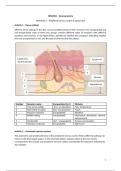
Afferent nerve endings in the skin can be classified based on their structure into encapsulated and
non-encapsulated. Each of these two groups contains different types of receptors with different
locations and functions. In the figure below, identify the labelled skin receptors, indicating whether
they are encapsulated or not, and the type of stimulus that they detect.
Number Receptor name Encapsulated (y/n) Stimulus
1 Free nerve ending Non- encapsulated Pain, temperature
2 Hair follicle receptor Non- encapsulated Touch
3 Pacinian corpuscle Encapsulated Vibration
4 Ruffini ending encapsulated Mechanical stimulation (stretch
and pressure)
5 Merkel disk Non – encapsulated Pressure and position
6 Meissner corpuscle Encapsulated light touch
Activity 2 – Autonomic nervous system
The autonomic and somatic divisions of the peripheral nervous system follow different pathways to
interact with their target organs. In the schematic below, indicate which of the two circuits
corresponds to the somatic and autonomic nervous system, and identify the structures indicated by
the numbers.
1
, Input your answers in the table below.
A Somatic (voluntary)
B Autonomic (involuntary)
1 Motor neurone
2 Skeletal muscle
3 Preganglionic motor neurone
4 Ganglion
5 Postganglionic motor neurone
6 Smooth muscle
7 Cardiac muscle
8 Glands
Activity 3 – Spinal nerves
Near to the spinal cord, spinal nerves divide into the dorsal and ventral roots. The dorsal roots are
located along the dorsolateral aspect of the spinal cord and are formed by afferent nerve fibres
coming from the periphery with somas located in the dorsal root ganglia. The ventral roots are
located along the ventrolateral aspect of the spinal cord and are formed by efferent motor nerve
fibres with somas located in the spinal cord. Nearer to the periphery, spinal nerves divide into the
dorsal and ventral ramus. The dorsal rami remain distinct from each other and innervate skin and
muscles on the back. The ventral rami innervate the trunk and limbs and converge in non-thoracic
regions forming nerve plexuses. In the figure below, identify as many of these structures as possible.
Can you locate some of the nerve plexuses in the anatomy model of the spinal cord?
2
Workshop 2 – Peripheral nervous system & Spinal cord
Activity 1 – Nerve endings
Afferent nerve endings in the skin can be classified based on their structure into encapsulated and
non-encapsulated. Each of these two groups contains different types of receptors with different
locations and functions. In the figure below, identify the labelled skin receptors, indicating whether
they are encapsulated or not, and the type of stimulus that they detect.
Number Receptor name Encapsulated (y/n) Stimulus
1 Free nerve ending Non- encapsulated Pain, temperature
2 Hair follicle receptor Non- encapsulated Touch
3 Pacinian corpuscle Encapsulated Vibration
4 Ruffini ending encapsulated Mechanical stimulation (stretch
and pressure)
5 Merkel disk Non – encapsulated Pressure and position
6 Meissner corpuscle Encapsulated light touch
Activity 2 – Autonomic nervous system
The autonomic and somatic divisions of the peripheral nervous system follow different pathways to
interact with their target organs. In the schematic below, indicate which of the two circuits
corresponds to the somatic and autonomic nervous system, and identify the structures indicated by
the numbers.
1
, Input your answers in the table below.
A Somatic (voluntary)
B Autonomic (involuntary)
1 Motor neurone
2 Skeletal muscle
3 Preganglionic motor neurone
4 Ganglion
5 Postganglionic motor neurone
6 Smooth muscle
7 Cardiac muscle
8 Glands
Activity 3 – Spinal nerves
Near to the spinal cord, spinal nerves divide into the dorsal and ventral roots. The dorsal roots are
located along the dorsolateral aspect of the spinal cord and are formed by afferent nerve fibres
coming from the periphery with somas located in the dorsal root ganglia. The ventral roots are
located along the ventrolateral aspect of the spinal cord and are formed by efferent motor nerve
fibres with somas located in the spinal cord. Nearer to the periphery, spinal nerves divide into the
dorsal and ventral ramus. The dorsal rami remain distinct from each other and innervate skin and
muscles on the back. The ventral rami innervate the trunk and limbs and converge in non-thoracic
regions forming nerve plexuses. In the figure below, identify as many of these structures as possible.
Can you locate some of the nerve plexuses in the anatomy model of the spinal cord?
2


