

NEU2004 – Neuroanatomy
Workshop 1 – Planes, Meninges, Ventricles & Vasculature
Activity 1 – Directions and planes of orientation
In anatomy, the location and relationships of structures are described with reference to three
orthogonal planes: sagittal or median, horizontal or transverse, and coronal or frontal. Directions
and relationships are designated as medial or lateral, superior or inferior and anterior or posterior,
with reference to the orientation of these planes. In neuroanatomy, the positional terms rostral,
caudal, dorsal and ventral are also commonly used. These terms have their origin in embryology and
mean, respectively, towards the head end (rostral), tail end (caudal), back (dorsal) and belly
(ventral).
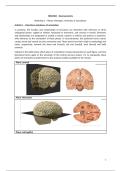
Indicate in the table below which plane of orientation is being represented on each figure, and how
directional terms apply to the schematic of the central nervous system. Try to extrapolate these
planes of orientation and directions to the anatomy models available for the session.
Plane: coronal
Plane: Horizontal
Plane: mid sagittal
1
, Directions:
a Superior
b Inferior
c Posterior
d Anterior
1 Rostral
2 Caudal
3 ventral
4 Dorsal
Activity 2 – Meninges
The central nervous system is protected by bone, and three concentric membranous coverings called
the meninges. The figure below depicts a cross section through the scalp, skull, meninges, and
cerebral cortex. Discuss with the members of your group how to fill in the gaps in the names of the
structures and input your answers in the table below. Can you correlate these structures with the
anatomical model of the meninges?
2
Workshop 1 – Planes, Meninges, Ventricles & Vasculature
Activity 1 – Directions and planes of orientation
In anatomy, the location and relationships of structures are described with reference to three
orthogonal planes: sagittal or median, horizontal or transverse, and coronal or frontal. Directions
and relationships are designated as medial or lateral, superior or inferior and anterior or posterior,
with reference to the orientation of these planes. In neuroanatomy, the positional terms rostral,
caudal, dorsal and ventral are also commonly used. These terms have their origin in embryology and
mean, respectively, towards the head end (rostral), tail end (caudal), back (dorsal) and belly
(ventral).
Indicate in the table below which plane of orientation is being represented on each figure, and how
directional terms apply to the schematic of the central nervous system. Try to extrapolate these
planes of orientation and directions to the anatomy models available for the session.
Plane: coronal
Plane: Horizontal
Plane: mid sagittal
1
, Directions:
a Superior
b Inferior
c Posterior
d Anterior
1 Rostral
2 Caudal
3 ventral
4 Dorsal
Activity 2 – Meninges
The central nervous system is protected by bone, and three concentric membranous coverings called
the meninges. The figure below depicts a cross section through the scalp, skull, meninges, and
cerebral cortex. Discuss with the members of your group how to fill in the gaps in the names of the
structures and input your answers in the table below. Can you correlate these structures with the
anatomical model of the meninges?
2


