Diseases and immunity
10.1 Diseases and immunity
Define pathogen as a disease-causing organism
Define transmissible disease as a disease in which the pathogen can be passed from one
host to another
Pathogens are passed on from one host to another and therefore the diseases they cause
are known as transmissible diseases
State that the pathogen for a transmissible disease may be transmitted either through direct
contact, e.g. through blood or other body fluids, or indirectly, e.g. from contaminated
surfaces or food, from animals, or from the air
Pathogens can be passed on from host to host in different ways, including:
Direct contact – the pathogen is passed directly from one host to another by transfer
of body fluids such as blood or semen (e.g. HIV, gonorrhoea, hepatitis B & C)
Indirect contact – the pathogen leaves the host and is carried in some way to
another, uninfected individual
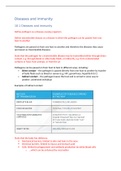
Examples of indirect contact:
State that the body has defences:
Mechanical barriers, limited to skin and hairs in the nose
Chemical barriers, limited to mucus and stomach acid
Cells, limited to phagocytosis and antibody production by white blood cells
o …which can be enhanced by vaccination
, Mechanical barriers
Structures that make it difficult for pathogens to get past them and into the body:
Skin – covers almost all parts of your body to prevent infection from pathogens. If it
is cut or grazed, it immediately begins to heal itself, often by forming a scab
Hairs in the nose – these make it difficult for pathogens to get past them further up
the nose, so they are not inhaled into the lungs
Chemical barriers
Substances produced by the body cells that trap/kill pathogens before they can get further
into the body and cause disease
Mucus – made in various places in the body, pathogens get trapped in the mucus
and can then be removed from the body (by coughing, blowing the nose, swallowing
etc.)
Stomach acid – contains hydrochloric acid which is strong enough to kill any
pathogens that have been caught in mucus in the airways and then swallowed or
have been consumed in food or water
Cells
Different types of white blood cell work to prevent pathogens reaching areas of the body
they can replicate in
By phagocytosis – engulfing and digesting pathogenic cells
By producing antibodies – which clump pathogenic cells together so they can’t move
as easily (known as agglutination) and releasing chemicals that signal to other cells
that they must be destroyed
State that antibodies lock on to antigens leading to direct destruction of pathogens, or
marking of pathogens for destruction by phagocytes
All cells have proteins and other substances projecting from their cell membrane. These are
known as antigens and are specific to that type of cell
Lymphocytes have the ability to ‘read’ the antigens on the surfaces of cells and recognise
any that are foreign
They then make antibodies which are a complementary shape to the antigens on the
surface of the pathogenic cell
The antibodies attach to the antigens and cause agglutination (clumping together)
This means the pathogenic cells cannot move very easily
At the same time, chemicals are released that signal to phagocytes that there are
cells present that need to be destroyed
There is often a lot of confusion amongst students regarding the terms antigen, antibody
and antibiotic:
An antigen is a chemical found on the surface of a cell
10.1 Diseases and immunity
Define pathogen as a disease-causing organism
Define transmissible disease as a disease in which the pathogen can be passed from one
host to another
Pathogens are passed on from one host to another and therefore the diseases they cause
are known as transmissible diseases
State that the pathogen for a transmissible disease may be transmitted either through direct
contact, e.g. through blood or other body fluids, or indirectly, e.g. from contaminated
surfaces or food, from animals, or from the air
Pathogens can be passed on from host to host in different ways, including:
Direct contact – the pathogen is passed directly from one host to another by transfer
of body fluids such as blood or semen (e.g. HIV, gonorrhoea, hepatitis B & C)
Indirect contact – the pathogen leaves the host and is carried in some way to
another, uninfected individual
Examples of indirect contact:
State that the body has defences:
Mechanical barriers, limited to skin and hairs in the nose
Chemical barriers, limited to mucus and stomach acid
Cells, limited to phagocytosis and antibody production by white blood cells
o …which can be enhanced by vaccination
, Mechanical barriers
Structures that make it difficult for pathogens to get past them and into the body:
Skin – covers almost all parts of your body to prevent infection from pathogens. If it
is cut or grazed, it immediately begins to heal itself, often by forming a scab
Hairs in the nose – these make it difficult for pathogens to get past them further up
the nose, so they are not inhaled into the lungs
Chemical barriers
Substances produced by the body cells that trap/kill pathogens before they can get further
into the body and cause disease
Mucus – made in various places in the body, pathogens get trapped in the mucus
and can then be removed from the body (by coughing, blowing the nose, swallowing
etc.)
Stomach acid – contains hydrochloric acid which is strong enough to kill any
pathogens that have been caught in mucus in the airways and then swallowed or
have been consumed in food or water
Cells
Different types of white blood cell work to prevent pathogens reaching areas of the body
they can replicate in
By phagocytosis – engulfing and digesting pathogenic cells
By producing antibodies – which clump pathogenic cells together so they can’t move
as easily (known as agglutination) and releasing chemicals that signal to other cells
that they must be destroyed
State that antibodies lock on to antigens leading to direct destruction of pathogens, or
marking of pathogens for destruction by phagocytes
All cells have proteins and other substances projecting from their cell membrane. These are
known as antigens and are specific to that type of cell
Lymphocytes have the ability to ‘read’ the antigens on the surfaces of cells and recognise
any that are foreign
They then make antibodies which are a complementary shape to the antigens on the
surface of the pathogenic cell
The antibodies attach to the antigens and cause agglutination (clumping together)
This means the pathogenic cells cannot move very easily
At the same time, chemicals are released that signal to phagocytes that there are
cells present that need to be destroyed
There is often a lot of confusion amongst students regarding the terms antigen, antibody
and antibiotic:
An antigen is a chemical found on the surface of a cell