
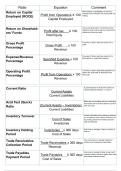
Ratio Equation Comment
Return on Capital Best measure of profitability, for every £1
invested in the business how much profit is it
Employed (ROCE) Profit from Operations X 100 making
Capital Employed
Return on Sharehold- How much does each £1 of ordinary share-
holders money receive after tax, interest and
Profit after tax X 100
ers’ Funds preference shares are paid
Total Equity
Gross Profit For every £1 that is sold how much of it is
Gross Profit x 100 profit.
Percentage
Revenue
Expense/Revenue For every £1 that is sold how much of it is
Specified Expense x 100 being spent on a particular expense
Percentage
Revenue
Operating Profit For every £1 that is sold what proportion of it
bottom line profit after all expenses have
Percentage Profit from Operations x 100 been paid
Revenue
Current Ratio A good measure of short term solvency it
should ideally fall between 1:1 and 2:1
Current Assets
Current Liabilities
Acid Test (Quick) Better test of immediate solvency excluding
inventories due to the time taken to convert
Ratio (Current Assets – Inventories) them into cash
Current Liabilities
Inventory Turnover Usually calculated using closing inventories.
It is a measure of the number of times in an
Cost of Sales accounting period the inventory has been
sold and replaced
Inventories
Inventory Holding Inventories x 365 days How long on average, in days, inventory is
held for
Period Cost of Sales
Trade Receivables How many days on average it takes for
Trade Receivables x 365 days money to be received for credit sales
Collection Period
Revenue
Trade Payables How long on average it takes to pay credit
Trade Payables X 365 days suppliers ideally should be higher than trade
Payment Period receivables collection period
Cost of Sales


