2/14/26, 5:37 PM Human Growth and Development CLEP Flashcards | Quizlet
Human Growth and Development CLEP
Save
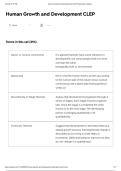
Terms in this set (294)
nature vs. nurture controversy it is agreed that both have some influence in
development, but some people think it is more
one than the other.
biologically built vs. environment
tabula rasa this is what the human mind is at birth (according
to the nurture side of the nature versus nurture
controversy), like a blank slate that experience
writes on
Discontinuity or Stage Theories Argues that development progresses through a
series of stages. Each stage involves a specific
task. Once the stage is completed the child
moves on to the next stage. The developing
person is changing qualitatively, not
quantitatively.
Continuity Theories Suggest that development is best described as a
steady growth process. Developmental change is
described as occurring in small steps or
increments. (Skills and behavior improve but they
do not change in a qualitatively.)
https://quizlet.com/1143859007/human-growth-and-development-clep-flash-cards/?new 1/17
,2/14/26, 5:37 PM Human Growth and Development CLEP Flashcards | Quizlet
Child Development vs. Life Span Some theories of development argue that
development is complete at the end of
childhood/adolescence (Sigmund Freud and Jean
Piaget are examples).
Life Span theories of development argue that
growth and change continue to occur throughout
the entire life span (Erick Erickson took a life span
perspective).
universality vs. context specific a theory that applies to all cultures and time
periods (such as Piaget proposed for his theory)
Bronfenbrenner is an example of the alternative
view which points out that there are differences
in development depending on the
culture/environment (such as in collectivist
cultures versus individualistic cultures)
Collectivist cultures Places greater value on the common good than
individual achievement
Individualistic cultures values individual achievements and the pursuit of
individual goals
accommodation by Piaget. modifying an existing scheme
assimilation by Piaget. taking new information from the world
and incorporating it into an existing scheme
Scheme by Piaget. basic thought about the world, objects,
events
disequilibrium what happens when a child understands the
world in a particular way (their scheme) then sees
something happen that can't fit into that
understanding.
https://quizlet.com/1143859007/human-growth-and-development-clep-flash-cards/?new 2/17
, 2/14/26, 5:37 PM Human Growth and Development CLEP Flashcards | Quizlet
constructivism Piaget's position that argues that children
construct schema (organized patterns of thought
or action) based on experiences they have
actively exploring the environment.
Piaget's stages of cognitive sensorimotor, preoperational, concrete
development operations, formal operations (each stage
represents a qualitatively different way of thinking
instead of just acquiring more information over
time)
sensorimotor stage 0-2 years old. Lacks concept of object
permanence until the end of this stage
(understanding that objects continue to exist
even when their presence can't be sensed) &
knows what they can do with their senses.
By the end of this stage they also have symbolic
representation (when one thing stands for
another thing) and deferred imitation (imitating a
model's behavior awhile after it was observed).
Piaget.
preoperational stage 2-7 years old. They think symbolically (e.g.
language),
are egocentric (have trouble seeing things from
others' perspectives),
use transductive reasoning (not reasoning
logically about cause and effect),
use animitic thinking (projecting human abilities
and traits onto inanimate objects),
and think semilogically. Piaget.
https://quizlet.com/1143859007/human-growth-and-development-clep-flash-cards/?new 3/17
Human Growth and Development CLEP
Save
Terms in this set (294)
nature vs. nurture controversy it is agreed that both have some influence in
development, but some people think it is more
one than the other.
biologically built vs. environment
tabula rasa this is what the human mind is at birth (according
to the nurture side of the nature versus nurture
controversy), like a blank slate that experience
writes on
Discontinuity or Stage Theories Argues that development progresses through a
series of stages. Each stage involves a specific
task. Once the stage is completed the child
moves on to the next stage. The developing
person is changing qualitatively, not
quantitatively.
Continuity Theories Suggest that development is best described as a
steady growth process. Developmental change is
described as occurring in small steps or
increments. (Skills and behavior improve but they
do not change in a qualitatively.)
https://quizlet.com/1143859007/human-growth-and-development-clep-flash-cards/?new 1/17
,2/14/26, 5:37 PM Human Growth and Development CLEP Flashcards | Quizlet
Child Development vs. Life Span Some theories of development argue that
development is complete at the end of
childhood/adolescence (Sigmund Freud and Jean
Piaget are examples).
Life Span theories of development argue that
growth and change continue to occur throughout
the entire life span (Erick Erickson took a life span
perspective).
universality vs. context specific a theory that applies to all cultures and time
periods (such as Piaget proposed for his theory)
Bronfenbrenner is an example of the alternative
view which points out that there are differences
in development depending on the
culture/environment (such as in collectivist
cultures versus individualistic cultures)
Collectivist cultures Places greater value on the common good than
individual achievement
Individualistic cultures values individual achievements and the pursuit of
individual goals
accommodation by Piaget. modifying an existing scheme
assimilation by Piaget. taking new information from the world
and incorporating it into an existing scheme
Scheme by Piaget. basic thought about the world, objects,
events
disequilibrium what happens when a child understands the
world in a particular way (their scheme) then sees
something happen that can't fit into that
understanding.
https://quizlet.com/1143859007/human-growth-and-development-clep-flash-cards/?new 2/17
, 2/14/26, 5:37 PM Human Growth and Development CLEP Flashcards | Quizlet
constructivism Piaget's position that argues that children
construct schema (organized patterns of thought
or action) based on experiences they have
actively exploring the environment.
Piaget's stages of cognitive sensorimotor, preoperational, concrete
development operations, formal operations (each stage
represents a qualitatively different way of thinking
instead of just acquiring more information over
time)
sensorimotor stage 0-2 years old. Lacks concept of object
permanence until the end of this stage
(understanding that objects continue to exist
even when their presence can't be sensed) &
knows what they can do with their senses.
By the end of this stage they also have symbolic
representation (when one thing stands for
another thing) and deferred imitation (imitating a
model's behavior awhile after it was observed).
Piaget.
preoperational stage 2-7 years old. They think symbolically (e.g.
language),
are egocentric (have trouble seeing things from
others' perspectives),
use transductive reasoning (not reasoning
logically about cause and effect),
use animitic thinking (projecting human abilities
and traits onto inanimate objects),
and think semilogically. Piaget.
https://quizlet.com/1143859007/human-growth-and-development-clep-flash-cards/?new 3/17