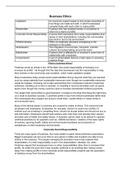
Business Ethics
Capitalism An economic system based on the private ownership of
how things are made and sold, in which businesses
compete freely with each other to make profits
Shareholder A person who has invested money in a business in
return for a share of profits
Corporate Social Responsibility A sense that businesses have wider responsibilities than
simply to their shareholders, including the communities
they work in and to the environment
Whistle-blowing When an employee discloses wrongdoing to the
employer or the public
Globalisation The integration of economies, industries, markets,
cultures and policymaking around the world
Stakeholder A person who is affected by or involved in some form of
relationship with a business
Consumerism A set of social beliefs that put a high value on acquiring
material things
What is business ethics?
Friedman wrote an article in the 1970s titled “the social responsibility of business is to
increase its profits”. He thought that the idea that businesses had the responsibility to help
their workers or the community was socialism, which made capitalism weaker.
Many businesses today accept social responsibilities that go beyond what they are required,
such as using materials from sustainable resources even though non-sustainable resources
would be cheaper, choosing not to take sponsorship from companies involved in fossil fuel
extraction, deciding not to test on animals, or investing in local communities such as sports
teams even though this money could be used to increase shareholder dividend payments.
The slogan that “good ethics is good business” is based on the idea that doing the right thing
us a route to business success. Customers prefer to buy from ethical businesses rather than
from businesses they suspect are trying to cheat them, exploit others or cause social or
environmental harm.
Many of the ethical issues in business are covered by codes of ethics. This concerns both
employers and employees. Employees, for example, should not avoid any conflicts of
interest such as investing in competing firms, should not accept bribes and should not buy or
sell information. Employers should treat workers well, train them and develop their careers
and take care of health and safety issues. A business cannot claim to be ethical if it ignores
unethical practices by its suppliers such as: child/forced labour; violation of the basic rights
of workers; ignoring health, safety and environmental standards and production in
sweatshops or other hazardous environments.
Corporate Social Responsibility
There are many types of business, from sole traders to giant transcontinental corporations.
Bigger businesses are set up so that no one person is liable and investors are able to buy
shares in the business. The people managing the business have a duty towards their
shareholders; it is their responsibility to act in the shareholders’ interests. So, when
Friedman argued that businesses have no other responsibilities other than to increase their
profits, he made the point that it was actually unethical to do anything else: taking money
away from making profits to fund corporate social responsibility projects was the equivalent
of stealing money from the shareholders.
, This idea convinced politicians such as Thatcher and Reagan that if businesses were set
free to pursue profit, then their growth would ‘trickle down’ to the rest of the country. To do
this, government regulation was reduced. This happened in a context of increasing social
problems due to rising inequality and an awareness of environmental issues.
Undoubtedly, businesses take on social responsibility because they think that it will improve
their image with customers or with a certain investor. Businesses may take action to reduce
their greenhouse gases and investing in energy efficiency but exclude businesses involved
in arms production or selling tobacco products.
Others may take on these responsibilities because they fear that if they do not, they will be
negatively viewed by customers. Businesses may improve facilities for employees or offer
discounts for employees because if they fear if they don’t, employees will work for the
competition instead. Without adopting self-regulation, businesses will face far more
government regulation (newspapers).
Companies that have shown CSR include the Body Shop. The Body Shop succeeded in
tackling social issues such as animal rights and Fair Trade. This just shows that it is perfectly
possible to own a successful business that doesn't depend entirely on profit but also looks
outwards as to how it can tackle other problems.
Stakeholders
Businesses have a responsibility to everyone involved in their actions – their stakeholders (a
person who is harmed by, or benefits from, the corporation and whose rights have to be
respected, or can be violated, by the corporation – government, customers, employees,
communities, suppliers, shareholders and competitors).
For example, if a transcontinental steel corporation wants to shut its UK steel works because
it has become unprofitable, then the shareholders will back this decision but the corporation
has the social responsibility to their employees as they would become unemployed. A
business has to consider the interests of all these stakeholders and act to lessen the
negative impact of its decision, even if this involves a significant loss of profits.
Ethical responsibilities can therefore oblige corporations to do what is right when they are
not compelled to do so. This is particularly the case when large amounts of stakeholders are
involved.
However, stakeholder interests rarely overlap. For instance, supermarkets compete for the
same customers so they offer cheaper prices on everyday products such as milk, so they
use their spending power over their dairy suppliers; if they want supermarket business then
they will have to sell the milk at a lower price than it cost them to produce it. This makes
customers happy but suppliers unhappy. If suppliers then campaign to raise awareness of
unethical supermarket purchasing, then customers may become unhappy and shop
somewhere else. Yet if supermarket increases the price of the milk, customers may move
somewhere else anyway.
Case Study - Risk Assessment (Ford Pinto)
The design and production of Ford Pinto cars was rushed to sell the car for under $2000,
which resulted in a fault. The axle arrangement, in concert with styling constraints, resulted
in a small luggage compartment that would be limited in carrying long objects such as golf
clubs. To increase the size of the luggage compartment, the gas tank was relocated to the
car’s rear (Strobel, 1994). This fault meant that Ford’s own test result = explosion in 8/11
tests. To put it right would have meant recalling all Ford Pintos, and spending between $10
Capitalism An economic system based on the private ownership of
how things are made and sold, in which businesses
compete freely with each other to make profits
Shareholder A person who has invested money in a business in
return for a share of profits
Corporate Social Responsibility A sense that businesses have wider responsibilities than
simply to their shareholders, including the communities
they work in and to the environment
Whistle-blowing When an employee discloses wrongdoing to the
employer or the public
Globalisation The integration of economies, industries, markets,
cultures and policymaking around the world
Stakeholder A person who is affected by or involved in some form of
relationship with a business
Consumerism A set of social beliefs that put a high value on acquiring
material things
What is business ethics?
Friedman wrote an article in the 1970s titled “the social responsibility of business is to
increase its profits”. He thought that the idea that businesses had the responsibility to help
their workers or the community was socialism, which made capitalism weaker.
Many businesses today accept social responsibilities that go beyond what they are required,
such as using materials from sustainable resources even though non-sustainable resources
would be cheaper, choosing not to take sponsorship from companies involved in fossil fuel
extraction, deciding not to test on animals, or investing in local communities such as sports
teams even though this money could be used to increase shareholder dividend payments.
The slogan that “good ethics is good business” is based on the idea that doing the right thing
us a route to business success. Customers prefer to buy from ethical businesses rather than
from businesses they suspect are trying to cheat them, exploit others or cause social or
environmental harm.
Many of the ethical issues in business are covered by codes of ethics. This concerns both
employers and employees. Employees, for example, should not avoid any conflicts of
interest such as investing in competing firms, should not accept bribes and should not buy or
sell information. Employers should treat workers well, train them and develop their careers
and take care of health and safety issues. A business cannot claim to be ethical if it ignores
unethical practices by its suppliers such as: child/forced labour; violation of the basic rights
of workers; ignoring health, safety and environmental standards and production in
sweatshops or other hazardous environments.
Corporate Social Responsibility
There are many types of business, from sole traders to giant transcontinental corporations.
Bigger businesses are set up so that no one person is liable and investors are able to buy
shares in the business. The people managing the business have a duty towards their
shareholders; it is their responsibility to act in the shareholders’ interests. So, when
Friedman argued that businesses have no other responsibilities other than to increase their
profits, he made the point that it was actually unethical to do anything else: taking money
away from making profits to fund corporate social responsibility projects was the equivalent
of stealing money from the shareholders.
, This idea convinced politicians such as Thatcher and Reagan that if businesses were set
free to pursue profit, then their growth would ‘trickle down’ to the rest of the country. To do
this, government regulation was reduced. This happened in a context of increasing social
problems due to rising inequality and an awareness of environmental issues.
Undoubtedly, businesses take on social responsibility because they think that it will improve
their image with customers or with a certain investor. Businesses may take action to reduce
their greenhouse gases and investing in energy efficiency but exclude businesses involved
in arms production or selling tobacco products.
Others may take on these responsibilities because they fear that if they do not, they will be
negatively viewed by customers. Businesses may improve facilities for employees or offer
discounts for employees because if they fear if they don’t, employees will work for the
competition instead. Without adopting self-regulation, businesses will face far more
government regulation (newspapers).
Companies that have shown CSR include the Body Shop. The Body Shop succeeded in
tackling social issues such as animal rights and Fair Trade. This just shows that it is perfectly
possible to own a successful business that doesn't depend entirely on profit but also looks
outwards as to how it can tackle other problems.
Stakeholders
Businesses have a responsibility to everyone involved in their actions – their stakeholders (a
person who is harmed by, or benefits from, the corporation and whose rights have to be
respected, or can be violated, by the corporation – government, customers, employees,
communities, suppliers, shareholders and competitors).
For example, if a transcontinental steel corporation wants to shut its UK steel works because
it has become unprofitable, then the shareholders will back this decision but the corporation
has the social responsibility to their employees as they would become unemployed. A
business has to consider the interests of all these stakeholders and act to lessen the
negative impact of its decision, even if this involves a significant loss of profits.
Ethical responsibilities can therefore oblige corporations to do what is right when they are
not compelled to do so. This is particularly the case when large amounts of stakeholders are
involved.
However, stakeholder interests rarely overlap. For instance, supermarkets compete for the
same customers so they offer cheaper prices on everyday products such as milk, so they
use their spending power over their dairy suppliers; if they want supermarket business then
they will have to sell the milk at a lower price than it cost them to produce it. This makes
customers happy but suppliers unhappy. If suppliers then campaign to raise awareness of
unethical supermarket purchasing, then customers may become unhappy and shop
somewhere else. Yet if supermarket increases the price of the milk, customers may move
somewhere else anyway.
Case Study - Risk Assessment (Ford Pinto)
The design and production of Ford Pinto cars was rushed to sell the car for under $2000,
which resulted in a fault. The axle arrangement, in concert with styling constraints, resulted
in a small luggage compartment that would be limited in carrying long objects such as golf
clubs. To increase the size of the luggage compartment, the gas tank was relocated to the
car’s rear (Strobel, 1994). This fault meant that Ford’s own test result = explosion in 8/11
tests. To put it right would have meant recalling all Ford Pintos, and spending between $10